Websites for moving companies
Websites for moving companies that customers can trust
People hiring movers are handing over everything they own, often in a stressful week, and they have heard stories about bait and switch quotes. A moving company website has to prove you are real and properly registered, explain how pricing works and collect enough detail for an estimate that holds up on moving day.
Start a projectWhat the site needs to do
Your USDOT number for interstate household moves and your California household movers permit number for moves within the state, shown where the rules expect them.
Dates, both addresses, home size, stairs and elevators, packing, special items and an inventory or video walkthrough option.
How local hourly moves and long distance moves are priced, what adds cost and what deposit and cancellation terms apply.
Your physical address, photos of your own trucks and crews, and reviews from real customers.
Different questions, different pricing and different paperwork, so each gets its own page.
Mistakes I see most
- No USDOT or state permit number anywhere on a site that advertises household moves
- Advertising California moving rates by the cubic foot, which state law prohibits
- Stock photos of trucks with another company logo blurred out
- A quote form with only name, phone and moving date
Related work

Pricing
Most moving companies fit the Business Site package. An inventory based estimator, online deposits or a quote dashboard for your office make it a Full Custom Build. See the Custom Next.js websites for businesses packages, or get a quick estimate with the website cost calculator.
What does someone planning a move need to see before requesting a quote?
They need to see that you are a real, registered company, that you do their kind of move, roughly how pricing works and how to get an estimate.
Moving is a trust purchase with a reputation problem. Many people have heard about quotes that doubled on moving day or belongings held until an extra fee was paid. Your homepage has to answer that worry before it asks for anything. Lead with what you do and where (local moves in a metro area, long distance from California, office moves), then put proof right under it: your registration numbers, photos of your own trucks and crews, reviews and your physical address.
The estimate request belongs on the homepage too, as a short first step that leads to the full form. Many movers use a two step form: date, origin ZIP, destination ZIP and home size first, then the details. That keeps the first step light while still getting what the estimator needs.
Which registration numbers belong on a moving company website?
For interstate household moves, your name and USDOT number belong in your advertising; for moves within California, your name and state permit number do. This is general information, not legal advice.
On the federal side, FMCSA's rules for household goods carriers (49 CFR 375.207) say every advertisement must include your name as it appears on your USDOT registration and your USDOT number, written in the form "U.S. DOT No." followed by the number. Your website is the most visible advertising you have, so the number belongs in the footer of every page. Household goods brokers have a separate rule (49 CFR 371.107) that names the website homepage directly: they must display their physical location, USDOT and MC numbers, and state that they are a broker and do not transport the goods themselves.
In California, household movers that operate within the state need a permit from the Bureau of Household Goods and Services, which took over the program from the Public Utilities Commission. The Bureau's regulations require a household mover to include its name and Bureau issued permit number in all forms of advertising, solicitation and other presentments to the public. The permit number, often called the Cal T number, also has to appear on every vehicle.
If you do both kinds of moves, show both numbers, labeled clearly. Check the current rules with FMCSA and the Bureau, or a lawyer, before you launch.
How should a moving estimate form work?
It should capture everything that changes the price: dates, both addresses, home size, access at each end, packing, special items and an inventory.
The fields that matter for a household move:
- Move date and how flexible it is.
- Origin and destination addresses, or at least ZIP codes.
- Home type and size (studio, one bedroom, house with garage).
- Stairs, elevators, long walks from the truck and parking at each end.
- Packing: full packing, partial, fragile items only or none.
- Special items: piano, safe, gym equipment, large artwork, appliances.
- Storage needs between move out and move in.
- An inventory, either a simple room by room checklist or a video upload.
Video walkthroughs are worth offering. A two minute phone video of each room gives an estimator far more than a list typed on a phone. Accept uploads or a link, and send the request to your estimator with the move date in the subject line.
Structured intake like this is the core of the quote tool I built for Artistic Printing, a commercial printer. The trade is different, but the lesson carries over: when the form asks for the specs that set the price, the first reply can be a real estimate instead of more questions.
Can I show prices on a moving website?
You can explain how you price and show rates where your pricing is predictable, but in California you must not advertise rates by the cubic foot.
For local moves, many companies charge by the hour for a crew and truck, sometimes with a minimum and a travel fee. Showing "two movers and a truck from X per hour, three hour minimum" style information helps people compare honestly. Say what adds time: stairs, long carries, packing, disassembly.
California's Household Movers Act (Business and Professions Code section 19253.1) says a household mover shall not advertise, quote or charge a rate based on cubic feet or another volumetric measurement. The state also sets maximum rates for in state household moves through a tariff the Bureau administers. Interstate moves follow federal rules on estimates, which differ again. Write pricing copy that matches the moves you actually do, and have it checked.
How do I earn trust in an industry known for scams?
Show the things a fly by night operator cannot: a real address, your own trucks, named crew leads, current registration numbers and clear terms.
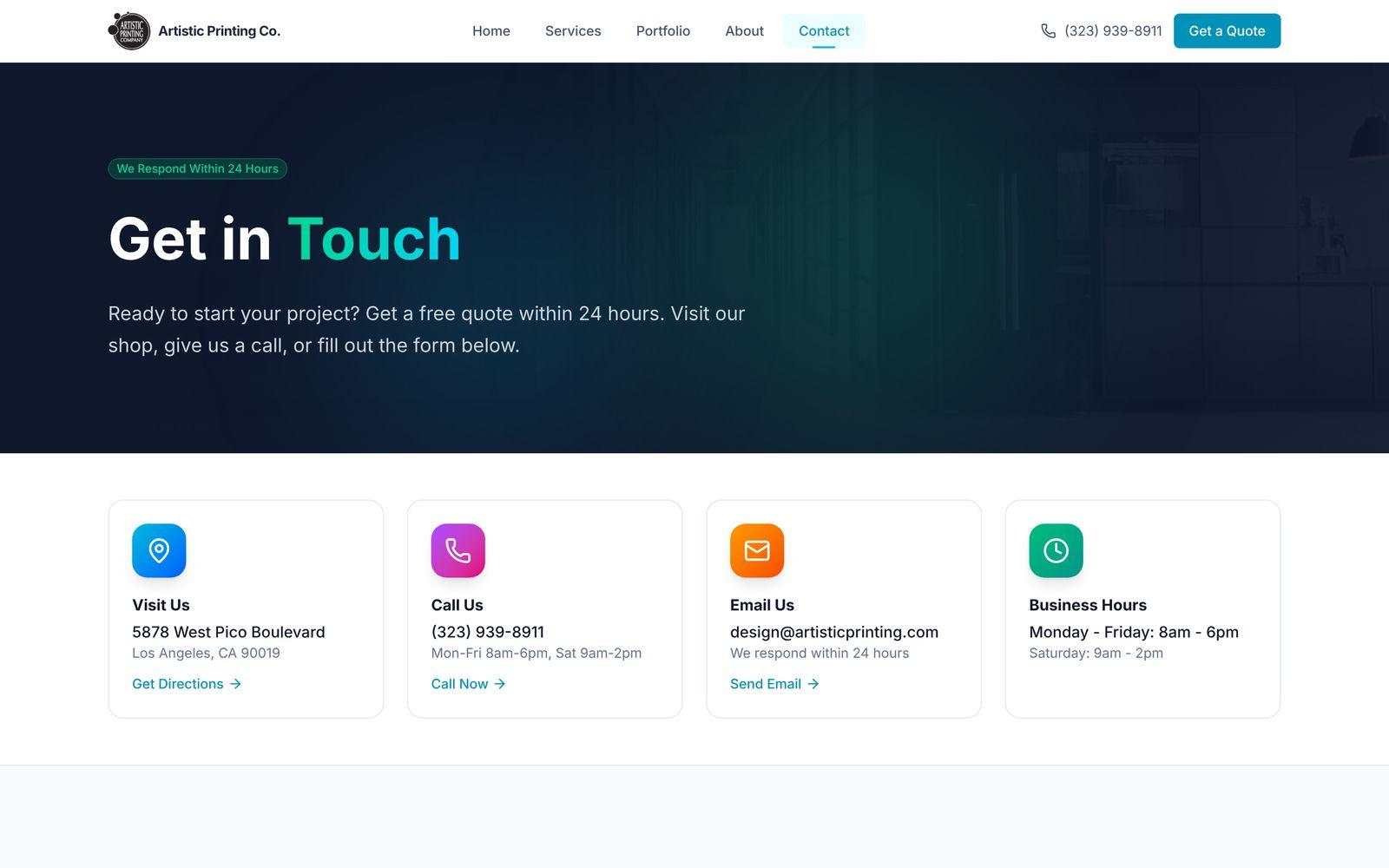
A contact page like the one I built for Artistic Printing, with a street address, phone, email and hours in plain view, does quiet but important work for a moving company. Add photos of your actual trucks with your name on them, your warehouse or office if you have one, and your crew leads by first name.
Then write the terms customers worry about: deposit amount, when it is refundable, how cancellation works, what valuation or protection options you offer and how claims for damage are handled. Plain policies on the site prevent arguments later.
Local, long distance or both: how should the pages be organized?
Give local moves, long distance moves and any specialty services their own pages, because each has different questions, pricing and paperwork.
A local moves page explains hourly pricing, crew sizes and typical durations by home size. A long distance page explains how estimates work, delivery windows, and the federal registration that applies. Specialty pages such as office moves, piano moving or packing services stand alone if you do enough of that work.
For cities, the same rule applies as for any service business. Google's spam policies describe pages targeted at specific cities that funnel users to one page as doorway abuse. A page for a city or a common route is worth writing only if you can add real detail: building types, parking permits, typical access issues, moves you have done there.
How do reviews and booking deposits fit in?
Show recent reviews near the estimate form, and take deposits only after the estimate is agreed, with terms shown before payment.
Reviews from people who moved recently, especially ones mentioning crews by name or tricky moves handled well, are the strongest proof you have. Ask every customer after the move. If you take a deposit online, a payment link from a processor like Stripe after the estimate is accepted keeps it simple, and the terms should appear right above the pay button.
The bottom line
A moving company website wins by being verifiably real: correct USDOT and California permit numbers where they belong, your own trucks and address, honest pricing that follows the rules, and an estimate form detailed enough that the quote holds up on moving day. Build those foundations first, then add an inventory estimator, online deposits or a quote dashboard when your volume calls for it. None of this is legal advice, so confirm the registration and advertising rules for your moves before launch.
Questions
Do movers have to show a USDOT number on their website?
Federal rules require interstate household goods carriers to include their name and USDOT number in advertisements, and household goods brokers must show theirs on their website homepage. This is general information, not legal advice.
What about moves within California?
Household movers operating within California need a permit from the Bureau of Household Goods and Services, and state regulations require the mover name and permit number in all forms of advertising.
Can the site give an instant moving quote?
It can give a range from home size, distance and extras, which your team confirms after a walkthrough or inventory. Make clear it is an estimate.
Can customers send a video of their home?
Yes. A quote form can accept video uploads or a link to a recording, which helps your estimator size the job without a site visit.
Can we take booking deposits online?
Yes, through a payment provider such as Stripe, with your deposit and cancellation terms shown before payment.
Building a site for your moving company?
Six quick questions, then an intro call if you want one.
Start a projectOther industries
Restaurants · Therapy practices · Medical clinics · Salons and spas · Startups · Local service businesses · Dental practices · Law firms · Real estate agents · Gyms and fitness studios · Ecommerce brands · Print shops and manufacturers · Nonprofits · Coaches and consultants · Med spas · Physical therapy and chiropractic clinics · Event venues · Car washes and auto detailing · Accountants and bookkeepers · Tutoring and education businesses · Photographers · Architects and interior designers · Plumbers and HVAC companies · Roofers and general contractors · Cleaning services · Landscapers and lawn care companies · Pet groomers and veterinary clinics · Food trucks · Bakeries and cafes · Wedding planners and event pros · Insurance agencies · Home care agencies · Tattoo studios · Churches and faith organizations · Auto repair shops · Property management companies · Florists · Daycare and childcare centers · Breweries and wineries · Funeral homes