Emergent developer
Fix and launch the app you built with Emergent
Built an app with Emergent and stuck in a debugging loop, burning credits or unsure how to host it yourself? I fix the code, secure the backend and ship it.
Get it fixedWhat Emergent builds
Emergent is an agent-based AI app builder that generates full-stack apps, typically a React frontend with a Python API backend and a MongoDB database, with built-in hosting on a live URL and GitHub integration on paid plans.
Where Emergent apps usually break
Reviewers consistently describe debugging as the biggest credit cost on Emergent. Each attempt changes more code and the original bug is still there.
Python endpoints that accept a record id and return or update it without checking who is asking. Anyone who finds the URL can read data belonging to other users.
Collections that grew prompt by prompt, with inconsistent fields, no indexes and duplicate records that make pages slow and queries unreliable.
Keeping an app live on Emergent hosting uses credits on top of development. Some owners want to move it to infrastructure they control.
Stripe, email or AI keys written into code or exposed to the React frontend instead of living in backend environment variables.
How I fix it
- Push the project to a GitHub repository you own
- Run frontend and backend locally and list every issue
- Fix authorization, secrets and data problems first
- Deploy on Emergent or move to your own hosting and database
- Test real user flows and hand over a write-up
Packages
One bug or error in an app that otherwise works, fixed and explained.
Up to three fixes plus one small feature or integration.
For apps whose core features already work: fix what blocks launch and ship it to production.
Apps I have shipped
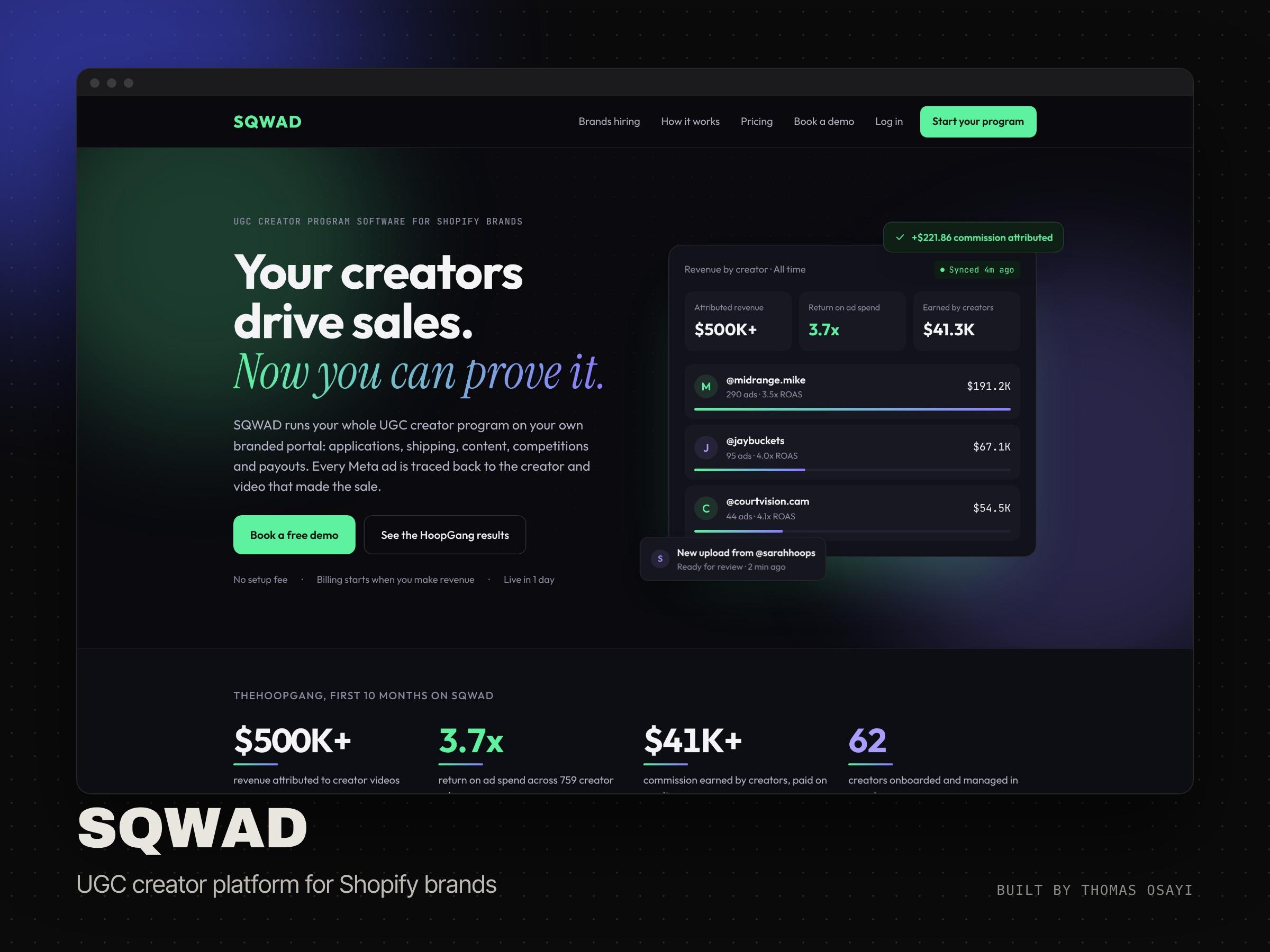
SQWAD
How I designed and built SQWAD, a SaaS platform Shopify brands use to run UGC creator programs, from applications to payouts.

Guardian MindCare
A therapy practice platform that matches clients with in-network therapists, with role-based portals for therapists, supervisors, trainees, clients and admins.

TheHoopGang
A creator portal for a basketball streetwear brand that manages 50+ creators, tracks content and runs refundable gear gifting.
What does Emergent actually generate?
A full-stack app built by a team of AI agents: typically a React frontend, a Python API backend and a MongoDB database, hosted by Emergent on a live URL.
That is a different shape from builders like Lovable or Bolt, which lean on Supabase and run most logic in the browser. With Emergent there is a real backend server between your users and your data. That is good: secrets can stay on the server and business rules can be enforced in one place. It also means the backend has to be written carefully, because every endpoint decides on its own whether a request is allowed.
Emergent also handles hosting, environment configuration and SSL for you, and paid plans add GitHub integration so the code can leave the platform. Reviewers report that keeping an app live costs credits each month on top of development, which becomes relevant once you start thinking about running the app for real.
Why do Emergent debugging loops burn so many credits?
Because each attempt to fix a bug is a full agent run that reads, changes and retests code, and when the agent misreads the cause, it changes the wrong code and tries again.
Independent reviews of Emergent describe debugging as the real credit sink, with fixes to AI-introduced bugs sometimes costing more than the original build. The pattern I see behind loops like this is almost always the same: the bug lives in a place the agent cannot see well, such as an environment variable, a data shape in MongoDB that differs from what the code expects, or two parts of the app that each assume the other handles something.
Signs you are in a loop:
- The same error comes back after three or four fix attempts.
- Fixes in one feature keep breaking a different feature.
- The agent says the problem is fixed, and it is not.
- You are spending more on credits debugging than you did building.
At that point a person reading the code and the logs directly is cheaper. My article on Lovable credits running out was written about Lovable, but the advice on when to stop prompting applies to Emergent just as well.
Is my Emergent app's backend secure?
Check every endpoint for authorization, because a Python backend that works is not the same as one that only lets each user see their own data.
The common problem is an endpoint like one that fetches an order by its id. The agent writes code that looks up the order and returns it. What it often does not write is a check that the order belongs to the user making the request. Anyone signed in, or sometimes anyone at all, who changes the id in the request can read other people's orders. I go through every route, add a dependency or middleware that identifies the user from their session or token, and filter every database query by that user.
The other things I check:
- Secrets. Stripe secret keys, email provider keys and AI keys belong in backend environment variables, never in the React code where any visitor can read them. My article on API keys exposed in your frontend explains which keys are safe to ship and which are not.
- CORS. The backend should accept requests only from your real domains, not from everywhere.
- Input validation on the server, so a malformed request cannot write junk into the database.
What goes wrong with MongoDB in Emergent apps?
Data structure drifts as the app grows prompt by prompt, and MongoDB does not stop it.
MongoDB does not enforce a schema by default, which makes it fast to build with and easy to make a mess in. After a few dozen prompts, the same collection can hold documents with different field names for the same thing, dates stored as strings in some records and real dates in others, and duplicate users created by a sign-up flow that ran twice. Pages slow down because nothing is indexed, and queries miss records because the field they filter on is spelled differently in half the documents.
I fix this in three steps: write down the shape each collection should have, add validation in the backend models so new data follows it, and run a careful one-time cleanup of existing records with a backup taken first. Then I add indexes for the queries the app actually runs. My article on how to back up your Supabase or Firebase database covers the backup habit; the same principle applies to MongoDB.
Should I keep hosting on Emergent or move it?
Keep it on Emergent if the app is small and you value having everything in one place; move it if you want predictable costs, your own database or more control over deploys.
Moving is a normal job, not a rewrite. The React frontend can go to a host such as Vercel or Netlify. The Python backend runs on any platform that supports Python services, such as Cloud Run, Render or Railway. MongoDB can move to MongoDB Atlas under your own account. The work is in recreating every environment variable, pointing the frontend at the new API address, setting CORS for the new domain and migrating the data with a tested restore. Once the code lives in GitHub, deploys happen on every push and you can still work in Emergent if you want to.
What should I prepare for a developer?
The GitHub repository, access to the database, and a short list of what is broken or must work before launch.
Use Emergent's GitHub integration to save the project to a private repository and add me as a collaborator. Share database access through the provider's own team invites, never by pasting connection strings into chat. For the list, one sentence per problem with steps to reproduce it, plus a two minute screen recording of the main workflow, is more useful than a long description. My article on what to send a web developer before your project starts has more detail.
How long does it take and what does it cost?
Most Emergent fixes take two to ten days, and the price depends on how many separate problems there are.
My fix packages:
- Quick Fix, from $60, about 2 days: one bug, often the one the agent has been looping on.
- Fix Plus Features, from $200, about 5 days: up to three fixes plus one small feature, for example securing endpoints, moving secrets to the backend and adding an admin page.
- Finish and Launch, from $600, about 10 days: for apps whose core already works, covering security, data cleanup, deploy on your domain or your own hosting, and real user testing.
If most of the product still needs building, I will quote from my SaaS MVP packages after reading the code instead. My article on whether to fix or rebuild an AI-built app explains how I decide.
The bottom line
Emergent gives you a real full-stack app with a Python backend and MongoDB, which is a strong starting point. When debugging starts eating credits, stop prompting and get the code into GitHub. Check every endpoint for authorization, move secrets to the backend, give your MongoDB data a defined shape, and decide deliberately where the app should live. Send me the repo if you want a second pair of eyes on it.
Questions
Can I get my code out of Emergent?
Yes. Emergent can save the project to a GitHub repository, which reviewers report is available from the Standard plan, and from there it can be run locally or deployed elsewhere.
Should I keep hosting on Emergent?
If the app is small and you want everything in one place, it can be fine. If you want predictable bills or more control, it can move to your own hosting and database.
Do I need to rewrite the Python backend?
Usually not. Most problems are missing checks, configuration and data structure, which can be fixed without a rewrite.
Do you need my Emergent login?
No. Access to the GitHub repository plus the database and hosting accounts is enough.
What does it cost to fix an Emergent app?
Thomas Osayi fixes one bug from $60, up to three fixes plus a small feature from $200, and launches an app whose core already works from $600.
Reading
- Supabase auth redirect URL not working? Fix localhost, preview and production redirects
Supabase confirmation or magic links sending users to localhost:3000 or the wrong page? Fix the Site URL, the Redirect URLs allow list, wildcards and emailRedirectTo.
- Environment variables undefined on Vercel? Every cause and fix
Works locally, undefined on Vercel? Fix missing NEXT_PUBLIC_ and VITE_ prefixes, wrong Production or Preview scope, the missing redeploy and build-time vs runtime mixups.
- How to fix a CORS error on a Next.js API route
Blocked by CORS policy calling your Next.js API? Read the exact error, handle the OPTIONS preflight, set headers in route handlers or next.config, or proxy instead.
Built with something else?
Lovable · Bolt · v0 · Replit · Cursor · Windsurf · Claude Code · Base44 · ChatGPT · Firebase Studio · Google AI Studio · GitHub Copilot · Rork · OpenAI Codex · Figma Make · Kiro · Anything · Gemini CLI · Google Antigravity · Manus