November 22, 2026 · 9 min read · Thomas Osayi
How to sell gift cards on your website
Four ways to sell gift cards online: Square, Shopify, your booking tool or a custom Stripe build. What each costs, how redemption works and the California rules to know.
Gift cards are money paid in advance for a visit that has not happened yet. For a restaurant, salon or shop, that is a good deal: cash today, a customer who comes in later, and often a new customer who would not have found you otherwise. The hard part is not selling them. It is tracking every balance and making sure each card works at the counter.
This guide compares the four ways to sell gift cards from your website, explains what a custom build involves, and covers the California rules that apply to every option. The legal section is general information, not legal advice.
Can a small business sell gift cards on its own website?
Yes, and the simplest setup takes an afternoon, as long as the gift cards come from the same system your staff use to take payment.
A gift card is not a product like a mug. It is a stored balance that someone redeems later, sometimes in pieces. That means three things must work: a way to buy the card online, a way to deliver it to the buyer or recipient, and a way to look up and deduct the balance when it is used. If your website sells cards from one system and your counter uses another, someone ends up checking codes by hand.
So the first question is where your customers pay. A cafe that runs Square at the counter should sell Square gift cards. A clothing brand on Shopify should use Shopify gift cards. A studio that runs everything through a booking platform should check whether that platform sells gift cards that redeem against appointments. Your website then becomes the shop window: a gift cards page that explains the offer and sends people to the purchase step.
What are my options for selling gift cards online?
There are four realistic routes, from a hosted page you link to, all the way to a system built into your own site.
Square eGift cards
Best for: restaurants, cafes and shops that already take payments with Square.
Cost range: at the time of writing, Square says eGift cards are free to set up, with a load fee of up to 2.5% on each amount added and 2.9% plus 30 cents processing on its eGift ordering page. Redemption has no extra fee.
Pros: the same card works online and at your Square register, and balances stay in one place.
Cons: the ordering page is Square's, so the styling is limited, and you link to it rather than owning the checkout.
Shopify gift cards
Best for: online stores already on Shopify.
Cost range: at the time of writing, Shopify's help center says gift cards are available on all subscription plans. Gift card products can go up to $10,000, and cards issued from the admin up to $2,000 unless support raises the limit.
Pros: built into the store and checkout, with balances visible in the admin and at Shopify POS.
Cons: a card redeems only at the store that issued it, and Shopify notes that for stores created on or after May 12, 2025, the portion of an order paid by gift card can carry third-party transaction fees.
Your booking or point of sale tool
Best for: salons, spas and studios that book and pay through one platform.
Cost range: often included in a paid plan, but check the tier before promising gift cards for the holidays.
Pros: cards redeem against appointments, and staff already know the system.
Cons: features vary widely, and some tools only sell physical cards or a fixed set of amounts.
A custom build with Stripe
Best for: businesses with their own ordering or booking system, or gift cards that must work across several channels.
Cost range: a real development project, usually part of a larger custom build, plus Stripe processing at 2.9% plus 30 cents per domestic card payment at the time of writing.
Pros: full control over design, amounts, delivery and reporting.
Cons: you own the ledger, the security and the bugs.
How does a custom gift card system work?
A custom system sells the card through a normal Stripe payment, then stores a code and a balance in your own database and deducts from that balance at checkout.
Stripe takes the money. It does not track gift card balances, so the gift card itself lives in your app. The pieces:
- A purchase page with amount choices, a custom amount field, sender and recipient names, a message and an optional delivery date.
- A Stripe Checkout Session for the amount. When the checkout.session.completed webhook arrives, the server creates the card.
- A gift card record with a random code, at least 16 characters and not guessable, plus the original amount, current balance and status.
- A transactions table that records every issue, redemption and refund. The balance should always equal the sum of these rows, never a number someone edits directly.
- A redemption step in your checkout or point of sale that validates the code, deducts up to the order total, and records the transaction in one database operation, so two simultaneous orders cannot spend the same balance.
- Emails: a receipt to the buyer and the card itself to the recipient, sent on the chosen date by a scheduled job.
- A small admin view to look up a card, see its history and void it if it was bought with a stolen card.
The parts people underestimate are partial redemption, rate limiting on code checks so nobody can guess codes, and the scheduled delivery. None are hard individually, but together they turn a weekend feature into a real piece of software.
What does California law say about gift cards?
California generally bans expiration dates and service fees on gift cards sold to the public, and it requires cash back for small balances on request.
The main rule is California Civil Code section 1749.5. In general terms:
- It is unlawful to sell a gift certificate with an expiration date.
- It is unlawful to sell one with a service fee, including a dormancy fee, apart from a narrow exception for small, long-dormant balances that meets several conditions printed on the card.
- Cards must be redeemable for their cash value or replaced at no cost.
- Since April 1, 2026, a balance under $15 must be redeemable in cash on request. Senate Bill 22 raised that threshold from $10, which had been in place since 2008.
There are exceptions. Cards given away free as part of a loyalty or promotional program, and cards for perishable food, can carry an expiration date if it is printed clearly on the front in capital letters. A free "$10 off your next visit" card from a promotion is treated differently from a gift card someone paid for.
This is a general summary, not legal advice. Laws change, other states have different rules, and a short consultation with a qualified professional is worth it before you print terms on cards.
Gift cards, promo vouchers and packages: what is the difference?
A gift card is prepaid money, a promo voucher is a discount you give away, and a package is prepaid services, and each one follows different rules.
Mixing them up causes real problems. If you sell a "$100 gift card for $80" during a holiday sale, the customer paid for it, so treat the full balance as a gift card. Many owners prefer to sell the card at face value and give a separate promotional voucher as a bonus, because the bonus can then follow promotional rules, including a clearly printed expiration date where that is allowed.
Packages are a third category. They are prepaid sessions, not a cash balance.
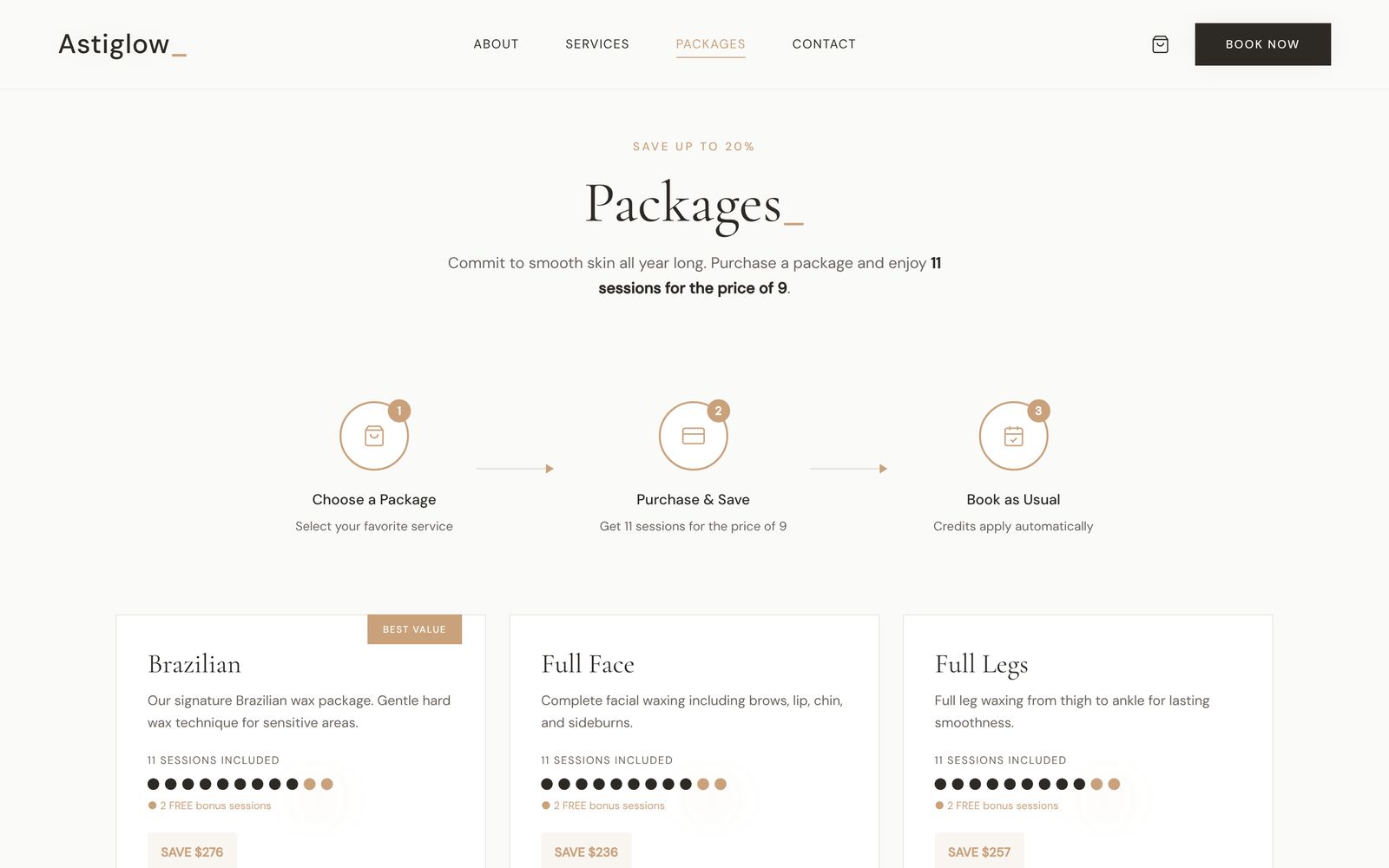
On Astiglow, the waxing studio site I built, packages get their own page: 11 sessions for the price of 9. A package is a commitment to regular visits, while a gift card is usually a present for someone else. Present them separately on your site, so a shopper looking for a gift does not land on a package offer meant for regulars, and the other way around.
A worked example: a restaurant adds gift cards before the holidays
Here is an illustration with a made-up business. A neighborhood restaurant in Silver Lake runs Square at the counter and has a simple website with a menu, hours and a reservations link. Every December, people call asking for gift cards, and the staff write paper certificates by hand.
The owner turns on Square eGift cards, sets amounts of $25, $50 and $100 plus a custom amount, and uploads a card design using the restaurant's photos. On the website, a new Gift cards page explains how the card works, says it never expires, and links to the Square ordering page. A small banner on the homepage runs from Thanksgiving to New Year's.
Cards bought online arrive by email and redeem at the register like any other Square gift card. Staff do not track paper certificates, the balance is always right, and a guest with a $6 balance left can ask for it in cash without the server having to call the owner.
The website part of this is a page, a banner and a few links. A custom system would only make sense if the restaurant ran its own online ordering and wanted cards to work there and at the counter from one ledger.
What mistakes should I avoid when selling gift cards?
Most gift card mistakes come from selling cards in one system and redeeming them in another, or from terms that break the rules.
- Printing an expiration date on paid gift cards in California.
- Short, guessable codes, or codes that can be checked without rate limiting.
- Editing balances by hand instead of recording transactions, which makes disputes impossible to settle.
- No plan for scheduled delivery, so a birthday card arrives the moment it is bought.
- Hiding the gift card page. Put it in the main navigation from November through December and in the footer the rest of the year.
- Forgetting your bookkeeping. Money from unredeemed cards is usually not treated as earned revenue until the card is used, so ask your accountant how to record it.
When should I hire a developer for gift cards?
Hire a developer when gift cards must work inside your own ordering or booking system, or when you want a branded purchase flow on your site rather than a hosted page.
If you use Square, Shopify or a booking platform with gift cards, the work is mostly setup plus a good page on your site. My Business Site package, from $450, covers a site with a dedicated gift cards page and a clean handoff to the hosted purchase step. A custom gift card system with Stripe, a ledger, redemption and an admin view belongs in a Full Custom Build, from $1,200, and usually sits next to custom ordering or booking. Before you decide, list where cards will be bought and where they will be spent. That answer usually picks the option for you.
The bottom line
Sell gift cards from the system you already take payments with, because the hard part is redemption, not the sale. Square and Shopify make online gift cards easy if you already use them, booking platforms often include them, and a custom Stripe system is for businesses that run their own ordering or booking. Whatever you choose, follow California's rules: no expiration dates or service fees on paid cards, and cash back for balances under $15 on request.
Questions, answered in one line
What is the cheapest way to sell gift cards online?
Using the gift card feature in the payment or store system you already use is usually cheapest, because setup is often free and you only pay normal processing and load fees.
Can gift cards expire in California?
Under California Civil Code section 1749.5, gift certificates sold to the public generally cannot carry an expiration date, with narrow exceptions such as some free promotional cards.
Do I have to give cash back for a small gift card balance in California?
Since April 1, 2026, California requires cash redemption on request for gift card balances under $15, up from $10 before.
Can I sell gift cards on a website that is not on Shopify?
Yes, you can link to or embed a gift card page from Square or your booking tool, or have a developer build gift cards with Stripe.
How much does it cost to add gift cards to a website?
Thomas Osayi adds a hosted gift card page to a business site from $450 and builds custom gift card systems as part of a Full Custom Build from $1,200.
Sources
- California Civil Code section 1749.5 California Public Law
- California raises gift card cash-out threshold to $15 Morgan Lewis
- Gift cards considerations and overview Shopify Help Center
- Square Gift Cards Square
- Pricing Stripe
Related articles
- How much does a restaurant website cost in 2026?
- How to take restaurant orders online without third-party fees
- Toast vs Squarespace vs a custom website for restaurants
- Google Business Profile vs website: do you need both?
Custom Next.js websites for businesses
Custom Next.js websites for small businesses, clinics, restaurants and startups. Fast, SEO-ready, built from scratch with booking, ordering or quote tools. Based in Los Angeles.
See the service