November 22, 2026 · 9 min read · Thomas Osayi
Toast vs Squarespace vs a custom website for restaurants
Comparing Toast Websites, Squarespace, Owner.com and a custom Next.js site for restaurants: costs at the time of writing, ordering fees, pros, cons and who each suits.
When a restaurant owner asks me which website builder to use, I ask two questions back. What POS do you run? And how many orders do you take online in a month? Those two answers decide most of this comparison before design even comes up.
Below I compare four real options: Toast Websites, Squarespace, Owner.com as an example of an all-in-one restaurant platform, and a custom Next.js site, which is what I build. I checked every third-party price on the vendor's own page, and I note "at the time of writing" because these change. I build custom sites, so read my bias into the last option, but I will tell you plainly when a platform is the better choice.
What should a restaurant website actually do?
A restaurant website has three jobs: show the menu, show when and where you are open, and let a guest book or order within a tap or two.
Everything in this comparison should be judged against those jobs. Guests arrive on a phone, often from Google Maps, and they want the menu first. So the questions that matter are:
- Can you show the menu as real text that loads fast and reads well on a phone?
- Can you keep hours, address and phone accurate and matching your Google Business Profile?
- How do reservations work: a link to OpenTable, Resy or Tock, a request form, or a built-in system?
- How does online ordering work, and what does each order cost you?
- Who owns the domain, the content and the guest data if you leave?
A beautiful template that buries the menu, or an ordering flow that charges a fee on every order forever, fails these jobs even if it looks great.
The four options at a glance
At the time of writing, here is how the costs and fit compare.
- Toast Websites: no public price; sold as an add-on to a Toast POS contract. Best when you already run Toast.
- Squarespace: $19 to $99 a month billed annually, or $25 to $139 billed monthly. Best for a polished menu and info site on a budget.
- Owner.com: $249 a month plus a 5 percent restaurant fee per order, or $499 a month flat, with guests paying a 5 percent order support fee. Best for owners who want ordering and marketing in one subscription.
- Custom Next.js site: one-time build, from $450 for a multi-page site or from $1,200 with pickup ordering on my packages, plus low hosting costs. Best for control and long-term cost.
The details are where the decision gets made.
Toast Websites: when does it make sense?
Toast Websites makes sense when your restaurant already runs on Toast POS and you want the site and ordering to stay in sync with it.
Best for
Restaurants on Toast, especially those already using Toast Online Ordering, Toast Tables or Toast Catering.
Cost range
Toast's websites product page links to pricing but does not list a price, and Toast's own pricing guide says websites and online ordering are add-ons billed separately with pricing that varies by business, at the time of writing. Expect a quote from sales.
Pros
- Menu and ordering sync with the POS in real time, so an 86'd item disappears online too.
- Pre-built pages for menus, online ordering, loyalty sign-up and gift cards.
- No-code editing for staff.
Cons
- Tied to Toast. If you switch POS, the site goes with it.
- Templates limit how distinctive the site can look.
- Pricing is by quote, so it is harder to compare and budget.
Squarespace: when does it make sense?
Squarespace makes sense for a restaurant that mainly needs a beautiful, easy-to-edit menu and information site and handles ordering elsewhere.
Best for
Cafes, bars and sit-down restaurants where reservations go through a booking platform and online ordering is light or handled by a POS or delivery app.
Cost range
At the time of writing, Squarespace lists Basic at $19 a month, Core at $29, Plus at $49 and Advanced at $99 when billed annually, or $25, $39, $65 and $139 billed monthly. Core charges a 3 percent transaction fee on commerce sales, while Plus and above list zero Squarespace transaction fees.
Pros
- Strong templates and photography-friendly layouts.
- Easy for an owner or manager to edit hours, menu and photos.
- Predictable monthly cost.
Cons
- Restaurant ordering usually means connecting another tool, so you may pay two subscriptions.
- Template sites can carry more scripts than a hand-built site, which affects mobile speed.
- Moving off later takes care to keep your Google rankings. I cover that in "How to move from Wix or Squarespace without losing your Google rankings".
Owner.com and all-in-one platforms: when do they make sense?
An all-in-one restaurant platform makes sense when you want a site, direct ordering, a branded app and marketing automation from one vendor, and the monthly cost is small next to your online sales.
Best for
Restaurants with steady online ordering volume that do not want to manage a developer or several tools.
Cost range
At the time of writing, Owner.com lists a Flex plan at $249 a month plus a 5 percent restaurant fee per order, and a Flat plan at $499 a month with no restaurant per-order fee, recommended for restaurants with $5,000 or more a month in online sales. On both plans, guests pay a 5 percent order support fee.
Pros
- Ordering, website, marketing emails and texts in one place.
- Setup and migration included in the plans.
- Built for restaurants specifically.
Cons
- One of the highest ongoing costs in this comparison: $2,988 to $5,988 a year in subscription alone.
- The guest-paid fee raises the price of ordering direct, which can blunt the reason to order from you instead of an app.
- You rent the site. Leaving means rebuilding.
A custom Next.js site: when does it make sense?
A custom site makes sense when you want a fast, brand-matched site, pickup ordering without a per-order platform fee, and ownership of everything.
Best for
Independent restaurants with a strong identity, regular takeout, or needs such as catering requests and private events that templates handle awkwardly.
Cost range
On my packages, from $450 for a multi-page site with a reservation request or catering form and local SEO, and from $1,200 for a custom build with pickup ordering or an admin menu editor. Hosting a fast pre-built site can be free or low cost. If you take payment online, Stripe's standard US rate is 2.9 percent plus 30 cents per card charge at the time of writing.
Pros
- Fast on phones, because pages are pre-built and images are resized per screen.
- No monthly platform fee and no per-order fee beyond card processing.
- The design and ordering flow match the restaurant, not a template.
- You own the code, the domain and the data.
Cons
- Higher upfront cost than a builder.
- Larger changes need a developer, unless the build includes an admin screen for the menu.
- POS integration is possible but adds work and cost.
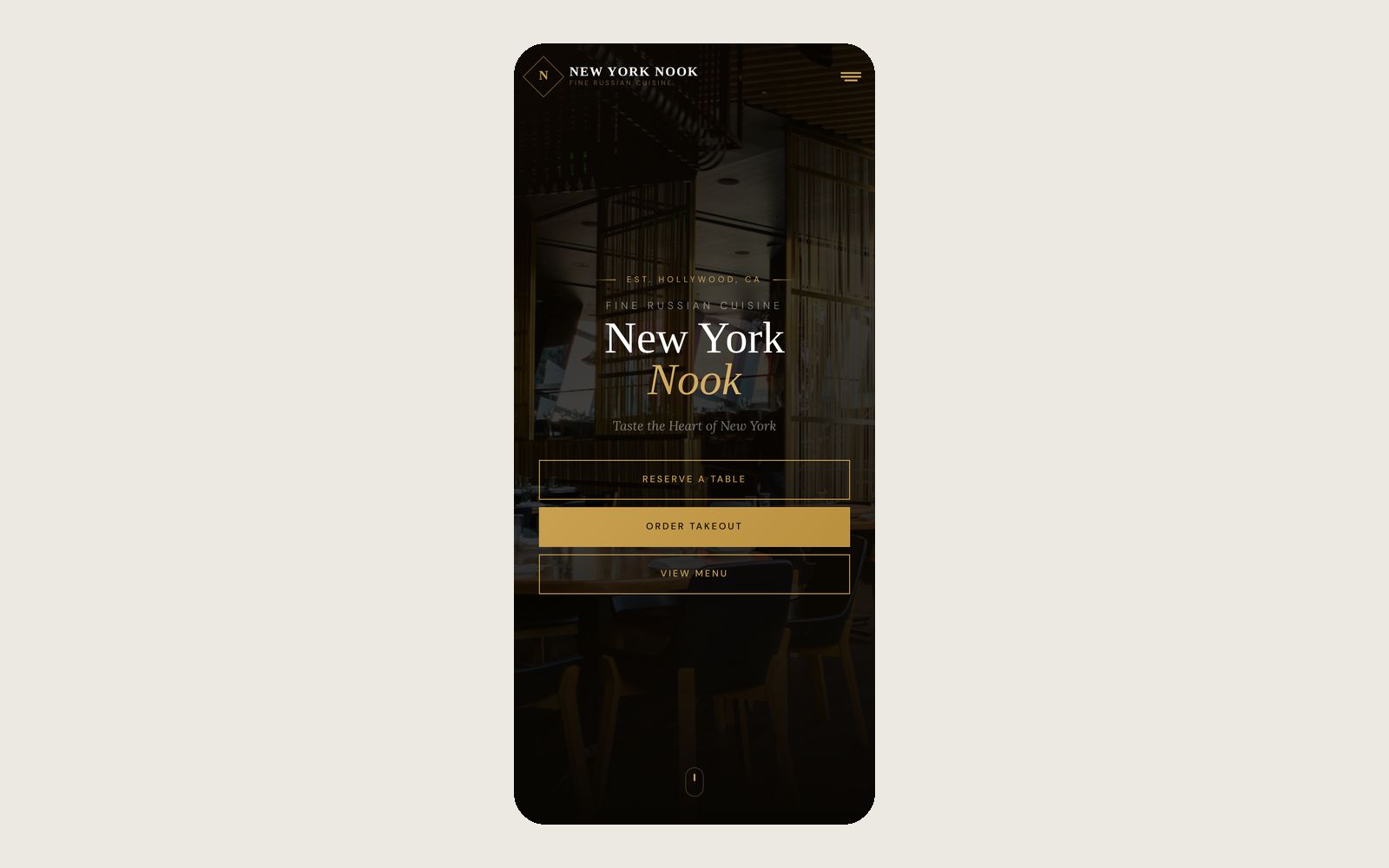
New York Nook, a Russian restaurant in Hollywood, is a custom site I built with the menu, reservation requests and pickup ordering on the restaurant's own domain, designed phone first so the three main actions sit in the first screen.
What does each option cost over three years?
Over three years, subscriptions add up faster than most owners expect.
These are illustrations using the listed prices at the time of writing, without card processing, domain or photography:
- Squarespace Core billed annually: $348 a year, or $1,044 over three years, plus any separate ordering tool.
- Owner.com Flex: $8,964 over three years, plus 5 percent of every order.
- Owner.com Flat: $17,964 over three years.
- Custom build with pickup ordering: from $1,200 once, plus hosting and occasional paid updates.
- Toast Websites: depends on your quote, bundled into your Toast contract.
How do menus, reservations and SEO differ between them?
The four options handle the everyday jobs differently, and the differences show up in how much staff time the site takes.
Menus
Toast pulls the menu from the POS, which is the biggest advantage of staying in its ecosystem: change a price at the register and it changes online. On Squarespace, someone edits the menu by hand in the site editor, which is easy but easy to forget. All-in-one platforms usually sync with the ordering menu they host. On a custom site, the menu can be a typed data file a developer updates, or a small database with an admin screen so staff edit it themselves.
Reservations
Every option can link out to OpenTable, Resy or Tock. Toast has its own Toast Tables product that integrates with Toast Websites. A custom site can add a simple reservation request form that notifies the restaurant and confirms to the guest, which suits smaller rooms that confirm each booking by hand.
SEO and speed
All four can rank. What matters is real text menus, accurate hours that match your Google Business Profile, a page per important offering such as catering or private events, and a fast mobile load. Platforms give you good defaults with less control. A custom build gives you full control over page titles, structured data and speed, but someone has to set it up properly.
Which should I choose for my restaurant?
Which should I choose for my restaurant?
Choose based on your POS, your order volume and how hands-on you want to be.
- You run Toast and take a lot of online orders: start with Toast Websites and Toast Online Ordering, since the sync is worth a lot in a busy kitchen.
- You need a beautiful menu and info site and little ordering: Squarespace on an annual plan is hard to beat for the money.
- You want ordering, marketing and an app without managing anyone, and online sales are high: an all-in-one platform can earn its fee.
- You want speed, a distinctive brand, pickup ordering without per-order platform fees and ownership: a custom site.
If you are comparing general builders more broadly, "Next.js vs Webflow vs Wix: which is right for your business site?" goes deeper on that side.
The bottom line
The best website builder for restaurants is the one that fits your POS and your ordering volume. Toast Websites wins for Toast restaurants, Squarespace wins for a low-cost menu site, all-in-one platforms win for owners who want one vendor and have the sales to justify the fee, and a custom site wins on speed, brand and long-term cost. Check current prices on each vendor's page before you sign, total the cost over three years, and make sure you own your domain whatever you pick.
Questions, answered in one line
What is the best website builder for restaurants?
It depends on your setup: Toast Websites for Toast POS users, Squarespace for a low-cost menu and info site, an all-in-one platform for owners who want built-in marketing, and a custom build for full control.
Is Toast Websites free?
Toast does not list a public price for Toast Websites at the time of writing; its pricing pages describe websites and online ordering as add-ons priced by quote.
Can Squarespace handle restaurant online ordering?
Squarespace works well for menus and information, but restaurants usually connect a separate ordering tool or POS ordering page rather than running a kitchen workflow on Squarespace itself.
Is a custom restaurant website worth it?
A custom site is worth it when you want pickup ordering without a per-order platform fee, a fast site that matches your brand, and ownership of the code and data.
How much does a custom restaurant website from Thomas Osayi cost?
Thomas Osayi builds multi-page restaurant sites with a reservation form and local SEO from $450, and custom builds with features like pickup ordering from $1,200.
Sources
- Squarespace pricing Squarespace
- Toast Websites Toast
- Toast pricing: how much does Toast cost? Toast
- Owner pricing Owner.com
- Stripe pricing Stripe
Related articles
- How much does a restaurant website cost in 2026?
- How to take restaurant orders online without third-party fees
- Google Business Profile vs website: do you need both?
- New business website checklist: everything to do before launch
Custom Next.js websites for businesses
Custom Next.js websites for small businesses, clinics, restaurants and startups. Fast, SEO-ready, built from scratch with booking, ordering or quote tools. Based in Los Angeles.
See the service