November 22, 2026 · 9 min read · Thomas Osayi
How much does a restaurant website cost in 2026?
Real price ranges for a restaurant website, from a one-page menu site to a custom build with reservations and pickup ordering, plus the monthly costs owners forget.
Restaurant owners ask me what a website costs, and the honest answer depends less on how pretty it is and more on what it has to do. A site that shows the menu and the hours is a small job. A site that takes reservations and pickup orders, and lets you change prices yourself on a Tuesday afternoon, is a real piece of software.
This guide breaks down the price ranges I see in 2026, what pushes a restaurant site from one range to the next, the monthly costs most quotes leave out, and how to decide what you actually need before you spend anything.
What is the short answer on restaurant website cost?
Most independent restaurants land somewhere between $150 and $1,500 for a custom build, or between roughly $20 and $500 a month on a platform, depending on features.
Here is how those ranges line up with my own packages, which are the only prices I can speak for:
- One-page site from $150, built in about 7 days: menu, hours, address, map, photos, tap-to-call and links to your reservation or delivery pages.
- Business site from $450, built in about 14 days: up to five pages such as menu, about, catering, private events and contact, with a reservation request or catering inquiry form and local SEO setup.
- Full custom build from $1,200, built in about 21 days: multi-page site with custom features such as pickup ordering, an admin screen to edit the menu, or a catering request flow.
On the platform side, general builders like Squarespace list plans from $19 to $99 a month billed annually at the time of writing, while restaurant ordering platforms charge much more. Owner.com, for example, lists $249 a month plus a 5 percent restaurant fee per order, or $499 a month flat, at the time of writing.
What actually drives the price of a restaurant website?
Features drive the price far more than page count or design style.
The menu
A menu typed as real text, organised into sections with prices and dietary notes, takes longer than uploading a PDF, but it is the single most important part of the site. If you want to edit it yourself, the menu needs to live in a small database or content system with an admin screen, which moves you into the custom build range.
Reservations
Linking to OpenTable, Resy or Tock costs almost nothing to add. A simple request form that emails the restaurant and confirms to the guest is a modest addition. A full booking system with table inventory is a different product, and most small rooms do not need it. I cover the trade-offs in "Online booking for your website: embed a tool or build it custom?"
Online ordering
Pickup ordering is the most expensive common feature. It needs a structured menu with modifiers, a cart, pickup time slots, order notifications to the kitchen and, if you take payment online, a payment integration and webhook handling.
Photography and content
Good food photos do more for a restaurant site than any copy. If you need a shoot, budget for it separately. A developer cannot fix dark phone photos with code.
What did a real restaurant site include?
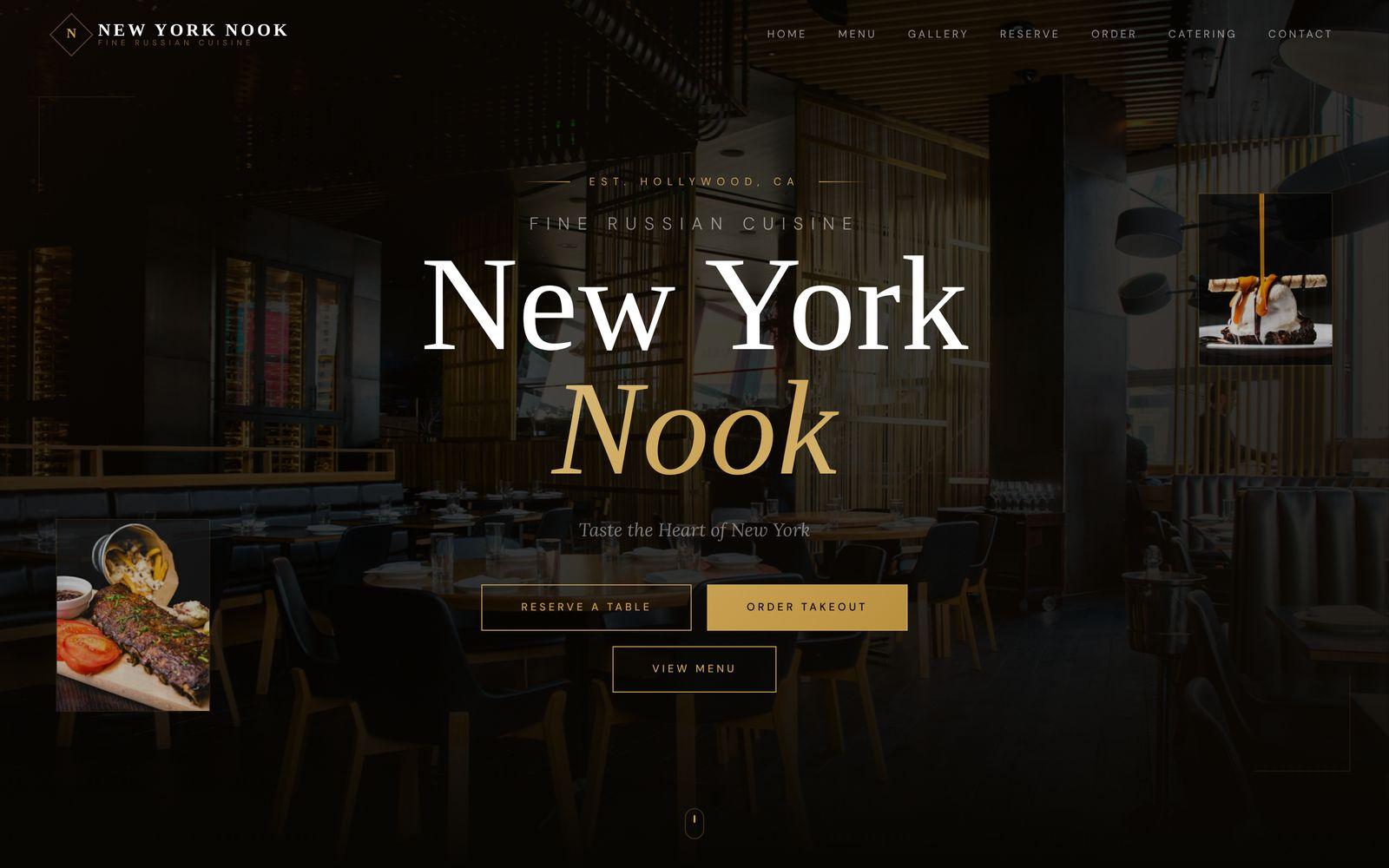
New York Nook, a Russian restaurant in Hollywood, is a good example of a full-featured independent restaurant site: menu, reservation requests and pickup ordering, all on the restaurant's own domain.
The homepage puts three actions at the top: reserve a table, order takeout and view the menu. Everything else, the story, the gallery, catering and private events, supports those three. That structure matters for cost because each of those actions is a feature with its own screens and logic, and it is why a site like this sits in the custom build range rather than the one-page range.
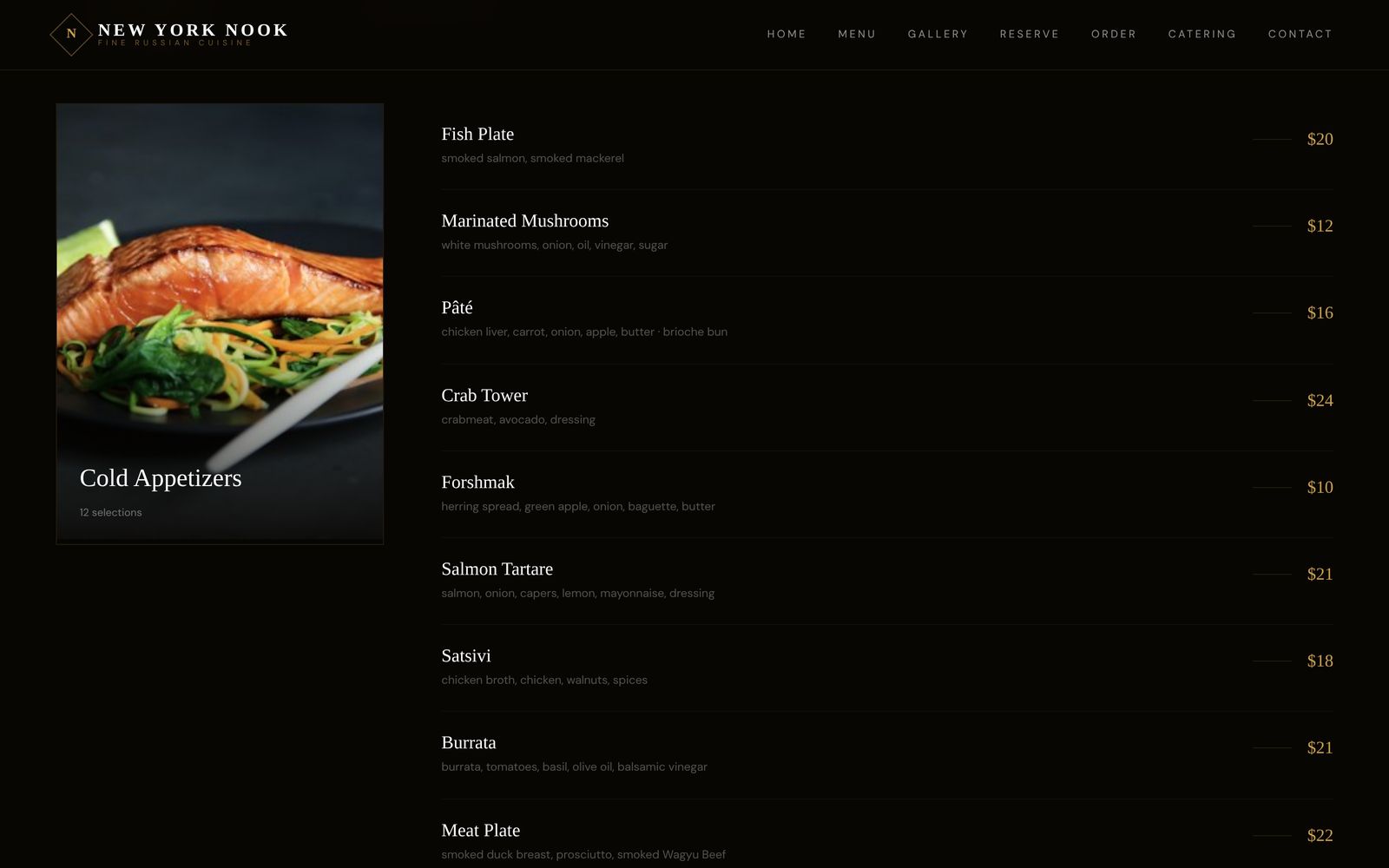
The menu section shows dishes with prices as real text on the page. That is cheaper to maintain than a designed PDF, and it means a guest searching for a specific dish can land on the site.
What monthly costs should a restaurant budget for?
Even a one-time build has a few running costs, and you should know them before you compare quotes.
- Domain name: a small yearly fee to your registrar. Keep it in your own account, not the developer's.
- Hosting: a fast pre-built site on a platform like Vercel can be free or low cost. Vercel's Pro plan is $20 per developer seat per month at the time of writing, which some businesses choose for support and team features.
- Card processing: if you take payment online, Stripe's standard US rate is 2.9 percent plus 30 cents per successful card charge at the time of writing.
- Email: a business email address through Google Workspace or similar, billed per user.
- Updates: menu and price changes. If you can edit the menu yourself, this cost drops close to zero. If not, budget for small paid updates, or a maintenance arrangement. I break that down in "What does website maintenance cost, and what does it include?"
Is a restaurant platform cheaper than a custom site?
A platform is cheaper in month one and usually more expensive by year two or three, especially once ordering fees are counted.
Take a platform at $249 a month. Over three years that is $8,964 in subscription fees alone, before any per-order fee. A $499 flat plan is $17,964 over the same three years. A custom build from $1,200 plus low-cost hosting comes out far lower, even if you pay for a handful of updates along the way.
That does not mean platforms are a bad choice. They bundle marketing tools, apps and support, and they make sense for owners who want everything in one dashboard and do not want to deal with a developer at all. But if what you mainly need is a fast site, a clean menu and a way to take pickup orders, paying a large monthly fee forever is a choice worth questioning. I compare the options side by side in "Toast vs Squarespace vs a custom website for restaurants".
How do delivery app fees change the math?
Delivery app commissions are often the largest hidden cost in a restaurant's online sales, and they are the main reason owners invest in their own ordering.
At the time of writing, DoorDash publishes Marketplace delivery commissions of 15 percent on Basic, 25 percent on Plus and 30 percent on Premier, with a 6 percent commission on pickup orders. Those percentages come out of every order placed through the app.
Here is an illustration with made-up numbers. A neighbourhood restaurant does $6,000 a month in pickup orders through a delivery app at 6 percent. That is $360 a month, or $4,320 a year. If half of those guests switch to ordering pickup on the restaurant's own site, and the restaurant pays only card processing on those orders, it keeps a meaningful part of that commission every month. Over a year, that alone can cover a custom build.
The bigger win is delivery. If any of your volume is delivery at 25 or 30 percent, even a small shift to direct pickup is worth real money. I walk through the setup in "How to take restaurant orders online without third-party fees".
What should I avoid when paying for a restaurant website?
The most expensive mistakes are the ones you pay for twice.
- Menu as a PDF or image. Guests pinch and zoom on a phone, Google cannot read it well, and you end up paying to redo it as text later.
- Heavy video and slow templates. Restaurant sites are opened on phones, often on weak signals. A slow homepage loses the guest before the menu loads. "Core Web Vitals explained for small business owners" covers what to check.
- Hours that do not match Google. If your site says open and your Google Business Profile says closed, guests trust neither.
- A domain registered in someone else's name. If a past developer or agency owns the domain, getting it back can take weeks.
- Paying for features you will not use. Do not buy an ordering system if your kitchen cannot handle the extra tickets during the rush.
Which option is right for my restaurant?
Match the build to what your guests do most, not to what the most expensive quote includes.
- Small cafe or food truck with a short menu: a one-page site from $150 with menu, hours, location, photos and links to your delivery and social pages is enough.
- Sit-down restaurant that takes bookings and catering: a multi-page site from $450 with menu, catering, private events and a reservation request form, plus local SEO setup.
- Restaurant with steady takeout volume: a custom build from $1,200 with pickup ordering and a menu you can edit yourself, so orders move off commission apps.
If you are not sure where you fall, the website cost calculator on my site gives a rough number based on the features you pick, and "Websites for restaurants" shows how I structure restaurant sites.
How can I keep my restaurant website cost down?
The cheapest way to lower the price is to arrive with your content ready and your features decided.
Most of the time on a small site goes into waiting and rework, not code. A developer who has to chase the current menu, guess at hours and swap photos three times will either charge more or take longer. Before you ask for quotes, gather:
- The current menu as a typed document, with section names, prices and dietary notes, not a photo of the printed menu.
- Ten to twenty good photos of dishes, the room and the exterior, at full resolution.
- Hours, holiday hours, address, phone and the exact name as it appears on your Google Business Profile.
- Login access to your domain registrar, or a decision to buy a new domain in your own name.
- Links to any reservation system, delivery apps and social accounts you already use.
- A short list of the two or three actions that matter most, such as book a table, order pickup or request catering.
Then phase the work. Many restaurants start with a fast menu and info site, watch how guests use it for a couple of months, and add pickup ordering once they know the kitchen can handle direct orders. That spreads the cost and avoids paying for a feature nobody uses. "What to send a web developer before your project starts" has a fuller checklist.
The bottom line
A restaurant website costs from about $150 for a clean one-page menu site to $1,200 and up for a custom build with pickup ordering and an editable menu. Platforms trade a low start for a monthly fee that adds up. Decide which actions matter most to your guests, book, order or just find you, and pay for those features first. Get every running cost in writing before you sign, keep the domain in your name, and put the menu on the page as text.
Questions, answered in one line
How much does a basic restaurant website cost?
A basic restaurant website with menu, hours, address, map and a tap-to-call button usually costs from $150 to a few hundred dollars as a custom build, or a monthly fee on a website builder.
Is it cheaper to use a website builder for a restaurant?
It is cheaper in the first month, but a builder or restaurant platform charges every month, so over two or three years a one-time custom site often costs less.
How much does it cost to add online ordering to a restaurant website?
Pickup ordering is the most expensive common feature because it needs a menu data model, a cart, pickup times and notifications, so it usually belongs in a larger custom build rather than a starter site.
What are the monthly costs of running a restaurant website?
Expect a yearly domain fee, hosting that can be free or low cost for a fast static site, card processing on any online payments, and occasional paid updates.
What does Thomas Osayi charge for a restaurant website?
Thomas Osayi builds one-page sites from $150, multi-page sites with a reservation or quote form and local SEO from $450, and custom builds with features like pickup ordering from $1,200.
Sources
- DoorDash Merchant Pricing DoorDash
- Squarespace pricing Squarespace
- Owner pricing Owner.com
- Stripe pricing Stripe
Related articles
- How to take restaurant orders online without third-party fees
- Toast vs Squarespace vs a custom website for restaurants
- Google Business Profile vs website: do you need both?
- New business website checklist: everything to do before launch
Custom Next.js websites for businesses
Custom Next.js websites for small businesses, clinics, restaurants and startups. Fast, SEO-ready, built from scratch with booking, ordering or quote tools. Based in Los Angeles.
See the service