November 17, 2026 · 9 min read · Thomas Osayi
Landing page vs website: which do you need?
The difference between a landing page and a full website, when each makes sense, and how they work together for ads and SEO.
People use "landing page" and "website" as if they meant the same thing, and that causes real confusion when you are trying to get a quote or plan a launch. The difference is focus. A landing page does one job for one audience. A website does many jobs for everyone who might look you up.
Which one you need depends on where your visitors come from and what you want them to do. Here is how I think it through with clients.
What is the difference between a landing page and a website?
A landing page is a single page built around one goal, and a website is a set of linked pages that covers the whole business.
On a landing page, everything points at one action: sign up, book a call, buy, apply. There is usually no navigation menu, because every link that is not the main action is a way out. The visitor arrives from somewhere specific, such as an ad, an email or a QR code, and the page continues the message that brought them.
A website has a homepage, service pages, an about page, pricing, contact and often articles. Visitors arrive from many places with many questions, and the navigation lets each of them find their own answer.
Side by side:
- Pages: one, against several
- Goal: one action, against many paths
- Navigation: none or minimal, against a full menu
- Traffic: ads, email, social and direct links, against search, referrals and repeat visitors
- Build time: days, against weeks
- Search: ranks for a narrow topic, against many topics
One note on terms. A "one-page website" is a small website on a single scrolling page, with a menu that jumps to sections. A landing page in the strict sense is a campaign page with one offer. They overlap, and for a new business the same page often does both jobs at first.
When is a landing page the right choice?
Choose a landing page when you know exactly who is arriving and exactly what you want them to do.
- Paid ads, where the page should repeat the promise in the ad
- A product, course or event launch with a date
- A waitlist or pre-order to test demand before you build
- A single offer, such as a free estimate or a seasonal package
- A new business that needs to be online this week
- A program inside a larger brand, such as hiring, wholesale or a creator program
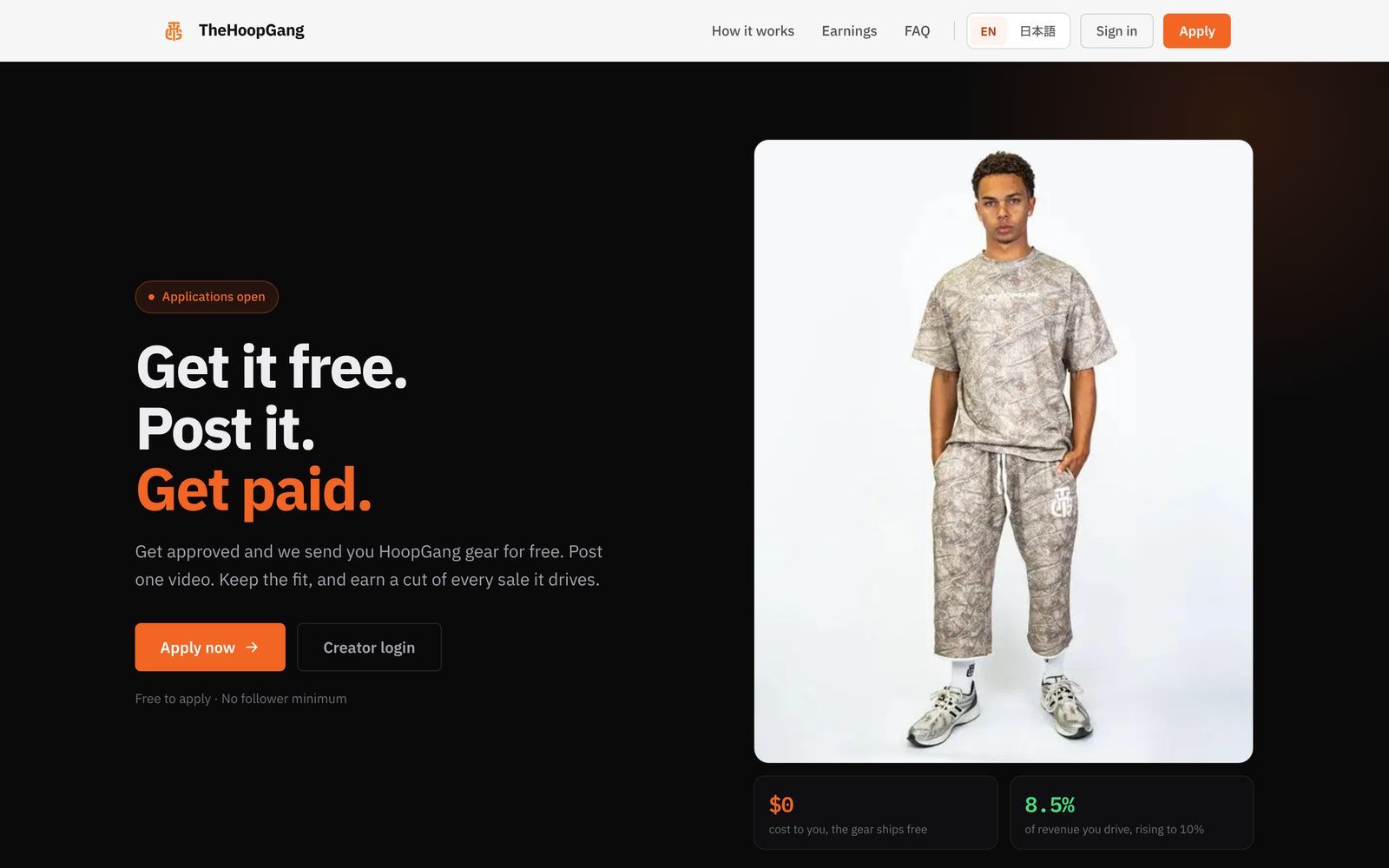
The last case is common. TheHoopGang, a basketball streetwear brand I work with, has a creator portal whose landing page speaks to one audience, creators, and asks for one thing, an application to the program. It does not try to sell clothes to shoppers. The store does that.
A landing page is also the cheapest honest test of an idea. If nobody joins the waitlist after you have put the offer in front of a few hundred of the right people, you have learned something for the price of one page.
What goes on a landing page that converts?
A landing page that converts has a headline matching the visitor's source, one offer, proof, answers to objections and a single repeated button.
The sections, in order
- Headline: the outcome the visitor wants, in the same words as the ad or email that sent them
- Supporting line and the main button
- The problem, stated briefly, so the visitor feels understood
- The offer: what they get, what it costs, what happens after they click
- Proof: reviews, results, logos or a demonstration
- Objections: short answers on price, time, risk and fit
- The button again
The form
Ask only for what you need to take the next step. For a callback, that is a name and a phone number. Each extra required field loses some people. If you need more detail, collect it after the first step, on the thank-you screen or in a follow-up email.
The thank-you step
After the action, send people to a confirmation screen that says what happens next and when. It is also where conversion tracking fires, so do not skip it.
Speed matters more here than anywhere else, because paid visitors are the most expensive ones you have. A page that takes five seconds to appear on mobile wastes ad spend before anyone reads the headline.
When do you need a full website?
You need a full website when customers research before they contact you, when you offer several services, or when you want steady traffic from search.
- People compare three or four providers and read about each one
- You have several services, locations or audiences, each needing its own explanation
- You want to be found for many different searches without paying for each click
- You need supporting pages: pricing, team, policies, careers, articles
- Partners, banks, landlords or journalists will look you up
A website also builds value over time in a way a campaign page does not. Each service page and each useful article is another way in from Google, and those pages keep working after an ad budget stops.
For local service businesses, a multi-page site matters for one more reason. Your Google Business Profile links to your site, and a page per service gives Google clear evidence of what you do and where.
Can a landing page rank on Google?
It can rank for a narrow topic, but one page cannot rank for everything a business does.
Search engines match a page to a query. A single page about "emergency drain cleaning in Burbank" can rank for that and close variations. It will struggle to also rank for water heaters, repiping and bathroom remodels, because one page cannot be the best answer for each of those. A site with a page per service gives each search its own strong candidate.
A few practical points:
- A one-page site still needs a proper title, description, headings and local business details
- Campaign pages made only for ads are often set to noindex, so near-identical variants do not compete with your main pages in search
- If you run several landing pages with similar text, point a canonical tag at the main version
- Links from other sites tend to go to homepages and useful articles, which a lone landing page does not have
So a landing page is a fine starting point for search, not a full plan. If search is a main source of customers for your kind of business, plan on growing into separate pages.
Should ads go to my homepage or a landing page?
Usually a landing page, because it can match the ad's exact message, and that match is what turns a click into an inquiry.
Message match
If the ad says "Free roof inspection in Long Beach", the page headline should say the same thing, and the button should book that inspection. Send the same click to a general homepage and the visitor has to hunt for the offer among everything else you do. Many will not bother. Ad platforms notice too. Google Ads rates landing page experience as one part of Quality Score, which affects what you pay per click.
One page per campaign theme
You do not need a page for every keyword. You need one for each distinct offer or audience. Three ad groups about three services means three pages, each with its own headline, proof and form.
Tracking
- Add UTM parameters to every ad link, so analytics shows which campaign sent each visitor
- Record a conversion when the thank-you screen loads or the form submits
- Import that conversion into the ad platform, so it can optimize toward inquiries instead of clicks
- Track phone calls from the page, since many local customers call instead of filling in a form
The exception is brand search. People who type your business name are looking for you in general, and the homepage is the right place for them.
How do a website and landing pages work together?
The website handles search, referrals and research, and landing pages handle campaigns, with both on the same domain and design.
A typical setup for a growing business:
- The main site at the root domain, with a page per service and location
- Campaign pages at paths such as /lp/free-inspection or /offer/spring, left out of the main menu
- Shared logo, colors and proof, so a visitor who clicks through to the main site feels they are in the same place
- One analytics property and one set of conversion events across both
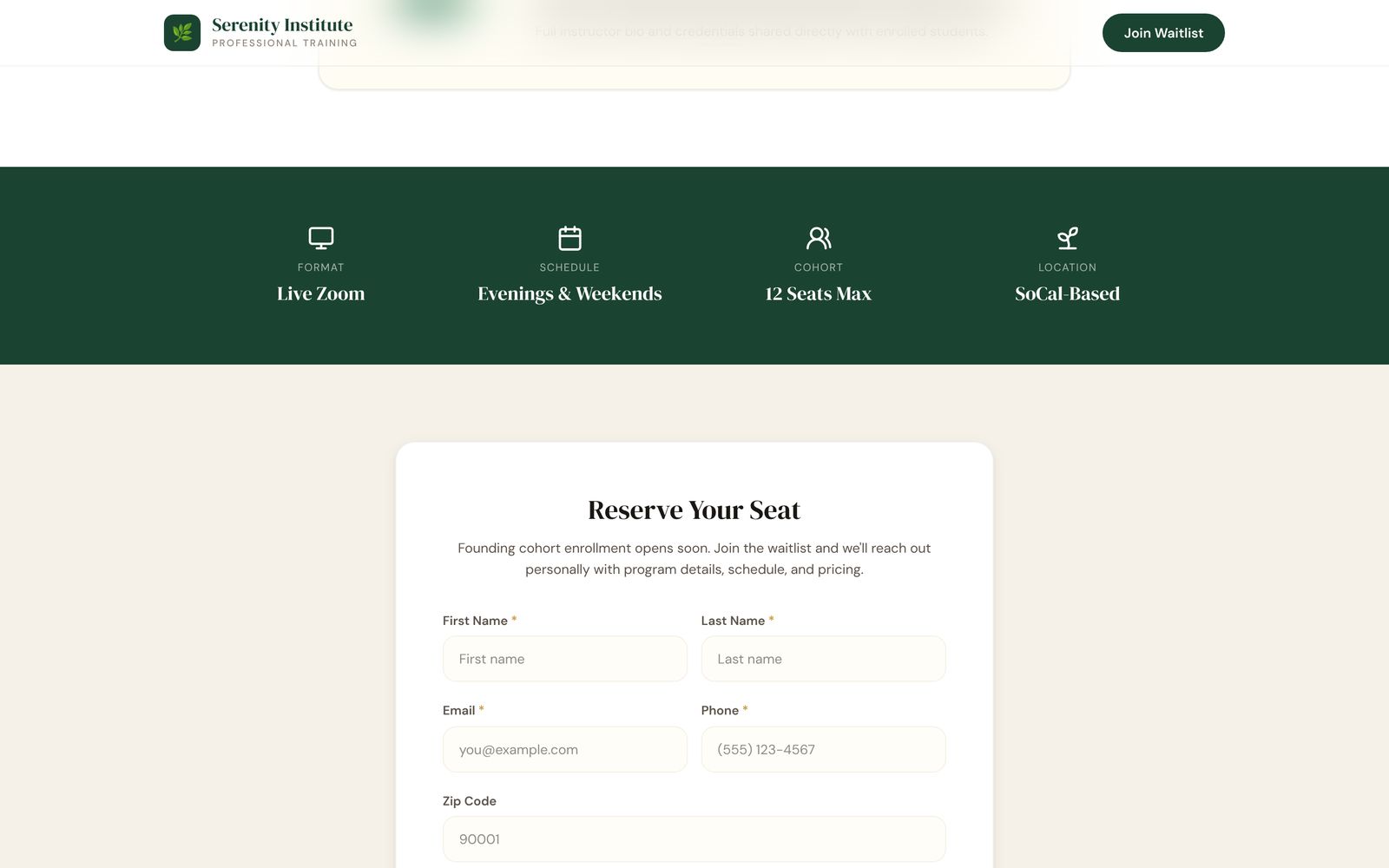
Serenity Institute shows how far focus can go inside a normal site. It is a site I built for a live, Zoom-based certification program for intervention professionals, so the whole site serves one audience considering one program.
Keeping landing pages on your own domain, in the same codebase as the site, has practical benefits. They load as fast as the rest of the site, they reuse the same components, and nobody pays a separate monthly fee for a landing page tool. When a campaign ends, the page redirects to the relevant service page instead of going dead.
How much does each cost, and how long does it take?
A focused one-page site is the lowest cost and the fastest, and a multi-page site costs more because each page needs its own content and design decisions.
My own packages, for reference:
- Starter Site: from $150, about 7 days. A polished one-page site with a contact form and SEO basics.
- Business Site: from $450, about 14 days. Up to 5 pages, a booking or quote form and local SEO setup.
- Full Custom Build: from $1,200, about 21 days. A multi-page site with custom features, a CMS or admin tools.
What usually decides the timeline is content. A one-page site needs a headline, an offer, a few proof points and photos, which most owners can gather in a day or two. A five-page site needs clear text for each service, and that takes real thought. Builds stall waiting on copy and photos far more often than on code.
Running costs are low either way. I deploy on Vercel, where hosting is free or close to it for most small business sites, plus the yearly fee for your domain. Ad spend is separate and almost always the larger number, which is the reason the page it lands on deserves attention.
Can a one-page site grow into a full website later?
Yes, if it is built as a real site from the start and not as a page inside a closed landing page tool.
The growth path I use:
- Start with one page whose sections are services, proof, about, questions and contact
- When a service deserves more room, move it to its own page and leave a short card on the homepage
- Add pricing, about and contact pages as the content grows
- Add articles when you have questions worth answering at length
- Keep the original URL as the homepage, so links and rankings carry over
Because each section is already a component in a Next.js build, turning a section into a page reuses the design. Nothing is thrown away.
The mistakes to avoid are the ones that force a restart: building on a tool that cannot export your content, putting the page on a subdomain you will later abandon, or using a temporary domain in ads and listings. Start on the domain you intend to keep.
The bottom line
If visitors arrive from one source with one intent, build a landing page. If they arrive from search with many different questions, build a website. Most businesses end up with both: a site that earns traffic over time and focused pages for each campaign. If budget is tight, start with one strong page on your real domain and grow from there.
Questions, answered in one line
Can a landing page rank on Google?
It can rank for a narrow topic, but a multi-page site with a page per service ranks for far more searches.
How much does a landing page cost?
Thomas Osayi builds focused one-page sites from $150, usually live in about 7 days.
Should ads go to my homepage or a landing page?
Usually a landing page that matches the ad's message, which tends to convert better than a general homepage.
Does a landing page need a navigation menu?
No. A campaign landing page works best with no menu, so the only thing to click is the main action.
Can a one-page site become a full website later?
Yes, if it is built on your own domain as a real site, each section can later move to its own page without starting over.
How many landing pages do I need for ads?
One for each distinct offer or audience, not one for every keyword.
Sources
- About Quality Score for Search campaigns Google Ads Help
- How to specify a canonical URL with rel="canonical" and other methods Google Search Central
- Block Search Indexing with noindex Google Search Central
Related articles
- How much does a restaurant website cost in 2026?
- How to take restaurant orders online without third-party fees
- Toast vs Squarespace vs a custom website for restaurants
- Google Business Profile vs website: do you need both?
Custom Next.js websites for businesses
Custom Next.js websites for small businesses, clinics, restaurants and startups. Fast, SEO-ready, built from scratch with booking, ordering or quote tools. Based in Los Angeles.
See the service