November 17, 2026 · Updated November 22, 2026 · 10 min read · Thomas Osayi
How to get your business mentioned in ChatGPT, Perplexity and Google AI answers
What makes AI search tools cite or recommend a business, and the practical steps a small business can take to show up in AI answers.
Ask ChatGPT, Perplexity or Google "who should I call for this in my area" and you get a short list of names with reasons. Nobody scrolls ten blue links. The business either is in the answer or is not, and owners are starting to ask me how that list gets made.
There is no secret switch. AI search tools answer a question by reading many sources and summarizing them. To be in the answer, your business has to be in the sources, described clearly enough that the tool can repeat it with confidence. Here is how that works and what a small business can do about it.
How do AI search tools decide which businesses to mention?
They mention businesses that show up, described the same way, across the sources they retrieve for a question.
There are two routes into an answer. The first is what the model absorbed in training: a snapshot of the web from some time ago. You cannot edit that. The second is live retrieval. When someone asks about a local service or a current product, the tool runs web searches behind the scenes, reads the top results and writes a summary with links. That second route is the one you can influence, and it is the one used for most "who should I hire" questions.
Two things follow from this. Ordinary search visibility still matters, because a page that is not indexed or never ranks for anything is unlikely to be retrieved. And the tool is looking for agreement. If your own site, your Google Business Profile and three directories all say you are a pediatric dentist in Pasadena, it can say so. If they disagree about what you do or where you are, the safer choice for the tool is to mention someone else.
Why do mentions on other websites matter so much?
Being named on trusted third-party sites is one of the strongest signals, because an AI tool treats what others say about you as better evidence than what you say about yourself.
Where useful mentions come from
- Review platforms and maps: Google Business Profile, Yelp, and the review sites specific to your industry
- Industry and local directories, including chamber of commerce and trade association listings
- Local news, neighborhood blogs and "best of" roundup articles
- Community discussions such as Reddit threads and local forums, where real customers recommend businesses
- Partner, supplier and client websites that name you
Keep the description identical
Write one sentence that says what you do, for whom and where, then use it everywhere: "Family-owned commercial printer in Los Angeles specializing in packaging and large-format work." Use the same business name, address and phone number on every profile, down to the suite number. Small differences read as different businesses.
How to earn them
Claim and complete every profile that already exists. Ask happy customers for reviews that mention the specific service. Offer a local reporter or blogger a useful fact or a quote on your subject. Sponsor or take part in something local that publishes a list of participants. None of this is new. It is the same reputation work that always mattered, and AI tools happen to read all of it.
How should I write pages so AI tools can quote them?
Start every page and every section with the direct answer, then explain, and keep each section able to stand on its own.
Answer first
A tool building an answer looks for a sentence it can lift. "A brake pad replacement at our shop takes about 90 minutes and costs between X and Y for most sedans" is liftable. "We pride ourselves on quality service" is not. Put the answer in the first sentence under each heading, and write the heading as the question a customer would type.
Self-contained sections
AI tools often quote a single section, not a whole page. Sections of roughly 120 to 180 words that make sense alone work better than long walls of text. That means naming the subject in each section, not writing "it" and relying on a paragraph further up the page.
A before and after. Before: "Our process is simple and stress-free, and we handle everything." After: "Bookkeeping cleanup for a small business with one year of unreconciled accounts usually takes two to three weeks. We need read-only bank access and your last filed tax return to start." The second version can be quoted as an answer. The first cannot be quoted as anything.
What kind of content gets cited most?
Comparisons and pages full of specific facts get cited most, because they match the questions people ask AI tools.
Comparisons
"X vs Y" and "which option is right for me" questions are common in AI search. An honest comparison of methods, materials or your own packages gives the tool exactly the structure it needs. Say plainly who each option suits and who it does not. A comparison that always concludes "choose us" reads as an ad, and tools favor sources that look balanced.
Specific facts
Prices, timelines, locations, quantities and named examples give an AI something concrete to repeat. Go through your service pages and check each one for:
- A price or a price range
- How long the work takes
- The areas you serve, by name
- What is included and what is not
- A real example with details
- Who the service is not right for
Vague marketing copy gives the tool nothing to work with. A page that says a one-page site starts at $150 and takes 7 days can be repeated word for word. A page that says "affordable solutions, fast turnaround" cannot.
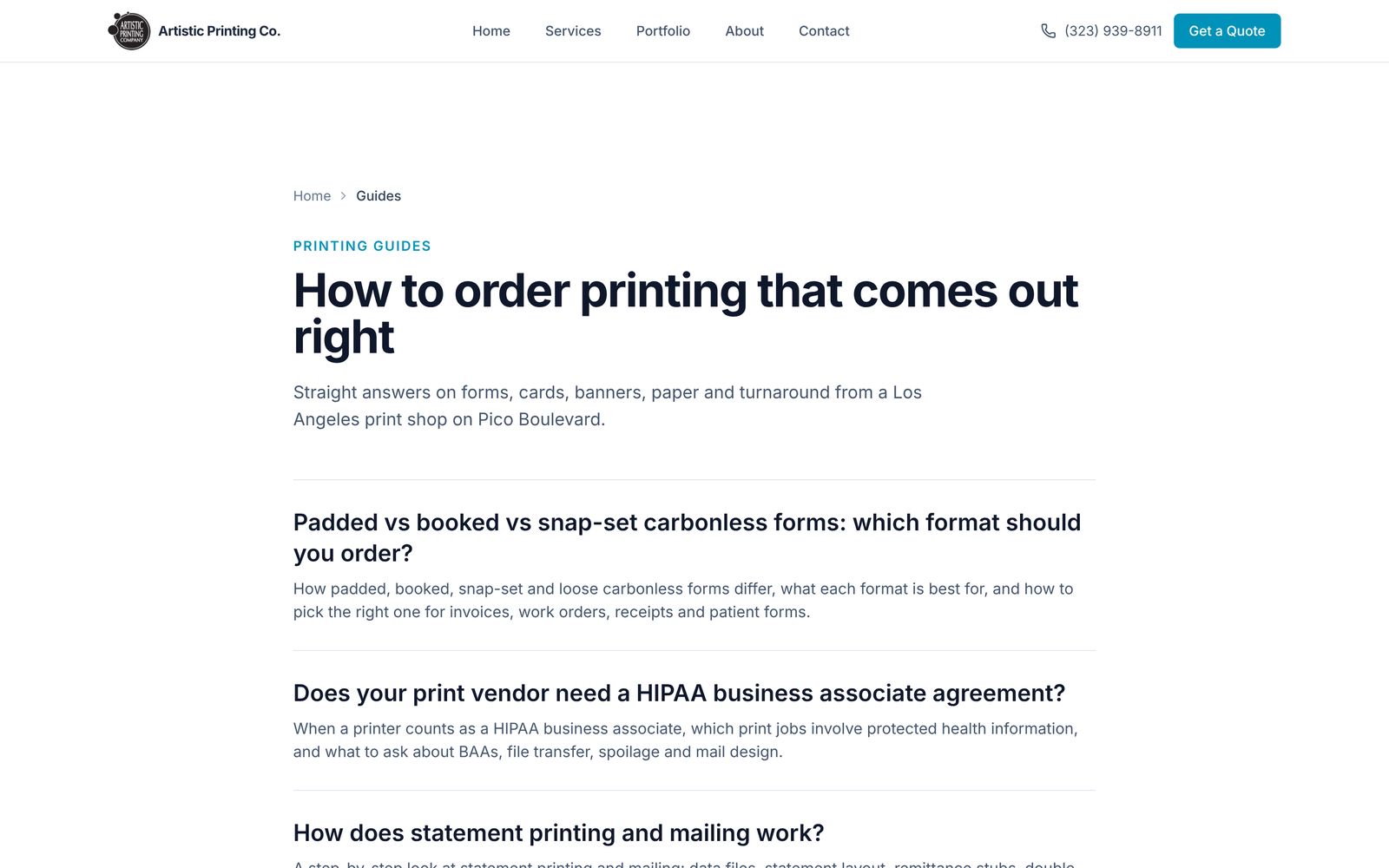
Artistic Printing, a commercial printer's site I built, has a printing guides section where each guide answers a question buyers ask before they order.
Does it matter how fresh my content is?
Yes, tools that retrieve live results lean toward recent, clearly dated pages for anything that changes over time, such as prices, regulations and recommendations.
Update a page when something real changes: a new price, a new service, a rule that changed, a better example. Show the date it was last updated on the page, and make sure the date in your structured data matches. A page with last year's prices is a liability twice over, because the tool may repeat the old number to a customer who then feels misled.
Never change dates without changing content. A new date on unchanged text fools nobody for long, and when the visible date and the content disagree, you have made the page less trustworthy, not more.
A realistic routine for a small business is a quarterly pass: open your five most important pages, correct anything out of date, add one new question you have been asked recently with its answer, and update the date.
What technical setup do AI crawlers need?
They need permission to fetch your pages, content that is present in the HTML, and details that match everywhere.
Access in robots.txt
Check the robots.txt file at the root of your domain. Some hosts and security plugins block AI crawlers by default. The ones to know are GPTBot, OAI-SearchBot and ChatGPT-User from OpenAI, PerplexityBot from Perplexity, and ClaudeBot from Anthropic. Google's AI answers draw on its normal search index, so Googlebot access is what counts there. Google-Extended is a separate control for whether your content is used with Google's Gemini models. If a search crawler is disallowed, it cannot read you and cannot cite you.
Content in the HTML
Many AI crawlers fetch the raw page and do not run JavaScript. If your site builds its text in the browser after loading, a crawler may see an empty shell. Open your page, choose View Source, and search for a sentence from the page. If it is not there, that is a problem worth fixing. Sites I build in Next.js are pre-rendered, so the full text is in the HTML.
Structured data and consistency
Add schema markup that matches what is visible: LocalBusiness with your name, address, phone and hours, and FAQ markup only for questions that appear on the page. Keep those details identical to your profiles elsewhere. Set up Bing Webmaster Tools as well as Google Search Console, since some AI tools draw on Bing's results.
About llms.txt
There is no clear evidence that AI tools rely on an llms.txt file today. It is cheap to add, and it is not a substitute for content and mentions.
How do I check whether AI tools mention my business?
Ask them the questions your customers ask, on a schedule, and write down what comes back.
Pick ten questions: a few "best" or "who should I hire" questions for your service and area, a few "how much does it cost" questions, and a few comparisons. Ask each one in ChatGPT, Perplexity and Google, in a fresh session, so earlier chats do not shape the result. Record three things in a spreadsheet: which businesses were named, which sources were linked, and whether the facts about you were right.
The sources column is the useful one. If the same directory or roundup article is cited again and again for your category and you are not on it, you have found your next task. If a tool states an old price or a wrong address, trace it to the page that says so and correct it there.
Answers vary from one run to the next, so look for patterns over a few months, not single results. Also check your analytics for referral visits from chatgpt.com and perplexity.ai. The numbers are usually small, but those visitors arrive already briefed.
What does not work?
Anything aimed at tricking the tool instead of informing the reader.
- Paying for placement. Organic answers are not for sale, and anyone promising a guaranteed mention is selling something they do not control.
- Stuffing pages with keywords or hidden text written for machines. The tools summarize meaning, and clumsy repetition makes a page less quotable.
- Publishing dozens of thin, near-identical pages for every nearby town. One strong page with real detail beats twenty copies.
- Fake reviews or made-up statistics. They are a risk to the business well beyond search.
- Refreshing dates on unchanged content.
- Treating a single technical file as the answer while the site still says nothing specific.
What does Google say it takes to appear in AI Overviews?
Google's own documentation says there are no extra requirements: a page that is indexed and eligible to show with a snippet in normal search can be used in AI Overviews and AI Mode.
That is worth knowing because a lot of what is sold as "AI optimization" contradicts it. At the time of writing, Google's page on AI features states that you do not need new machine-readable files, AI-specific text files or special schema markup. What it does recommend is the ordinary list:
- Allow crawling in robots.txt, and check that your host or CDN is not blocking Googlebot
- Keep important content in text, not only in images or video
- Link between your own pages so they can be found
- Give visitors a good page experience
- Make structured data match what is visible on the page
- Keep your Business Profile details current
Google also says meeting these does not guarantee a page will be shown. And the Google-Extended control in robots.txt, which governs use of your content for Gemini models, does not affect whether you appear in Google Search.
For a small business, that means the work in this article is the work. There is no separate AI checklist for Google.
The bottom line
AI answers are built from sources, so the work is to be a good source and to be mentioned by other good sources. Describe your business the same way everywhere, earn mentions on the sites your category relies on, open each page and section with a plain answer, fill your pages with specific facts, keep them current, and let the crawlers in. It is slower than a trick, and it is the only approach that keeps working when the tools change.
Questions, answered in one line
Is AI search optimization different from SEO?
It builds on the same foundation, but mentions on other websites and clearly quotable answers carry extra weight in AI answers.
Does an llms.txt file get me into ChatGPT?
There is no clear evidence that AI tools rely on llms.txt today; it is cheap to add but not a substitute for content and mentions.
Can I pay to appear in AI answers?
Not in the organic answers; you earn mentions through content, reviews and coverage on other sites.
Should I block AI crawlers in robots.txt?
Not if you want to be cited: a search crawler that is blocked cannot read your pages, so it has nothing of yours to quote.
How do I check whether AI tools mention my business?
Ask ChatGPT, Perplexity and Google the questions your customers ask, in a fresh session, and record which businesses and sources appear each month.
How long does it take to show up in AI answers?
There is no fixed timeline; new pages can be picked up within weeks once they are indexed, while mentions on other sites build over months.
Sources
- AI Features and Your Website Google Search Central
- Google's common crawlers Google for Developers
- Overview of OpenAI Crawlers OpenAI
Related articles
- How much does a restaurant website cost in 2026?
- How to take restaurant orders online without third-party fees
- Toast vs Squarespace vs a custom website for restaurants
- Google Business Profile vs website: do you need both?
Custom Next.js websites for businesses
Custom Next.js websites for small businesses, clinics, restaurants and startups. Fast, SEO-ready, built from scratch with booking, ordering or quote tools. Based in Los Angeles.
See the service