November 25, 2026 · 8 min read · Thomas Osayi
Google Ads landing page for a local business: message match, one goal and call tracking
How to build a Google Ads landing page for a local business: match the ad, keep one goal, track calls and forms, load fast, and improve landing page experience.
Paying for clicks and sending them to a page that was never built for them is one of the most common ways local businesses waste ad money. The ad says "same-day garage door repair in Pasadena." The click lands on a homepage with a slideshow, six menu items and a contact page two clicks away. Some people call anyway. Many leave.
A landing page built for the ad fixes most of that. This post covers what goes on one for a local business, how to track the calls and forms it produces, and how it ties into Google's landing page experience and Quality Score. If you are not sure whether you need a landing page at all, "Landing page vs website: which do you need?" covers that decision first.
What makes a good Google Ads landing page for a local business?
A good Google Ads landing page repeats the ad's promise, asks for one action, proves you serve the searcher's area, and loads fast on a phone.
Most local ad clicks come from people with a specific problem and a short attention span. They have just typed something like "emergency plumber Long Beach," seen your ad, and tapped it. In the next few seconds they decide whether this page is about their problem, in their area, from someone who looks trustworthy.
The parts that answer those questions:
- A headline that matches the ad and the search.
- The area served, stated plainly near the top.
- One clear action: a tap-to-call button, a short form, or both pointing to the same goal.
- Proof: reviews, photos of real work, licenses or years in business where true.
- Answers to the objections that stop people calling, such as price range, availability and what happens next.
Everything else is optional. Navigation menus, blog links and long company histories mostly give visitors a way to wander off.
Should ads go to your homepage or a dedicated landing page?
Send ads to a dedicated page that matches each ad group, because a homepage tries to serve everyone and rarely matches any single ad well.
Your homepage has to introduce the whole business to many kinds of visitors. A landing page only has to speak to one: the person who searched for one service and clicked one ad.
For a small local account, you do not need dozens of landing pages. A practical starting point is one landing page per core service you advertise. A plumber running separate ad groups for water heaters, drain cleaning and leak detection would have three pages, each with its own headline, photos and proof.
Existing service pages can work as landing pages if they are already focused, fast and have a clear call to action. The difference is usually what you remove: a dedicated page often hides the main menu and footer links so the only obvious next step is to call or fill in the form.
What is message match and why does it matter?
Message match means the landing page says the same thing as the ad and the search, so the visitor immediately knows they are in the right place.
If the ad promises "free estimates for roof repair in Torrance," the page headline should mention roof repair, Torrance and free estimates. If the ad mentions a price or an offer, the page should show the same price or offer, near the top, with the same conditions.
Mismatch is surprisingly common. An ad for one service lands on a general page, an offer in the ad is missing from the page, or the ad names a city the page never mentions. Each mismatch makes the visitor work harder to confirm they are in the right place.
It also matters to Google. Its help pages describe landing page experience as a measure of how relevant and useful your landing page will be to people who click your ad, and suggest aligning the page with your keyword and with what customers are searching for.
Why should the page have only one goal?
One goal keeps the visitor's decision simple, and it makes your tracking clean, because every conversion means the same thing.
For a local service business, the goal is almost always a lead: a phone call or a quote request. Both can be on the page, because they are two ways to do the same thing. What should not be on the page are competing goals like "follow us on Instagram," "read our blog" or "browse all services."
A few practical rules:
- Repeat the same call to action at the top, in the middle and at the bottom of the page.
- On mobile, a sticky call button at the bottom of the screen keeps the main action in reach.
- Make the button text specific, like "Get a free estimate" or "Call for same-day service," rather than "Submit."
- Remove the main menu, or reduce it to the logo and phone number.
How do you track calls from a landing page?
Track calls with Google Ads call reporting and website call conversions, so you can see which ads and keywords lead to phone calls and not just clicks.
At the time of writing, Google's help page on call reporting explains that when call reporting is on, Google assigns a forwarding number to your ad so you can see call details and count qualifying calls as conversions. If you turn it off, your direct number shows, but Google Ads cannot track those calls. The forwarding numbers belong to Google and can change, so do not print them on vans or flyers.
For people who click through to the page and then call, set up website call conversion tracking, which Google documents as the other permitted use of its forwarding numbers. Count only calls above a duration you choose, so wrong numbers and hang-ups are not counted as leads.
Also track:
- Form submissions, ideally by sending visitors to a thank-you page or firing a conversion event when the form succeeds.
- Taps on the call button, as a separate, softer signal.
"How to track website leads with Google Analytics 4: forms, calls and UTMs" covers the analytics side in more detail.
What should the form ask?
Ask only what you need to call someone back and give a rough quote, usually name, phone, service needed and postcode or city.
Every extra field costs you some leads. Things like budget, how they heard about you and detailed project descriptions can wait for the phone call. An optional photo upload is worth adding for trades where a picture saves a site visit.
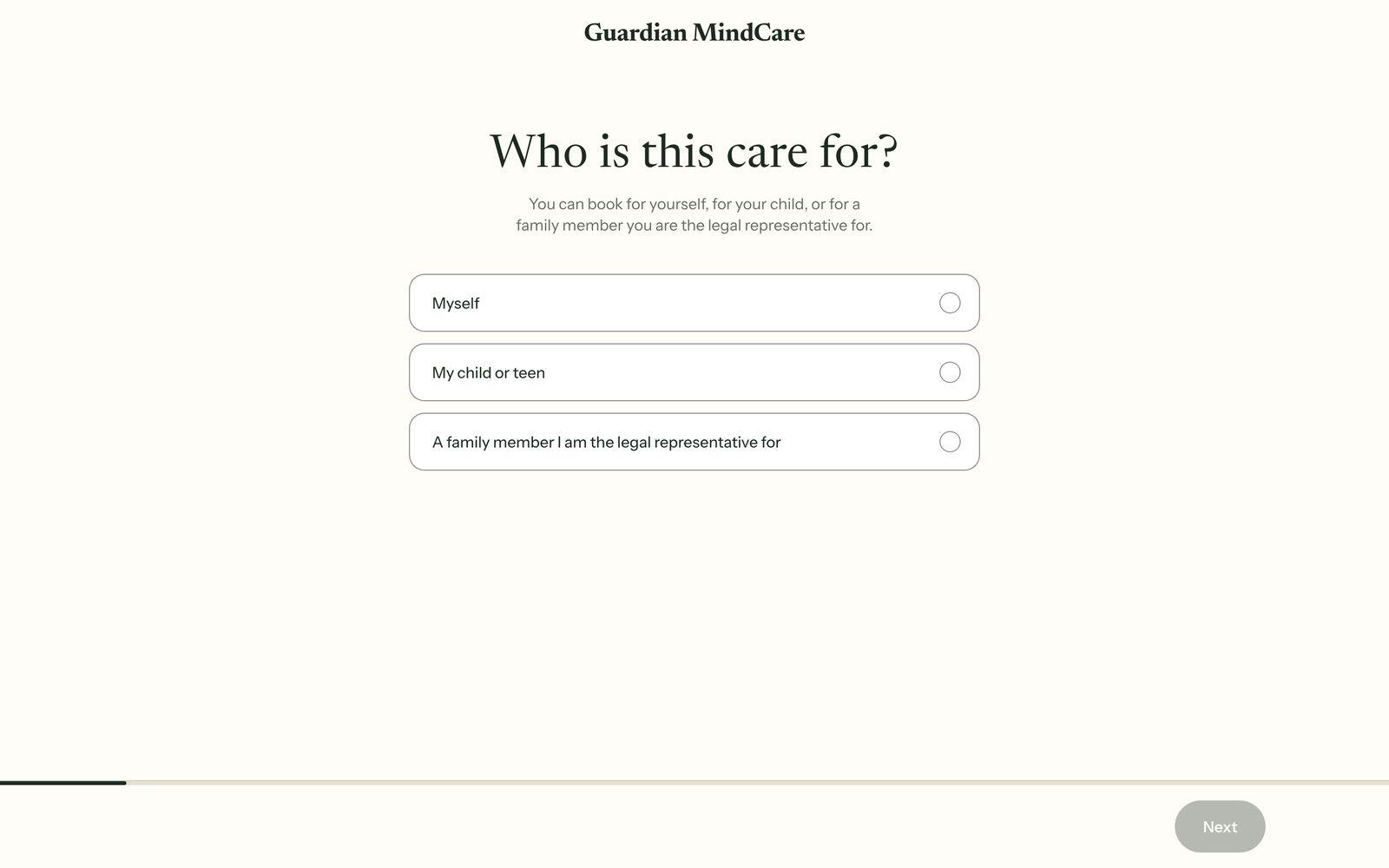
A multi-step form can work well if the first step is an easy, low-commitment question. For Guardian MindCare, a therapy practice platform I built, the get-matched intake starts with a single question about who the care is for, before asking for anything personal.
Confirm the submission clearly on screen, send an email or text confirmation, and make sure someone actually responds quickly. A fast reply often matters more than any design choice on the page. "Quote request forms for service businesses" goes deeper on fields and follow-up.
How fast does the page need to be?
The page should load quickly on a typical phone connection, because most local ad clicks are on mobile and a slow page loses people before they see your offer.
Google's help page on evaluating landing pages notes that a one-second delay on mobile can impact mobile conversions by up to 20 percent. The landing pages report in Google Ads also shows a mobile-friendly click rate, which tells you whether pages are passing Google's mobile-friendly check.
The usual fixes for a slow landing page:
- Compress and resize images, and avoid large background videos.
- Remove scripts you do not need, such as chat widgets, heatmaps and old tracking tags.
- Keep fonts to one or two families.
- Host the page on a fast, modern platform rather than an old shared server.
"Why is my website slow? Causes, tests and fixes" walks through how to test and fix this.
How do Quality Score and landing page experience fit in?
Landing page experience is one of three components of Quality Score, a 1 to 10 diagnostic that helps you see where ads and pages could improve.
At the time of writing, Google's help page lists the three components as expected clickthrough rate, ad relevance and landing page experience. Each is rated above average, average or below average compared with other advertisers whose ads showed for the same searches over the past 90 days. Google also states that Quality Score is not an input in the ad auction; it is a diagnostic tool.
So treat a below average landing page rating as a prompt, not a penalty. It usually points to a page that does not clearly match the keyword, is hard to use on mobile, or does not give people what the ad promised. Fixing those issues helps real visitors, which is the point of the rating.
A worked example
Here is an illustration, not a real client: a made-up garage door repair company running ads in Pasadena and Altadena.
The account has two ad groups: broken springs and new door installation. Each gets its own landing page. The springs page headline reads "Broken garage door spring? Same-day repair in Pasadena and Altadena," matching the ad. Below it are a tap-to-call button, a three-field form, a short price range for typical spring jobs, photos of the owner's own repairs and a few reviews.
Call reporting is on, website call conversion tracking covers people who call from the page, and only calls longer than a set duration count. Forms send visitors to a thank-you page tracked as a conversion. After a few weeks, the owner can see which ad group produces calls rather than just clicks.
The bottom line
A Google Ads landing page for a local business does one job: turn a paid click into a call or a quote request. Match the ad, keep one goal, show you serve the area, load fast on a phone and track every call and form. Do that and the landing page experience rating usually takes care of itself. If you need one built, a focused one-page site is often enough, and my Starter Site package starts at $150.
Questions, answered in one line
Should Google Ads go to my homepage?
Usually not. A homepage serves many audiences, while a dedicated landing page can match one ad's promise and ask for one action.
How do I track phone calls from Google Ads?
Turn on call reporting so Google assigns a forwarding number to your call assets, and set up website call conversions for people who call the number on your landing page.
What is landing page experience in Google Ads?
It is Google's estimate of how relevant and useful your landing page will be to people who click your ad, and it is one of the three components behind Quality Score.
How long should a Google Ads landing page be?
Long enough to answer the questions that stop someone from calling, such as price range, area served and proof of quality, and no longer than that.
What does Thomas Osayi charge for an ad landing page?
Thomas Osayi builds a one-page Starter Site from $150 in about 7 days, which suits a single focused landing page for one service.
Sources
- Landing page experience: Definition Google Ads Help
- About Quality Score for Search campaigns Google Ads Help
- About call reporting Google Ads Help
- Evaluate the performance of your landing pages Google Ads Help
Related articles
- How much does a restaurant website cost in 2026?
- How to take restaurant orders online without third-party fees
- Toast vs Squarespace vs a custom website for restaurants
- Google Business Profile vs website: do you need both?
Custom Next.js websites for businesses
Custom Next.js websites for small businesses, clinics, restaurants and startups. Fast, SEO-ready, built from scratch with booking, ordering or quote tools. Based in Los Angeles.
See the service