November 17, 2026 · Updated November 22, 2026 · 10 min read · Thomas Osayi
Do I need a website if my business already has Instagram?
What a website does that Instagram and Google Business Profile cannot, and when a social-only presence is enough for a small business.
Social media is where people discover you. A website is where they decide. If your business already has an active Instagram, you have the harder half, attention. The question is where that attention goes when someone is ready to book, buy or ask a real question.
My short version: Instagram alone can carry a business for a while, but it leaves you invisible to people who search and dependent on a platform you do not control.
What does Instagram do well for a small business?
Instagram is very good at showing your work, building familiarity and keeping you in front of people who already follow you.
For visual businesses such as salons, tattoo artists, bakers, trainers and restaurants, it is often the strongest discovery channel there is. A potential client sees your work in a friend's story, taps through, scrolls your grid and forms an opinion in under a minute. No website does that kind of social proof as naturally.
It also gives you things that are hard to build elsewhere:
- A running portfolio that updates every time you post
- Direct messages, which lower the barrier to a first question
- Tags and shares from happy customers
- Location tags and hashtags that reach people nearby
- Free tools: story highlights for prices and policies, action buttons, a shop tab for products
So this is not an argument against Instagram. Keep posting. The point is that Instagram is a channel, and a business needs a home that the channels point to.
What can a website do that Instagram cannot?
A website can be found in search, hold detailed information, take bookings and payments on your terms, and belong to you.
Be found by people who are searching
Someone typing "lash extensions near me" or "birthday cake delivery Culver City" into Google is often ready to buy today. Google's results for those searches are built from business profiles and websites. An Instagram profile may appear for your business name, but it rarely appears for a service search. Instagram reaches people who are scrolling. A website reaches people who are looking.
Answer detailed questions
A caption is a poor place for a price list, a cancellation policy, parking directions or an explanation of how a service works. On a site, each of those has a permanent address you can link to. That saves you from answering the same DM forty times.
Take bookings, deposits and orders
A site can show live availability, take a deposit, sell a gift card or accept an order, through tools you chose and at fees you agreed to. You are not limited to what the app supports this year.
Stay yours
Reach on Instagram depends on a ranking system you cannot see, and it changes. Accounts get hacked, restricted or disabled, sometimes by mistake, and getting one back can take a long time. A domain you own and a site you control do not vanish because of someone else's policy decision.
Look established
For a first-time customer about to spend real money, or a landlord, supplier or journalist checking you out, a clear website signals a real, stable business.
Is a Google Business Profile enough without a website?
A Google Business Profile is essential and free, but it works better with a website behind it.
The profile is what appears in the map results: your name, hours, reviews, photos and a call button. Every local business should claim and complete one, whether or not it has a site. On its own, though, it has limits:
- It has no room to explain services in depth
- You control little of the layout and none of what appears beside it, including competitors
- It gives Google a short description to judge you by, where a website gives it pages of evidence
- The simple websites Google used to generate from a profile were shut down in 2024, so the profile no longer comes with a page of its own
Linking the profile to a website with the same name, address and phone number helps Google connect the two and understand what you offer. Service pages on the site support the categories and services listed on the profile. Reviews live on the profile and can be quoted on the site, so each strengthens the other.
How do Instagram, Google and a website work together?
Instagram brings attention, Google brings people who are searching, and both send them to the website to act.
The setup is simple:
- The link in your Instagram bio goes to your site, either the homepage or a booking page
- Your Google Business Profile links to the same site
- The site has the booking, ordering or contact step, with prices and answers alongside
- The site links back to your Instagram, so visitors can see recent work
Now every channel ends in one place that you control and can measure. Add UTM tags to the bio link and your analytics will show how many visitors came from Instagram and how many of them booked.
New York Nook, a Russian restaurant in Hollywood, is a site I built with this job in mind. Whatever sends a guest there, they can see the full menu with photos, request a reservation or order pickup from their phone.
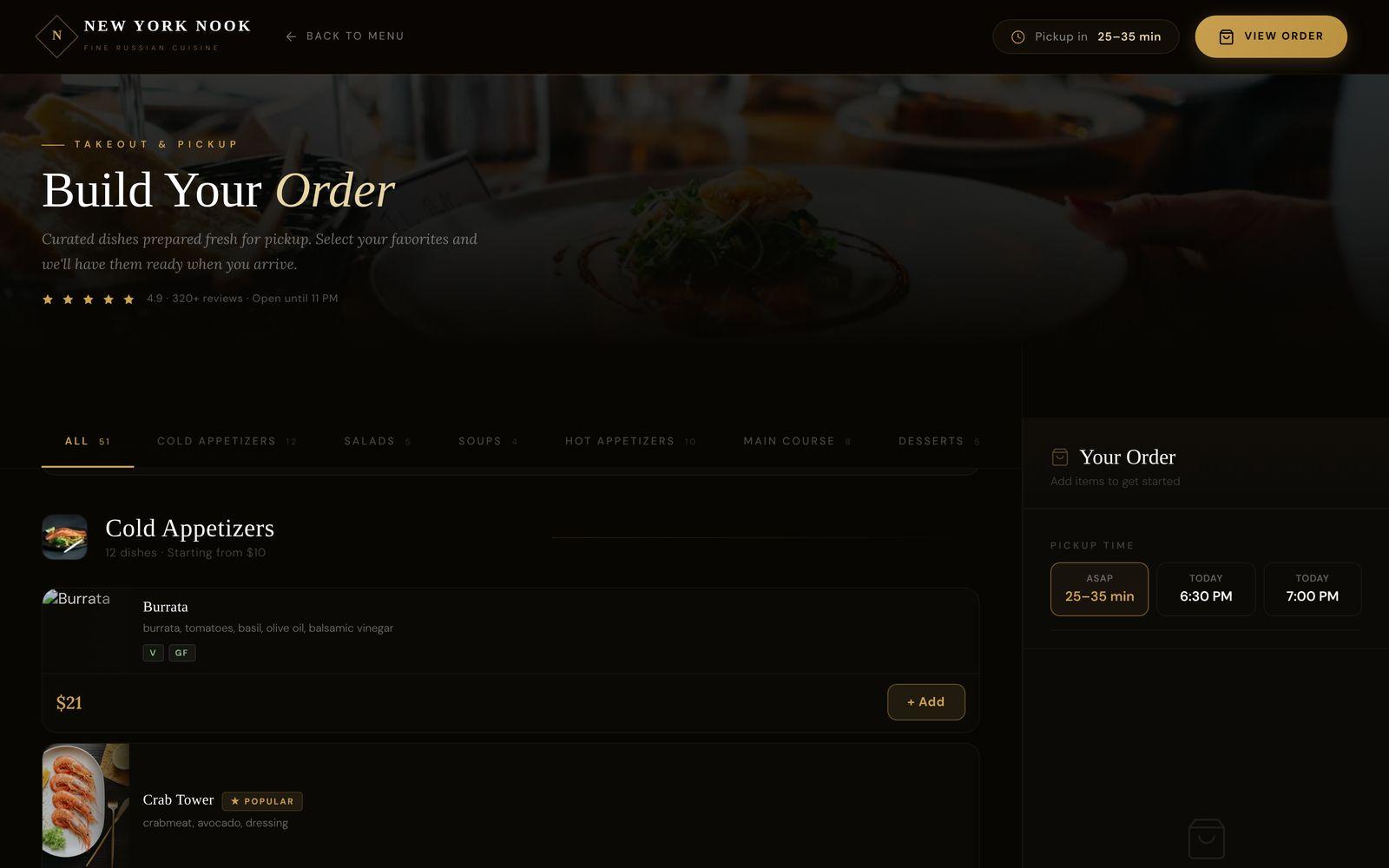
You can also bring Instagram into the site, with care. A few of your best photos placed by hand load faster than a live embedded feed, and they never show a post you would not have chosen for that spot.
When is Instagram alone enough?
Social-only is reasonable when you are testing demand, fully booked through referrals, or selling through DMs at a volume you can handle by hand.
Situations where waiting makes sense:
- You started last month and are still working out what you sell and to whom
- Your calendar is full from word of mouth and you are not looking for new customers
- You take a few custom orders a week and enjoy handling each conversation
- Your business is a side project with no plan to grow
Signs it is time for a site:
- You answer the same questions about price, location and availability every day
- People ask "do you have a website?" before they book
- You want customers who have never heard of you, from search
- You are about to pay for ads and need somewhere to send the clicks
- A drop in reach or an account problem has already cost you a slow week
- You want to take deposits, sell gift cards or offer packages
The pattern I see is that a business does fine on Instagram until it wants to grow past its existing circle. Followers are people who already know you. Search is where the strangers are.
What does the simplest useful website include?
One fast page with what you do, proof, prices, location and a single button to book or contact you.
You do not need ten pages to start. A first site needs:
- A headline saying what you do and where
- Your services with starting prices
- Photos of real work, which you already have from Instagram
- A few reviews, quoted from Google or from clients with permission
- Location, service area and hours
- One clear action: book, order, call or message
- Answers to the five questions you get most in DMs
- Links to Instagram and your other profiles
Technical basics matter as much as content: a real domain name, a title and description for search, local business details in structured data, a layout made for phones, and quick loading on mobile data.
Astiglow, a waxing studio site I built, follows this idea. Clients see the services and prices, pick a package and book online, with no call or message needed.
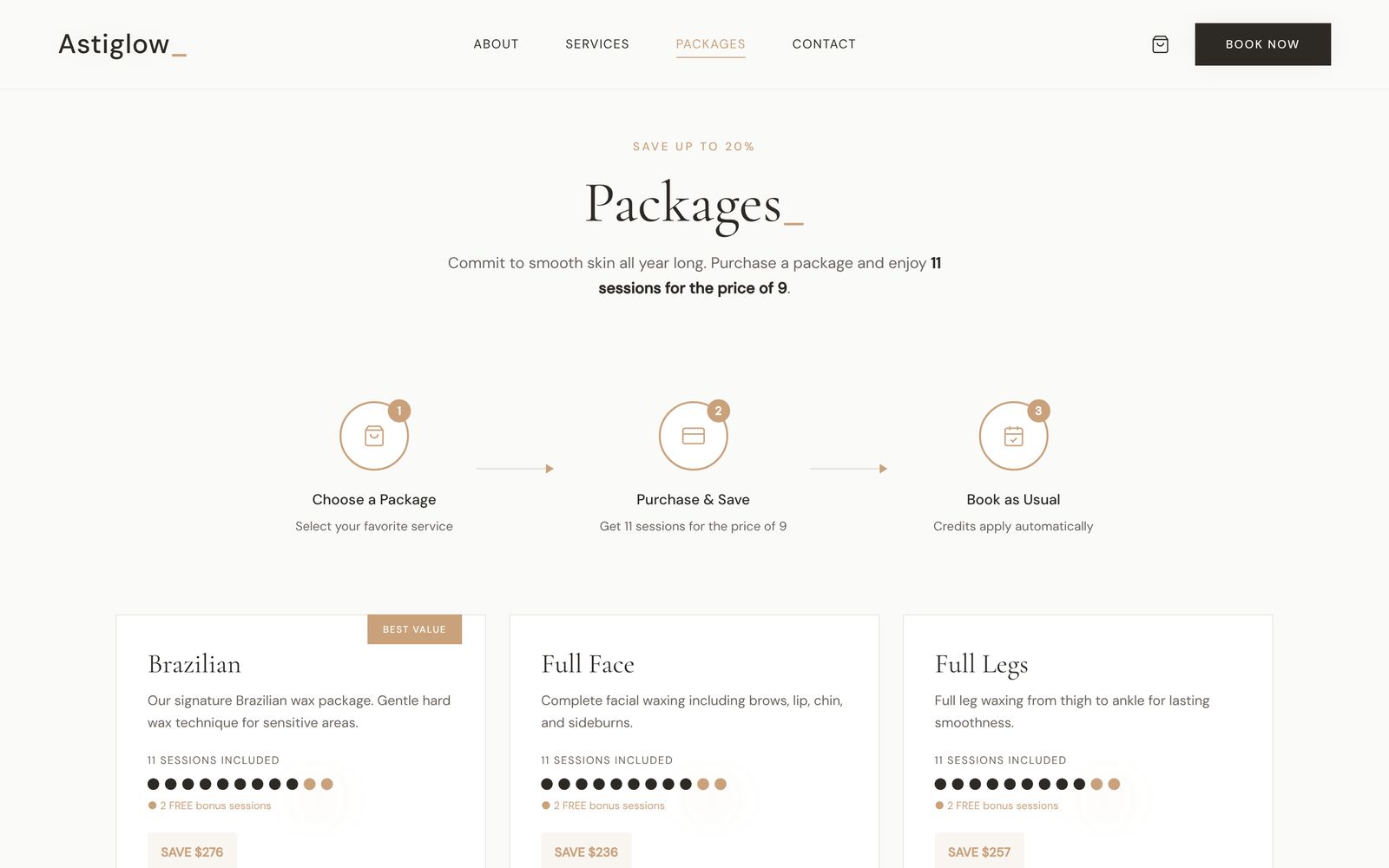
Most of the material for a first site is already on your profile. Your best photos, your highlights and your most asked questions are a draft of the page.
What does a first website cost compared with staying social-only?
A simple site is a small one-time cost and a low yearly one, set against the customers you never see because they searched instead of scrolled.
What you pay for:
- The build. My Starter Site is from $150 and takes about 7 days: a polished one-page site with a contact form and SEO basics. The Business Site, from $450 and about 14 days, adds up to 5 pages, a booking or quote form and local SEO setup.
- A domain name, a yearly fee paid to a registrar. Register it in your own name and account.
- Hosting. I deploy on Vercel, where hosting is free or close to it for most small business sites.
- Any booking or ordering tool you choose, paid to that vendor.
The cost of staying social-only is harder to see, because it shows up as absence. Nobody tells you they searched for your service, did not find you and booked someone else.
DIY site builders are an option too, and for some owners they are the right one. The trade-off is your own time and a monthly subscription, and a result that depends on how much care goes into speed and search setup.
What mistakes do Instagram-first businesses make with a first site?
The most common mistake is treating the site as a formality and not as the place where the booking happens.
- Using a third-party link page as the "website" forever. It is fine as a stopgap, but it sits on someone else's domain and builds no search presence for yours.
- Building a site and never linking it from the bio or the Google profile
- Leaving prices off because "they can DM me", which sends searchers to a competitor who lists them
- Uploading full-size phone photos that make the page slow
- Letting the site go stale, with old hours and last year's menu, while Instagram stays current
- Registering the domain through a friend or a builder account you later lose access to
- Adding a live feed, a chat widget and a pop-up to a page that should load in a second
A site needs far less upkeep than a feed. Update it when prices, hours or services change, and check the booking path on your phone once a month. That is enough.
What should I do in the first week after the site goes live?
Connect it to every place customers already find you, so the new site starts collecting visits from day one.
A simple launch week:
- Day one: change your Instagram bio link to the site, with a UTM tag so analytics can tell those visits apart
- Day one: add the website to your Google Business Profile, and check that the name, address, phone and hours match the site exactly, as Google's profile guidelines ask
- Day two: post about the site and pin it, pointing to one useful thing, such as the price list or online booking
- Day two: add the site to your other profiles: Facebook, TikTok, Yelp and any industry directory
- Day three: set up Google Search Console, submit the sitemap and request indexing for the homepage
- Day five: book something through your own site on your phone, as a stranger would
- Day seven: look at analytics. Which pages did people open, and did anyone click book or call?
After that, change one thing at a time. If people read the prices and leave, look at the booking step. If nobody reaches the prices, look at the first screen.
The bottom line
Keep Instagram for discovery and build a simple site for decisions. Start with one fast page that says what you do, shows your work and prices, and has one button to book or get in touch, then link it from your bio and your Google Business Profile. If you are still testing an idea, you can wait. Once you want customers who search, you need a place they can find.
Questions, answered in one line
Can I run a business on Instagram alone?
Some businesses do, but they depend on one platform's algorithm and rules for every customer.
Does a website help my Google Maps listing?
Yes, a website linked from your Google Business Profile with matching details helps Google understand and trust the business.
What is the cheapest useful website?
A focused one-page site with services, proof, location and a booking or contact button.
Is a Google Business Profile enough without a website?
It is essential for map results, but it has little room for detail and works better when it links to a website with matching business details.
Where should my Instagram bio link go?
To a page on your own domain, either the homepage or a booking page, so the link keeps working if you change tools later.
How much does a simple business website cost?
Thomas Osayi builds one-page Starter Sites from $150 in about 7 days, plus a yearly domain fee paid to the registrar.
Sources
- Guidelines for representing your business on Google Google Business Profile Help
- Local Business (LocalBusiness) Structured Data Google Search Central
Related articles
- How much does a restaurant website cost in 2026?
- How to take restaurant orders online without third-party fees
- Toast vs Squarespace vs a custom website for restaurants
- Google Business Profile vs website: do you need both?
Custom Next.js websites for businesses
Custom Next.js websites for small businesses, clinics, restaurants and startups. Fast, SEO-ready, built from scratch with booking, ordering or quote tools. Based in Los Angeles.
See the service