November 22, 2026 · 10 min read · Thomas Osayi
Are website contact forms HIPAA compliant? What health practices need to know
When a HIPAA compliant contact form matters, what a business associate agreement covers, what your form should never ask for, and how to set it up safely.
Anyone planning a website for a therapy practice, clinic or wellness business runs into the same question early: is the contact form on my website HIPAA compliant? The honest answer is that a form is neither compliant nor non-compliant by itself. HIPAA applies to organizations and to how they handle protected health information, and a website form is one of the doors that information can walk through.
This post is general information from a developer's point of view. It is not legal advice, and if your practice is a covered entity, the final calls belong with your privacy officer or a healthcare attorney. What I can do is explain how the technical pieces fit together, so you ask them the right questions and so your website does not quietly create a problem you never knew about.
Are website contact forms HIPAA compliant?
A contact form is only a HIPAA concern when a covered entity or business associate uses it to collect protected health information, and at that point every system the submission touches has to be handled under the HIPAA Rules.
Think about where a single submission travels: the visitor's browser, the form processor, storage, an email inbox, a phone, and at least one backup. A form plugin can encrypt the first hop perfectly and still drop the full message into an ordinary email account with no agreement in place.
So the useful question is not "is this form plugin HIPAA compliant?" It is "what does this form collect, and is every place that data lands covered?" A form that only asks for a name, a phone number and a general request carries much less risk than one with a large box that says "Tell us what is going on." The second one invites symptoms, diagnoses and medications, often from people who have not even become patients yet.
Who has to follow HIPAA in the first place?
HIPAA applies to covered entities, meaning health plans, health care clearinghouses and health care providers that transmit health information electronically in connection with certain transactions, plus the business associates that work for them.
HHS puts the provider condition plainly: providers are covered "only if they transmit any information in an electronic form" in connection with the standard transactions, such as insurance claims. In practice, a therapy practice or medical group that bills insurance electronically is almost certainly covered. A practice that is covered has to think about its website forms as part of its HIPAA program, not as a marketing detail.
Plenty of health-adjacent businesses are not covered entities. A waxing studio taking bookings or a gym collecting sign-ups usually is not, because it is not a provider billing health plans. That does not mean anything goes. State privacy laws can still apply to health information, and patients expect discretion either way. If you are unsure whether you are covered, that is the first question to put to a lawyer, before anyone argues about form plugins.
What is a business associate agreement, and who needs to sign one?
A business associate agreement, or BAA, is a contract between a covered entity and a vendor that handles protected health information on its behalf, setting out how the vendor may use that information and how it must protect it.
HHS describes a business associate as a person or company, other than the practice's own workforce, that performs functions involving protected health information for a covered entity. Its list of examples includes cloud service providers that store or process electronic PHI, IT vendors with access to systems containing it, and health app developers. According to HHS, a BAA has to describe the permitted uses and disclosures of PHI, bar the vendor from going beyond them, require it to report security incidents, and require the same terms from any subcontractor.
For a website, the vendors that typically need one are:
- The form service or backend that receives and stores submissions
- The database or cloud host where submissions are saved
- The email provider whose inbox receives the full message
- Any CRM, scheduling or chat tool the submission is copied into
- Your developer, if they can access real submissions while maintaining the site
One detail surprises people. HHS cloud guidance says a provider that stores only encrypted PHI is still a business associate even if it does not hold the encryption key. Encryption is required good practice, but it does not replace the agreement.
Which parts of a typical website form create HIPAA problems?
The form itself is rarely the weak point; the problems sit in what happens around it.
These are the patterns I look for first when I review a practice website:
- The submission is emailed in full to a front desk address on a consumer email plan with no BAA.
- The form builder stores every submission in its own dashboard, and nobody checked whether that plan includes a BAA.
- An automation tool copies each submission into a spreadsheet or a chat channel.
- A Meta pixel, an ad tag or a session replay tool runs on the contact page and the thank-you page.
- The thank-you page URL carries form answers in the query string, for example a "service=anxiety" parameter, which then shows up in analytics.
- The automatic reply repeats the visitor's message back to them by email.
- A chat widget on every page invites people to type their symptoms to an unvetted vendor.
Each one is fixable once you know it is there.
What does HHS say about tracking pixels on health websites?
HHS guidance on online tracking technologies warns that tracking tools on pages where people schedule appointments, check symptoms or log in can collect protected health information, and that disclosing it to a tracking vendor without proper safeguards falls under the HIPAA Rules.
The status of that guidance matters, so here it is as HHS states it at the time of writing. On June 20, 2024, a federal court in Texas vacated part of the guidance: the part saying HIPAA obligations arise when a tracking tool connects a visitor's IP address with a visit to an unauthenticated public page about health conditions or providers. HHS says it is evaluating its next steps.
What remains is still important for forms. The guidance says tracking on logged-in pages generally has access to PHI. It also says that unauthenticated pages offering appointment scheduling or symptom checking may have access to PHI in certain circumstances, and that if tracking collects something like an email address or a typed reason for seeking care, that is a disclosure of PHI.
My practical rule for health practices: no ad pixels, no session recording and no third-party chat on contact, booking, intake or thank-you pages, and no form answers in URLs. Measure those pages with a simple count of submissions on your own server instead. Your attorney can approve something more elaborate if marketing truly needs it.
What should a healthcare contact form not collect?
The safest healthcare contact form collects only what your staff need to call or email someone back, and nothing about their health.
HIPAA's Privacy Rule has a minimum necessary principle, and it is good design advice even where it does not strictly apply. A first contact form needs very little:
- Name
- Phone number or email, and which they prefer
- Best time to reach them
- A general category, such as "new patient appointment" or "question about insurance"
- Whether they are a new or existing client
Leave out symptoms, diagnoses, medications, dates of birth, insurance member IDs, Social Security numbers, file uploads and any open text box labelled "describe your concern." Under the message field, if you keep one, add a line such as "Please do not include medical details here. We will talk through your needs privately."
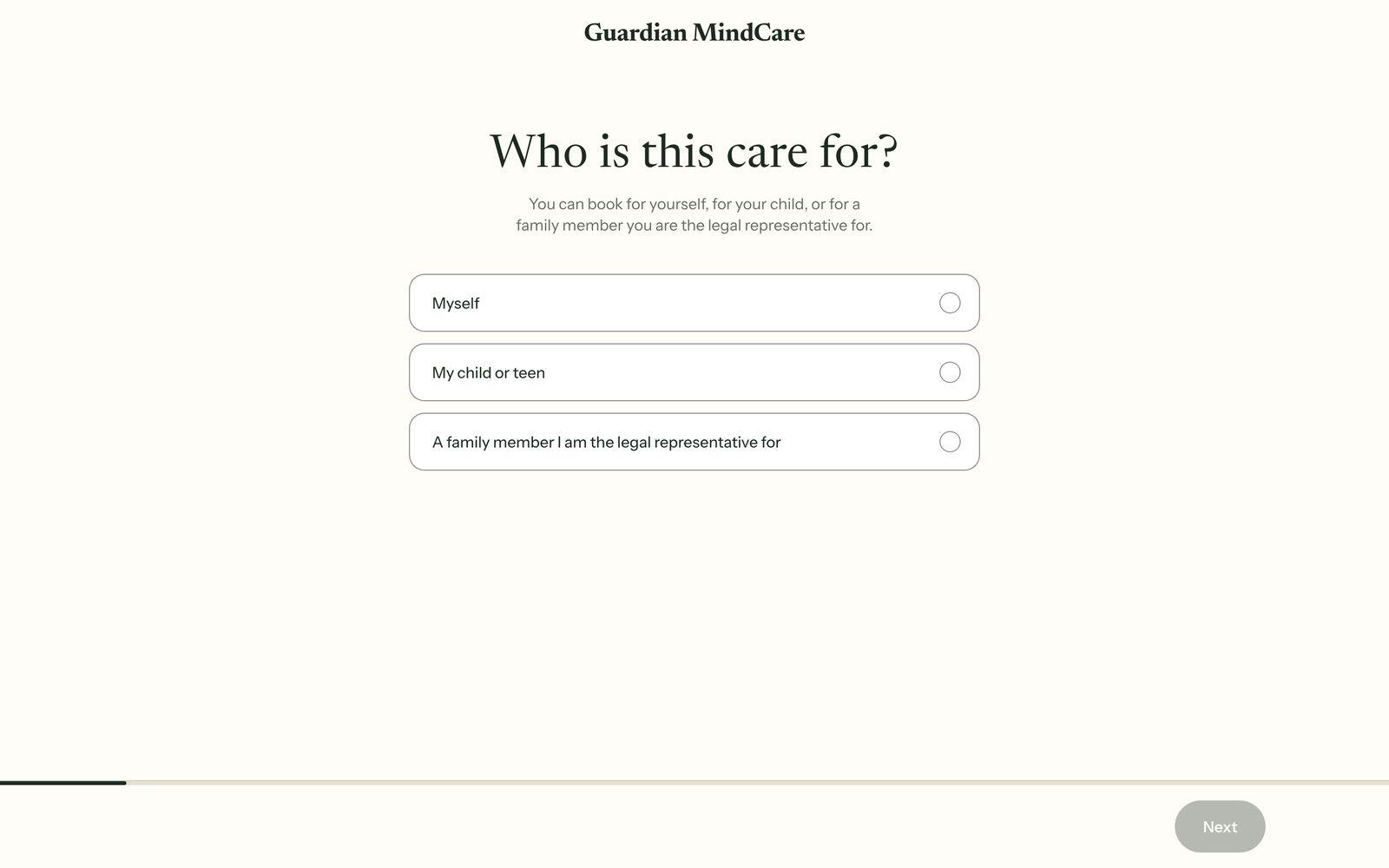
For Guardian MindCare, a therapy practice platform I built, the guiding principle was that the safest data is the data you never collect. The get-matched intake opens with a single gentle question about who the care is for, and clinical detail belongs in the practice's clinical records system rather than in a marketing form.
How do I set up a form that has to handle PHI?
If your workflow genuinely needs health information before the first call, move that step into a system designed and contracted for it rather than stretching a marketing form.
Option 1: keep the website form general and use your clinical system for intake
Best for most practices. The website collects contact details only. After scheduling, the patient completes intake inside your EHR or practice management system's patient portal, which you already have a BAA with.
Option 2: embed a form tool on a HIPAA plan with a signed BAA
Some form builders offer HIPAA-specific plans and will sign a BAA, usually only on particular tiers. Confirm the plan, sign the agreement before collecting anything, turn on encryption and two-factor sign-in, and make sure notification emails do not include the answers.
Option 3: a custom intake built around vendors that sign BAAs
For a practice that needs its own intake flow, I build the form on the site and send submissions only to storage covered by a BAA. The staff notification email says "New inquiry received, sign in to view" and contains no details. Access is limited by role, with every view logged.
On cost, a practice website with a minimal, safe contact form fits my Business Site from $450 in 14 days. Custom intake or portal features fit a Full Custom Build from $1,200, plus whatever the covered vendors charge, which is often more than their standard plans. HIPAA also expects a risk analysis and policies that no website build covers on its own.
What does a safer setup look like in practice?
Here is an illustration with a made-up business: Harbor Street Physical Therapy, a two-location clinic that bills insurance.
Before: the WordPress form asked visitors to "describe your injury," emailed the full message to a shared Gmail inbox, and ran a Meta pixel on every page. The thank-you page URL included the selected service, so "lower back pain" appeared in their ad and analytics data.
After the changes:
- The form asks for name, phone, email, preferred location, new or returning patient, and best time to call.
- A note under the form asks visitors not to share medical details.
- Submissions are stored in a service covered by a BAA, and the staff email only says a new inquiry arrived.
- The pixel and session recording are removed from the contact and thank-you pages, and the thank-you URL carries no answers.
- After the first call, the patient receives a link to the intake forms in the clinic's EHR.
The site looks identical to visitors. Work like this usually takes a few days, and a shorter form is usually easier for visitors to finish anyway.
When should I bring in a lawyer or compliance consultant?
Bring one in before you collect any health information online, before you add marketing tags to a health site, and whenever a vendor's answer about a BAA is vague.
A developer can build the technical controls and tell you where data goes. A developer cannot tell you whether your practice is a covered entity, whether a vendor's agreement is adequate, or what your state adds on top of HIPAA. Be wary of any badge or plugin that promises compliance in one click. Compliance depends on what you collect, which agreements you have signed and how your staff handle the data, not on a logo in the footer.
Useful questions to take to that conversation: Which of our website vendors need a BAA? Can our contact form stay outside PHI entirely? Which tracking tools are acceptable on which pages? Who reviews this each year? If you are also planning the rest of the site, my post "What pages does a small business website need? A page-by-page plan" covers the structure around the form.
The bottom line
A website contact form becomes a HIPAA question the moment it collects health information for a covered entity. The simplest protection is to not collect it: ask for contact details and a general request, tell visitors to leave medical details out, and move clinical intake into a system with a signed BAA. Then check what else runs on those pages, because pixels and inboxes cause more trouble than the form itself. Treat this as a starting checklist, not legal advice, and confirm your setup with a healthcare attorney or privacy officer.
Questions, answered in one line
Is a standard website contact form HIPAA compliant?
Not by default, because most standard form tools and email inboxes are not covered by a business associate agreement and were not set up to handle protected health information.
Does my website form vendor need to sign a BAA?
If the form collects protected health information for a covered entity and the vendor stores or processes those submissions, HHS guidance treats that vendor as a business associate that needs a BAA.
Can I use Google Analytics or a Meta pixel on my medical practice website?
HHS guidance warns that tracking tools on pages where patients schedule appointments or describe their reason for care can disclose protected health information, so keep them off form, intake and thank-you pages unless your attorney approves the setup.
What should a healthcare contact form ask for?
Ask for a name, a phone number or email, a preferred contact time and a general service type, and tell visitors not to include medical details.
Can Thomas Osayi build a privacy-conscious website for a health practice?
Yes, a Business Site from $450 covers a practice website with a minimal contact form, and a Full Custom Build from $1,200 covers custom intake or portal features built around vendors that will sign a BAA.
Sources
- Business Associates U.S. Department of Health and Human Services
- Guidance on HIPAA and Cloud Computing U.S. Department of Health and Human Services
- Use of Online Tracking Technologies by HIPAA Covered Entities and Business Associates U.S. Department of Health and Human Services
- Covered Entities and Business Associates U.S. Department of Health and Human Services
Related articles
- How much does a restaurant website cost in 2026?
- How to take restaurant orders online without third-party fees
- Toast vs Squarespace vs a custom website for restaurants
- Google Business Profile vs website: do you need both?
Custom Next.js websites for businesses
Custom Next.js websites for small businesses, clinics, restaurants and startups. Fast, SEO-ready, built from scratch with booking, ordering or quote tools. Based in Los Angeles.
See the service