Internal data platform
THG Brain
THG Brain puts The Hoop Gang's sales, email, ads, support inbox and creator portal data in one place, synced, searchable and queryable from the team's own Claude.
- Model Context Protocol
- Claude
- Shopify
- Klaviyo
- Gmail
- Meta Ads
- Google Ads
- GA4
The problem
A growing brand runs on numbers that live in different places. Sales are in the store. Email results are in the email platform. Ad spend and results are split across ad accounts. Customer questions arrive in a support inbox, and creator activity sits in the creator portal. Each tool has its own dashboard, and each one answers its own questions well. The questions a team actually asks cross those lines: did that email push sales, which creators are worth another round of gear, what are customers writing in about this week.
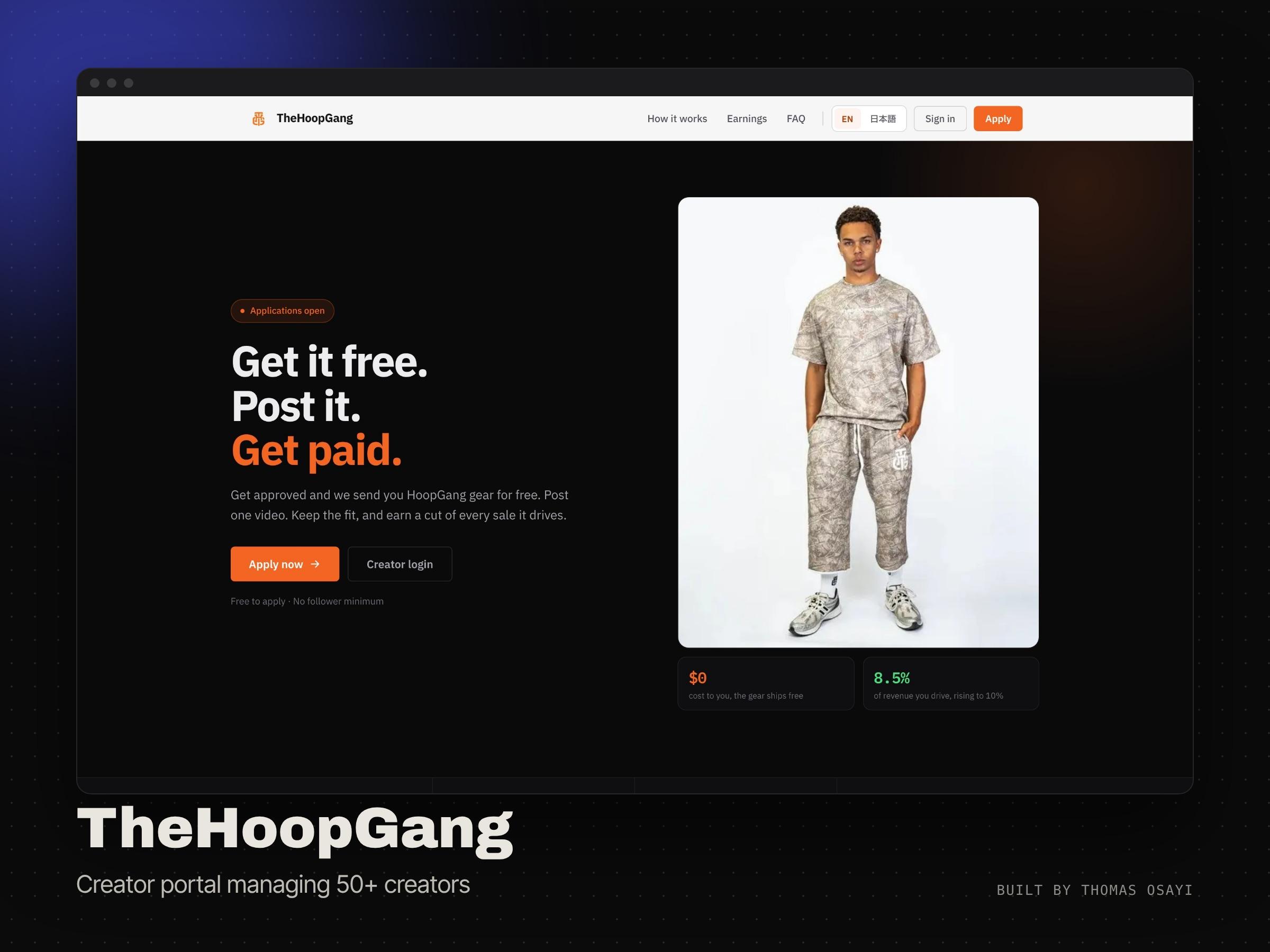
I work as a software engineer at The Hoop Gang, a basketball streetwear brand, and I built THG Brain to close that gap. It is an internal data platform that puts every number THG runs on in one place: sales, email, ads, support inbox and the creator portal, synced and searchable, and queryable straight from the team's own Claude.
What the team needed
- One place that holds the data from every system the business runs on
- Data that stays current without someone exporting spreadsheets
- Search across all of it, not one source at a time
- A way to ask questions in plain language instead of building a report for each one
- Access limited to the people who should have it, with no way to change the source data by accident
How I approached it
Bring the data to one place first, then decide how people ask about it. A question that spans sales and email cannot be answered while the two sit in separate tools, so the foundation of THG Brain is the sync: each source is pulled into one platform where records from different systems can be searched and compared side by side.
Only after that did the question of the interface come up, and the answer was to not build a dashboard for every question. The team already uses Claude. The most useful interface was the one they had open anyway.
What I built
Synced sources
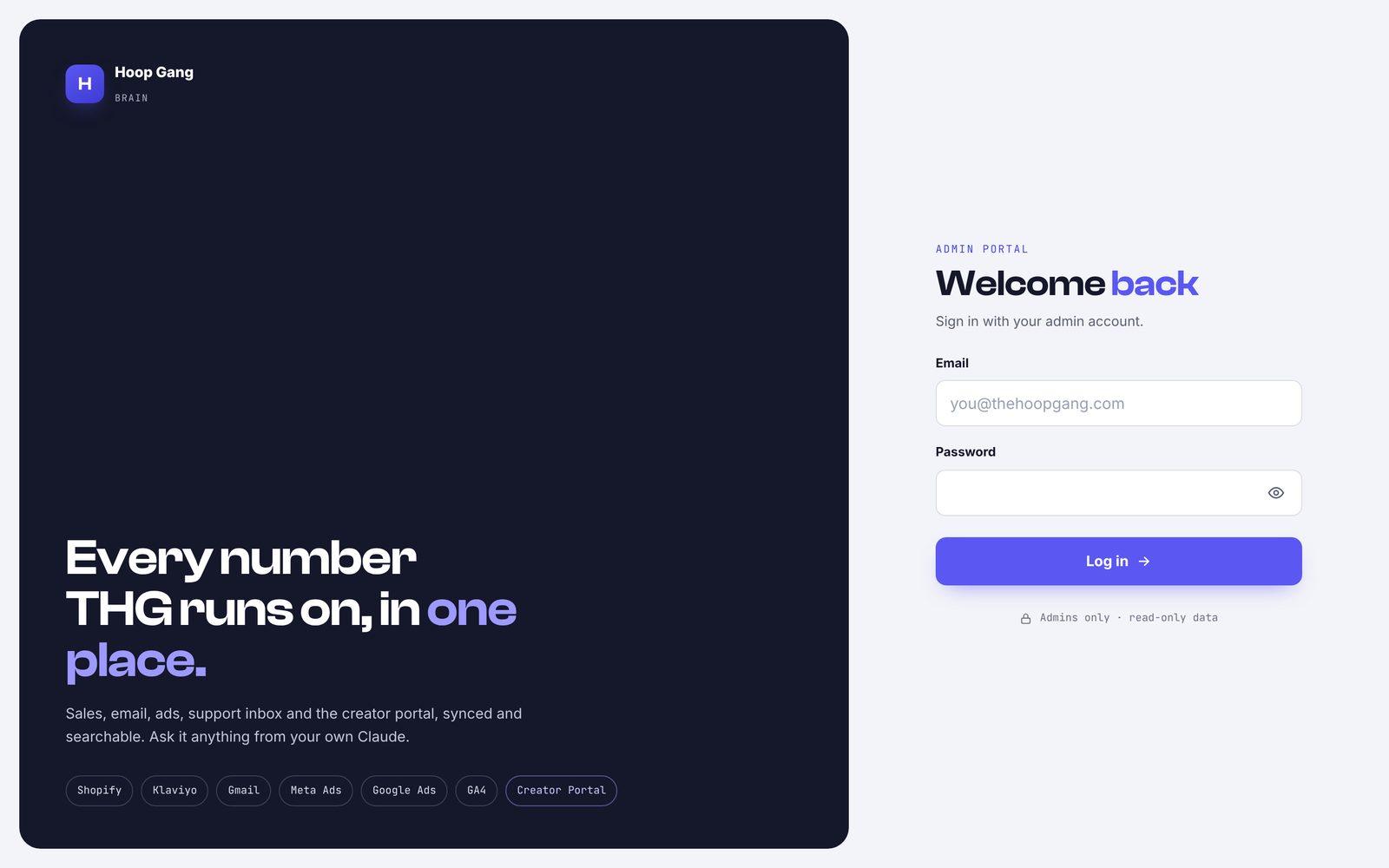
The sign-in screen lists the sources THG Brain brings together: Shopify, Klaviyo, Gmail, Meta Ads, Google Ads, GA4 and the creator portal. Between them they cover the store's sales, email marketing, the support inbox, paid ads on two platforms, website traffic and the brand's creator program.
Syncing means the platform keeps its own copy of the records from each source and keeps it current. That copy is what makes cross source questions possible, and it means a question does not depend on every outside service answering in the moment.
Search across everything
Once the records sit in one place, they can be searched together. A search for a product, a customer issue or a creator can return what each system knows about it, instead of the team opening seven tabs and piecing the story together.
Queryable from Claude
This is the part that changes how the team works. THG Brain is set up so that the team's own Claude can query it directly. Someone on the team asks a question in plain language, and Claude looks up the answer in THG Brain's data rather than guessing.
An admin portal
There is also a web admin portal. The sign-in page marks it as admins only, with read-only data.
How the Claude access works, conceptually
The connection follows the Model Context Protocol pattern, an open standard for giving an AI assistant access to outside tools and data. Here is the idea in plain terms.
- The platform exposes a set of tools. Each tool is a narrow, well described action, such as searching records or pulling performance data for a source over a date range.
- Claude is connected to those tools. When a question comes in, Claude decides which tools to call and with what inputs.
- The tools run against THG Brain's data and return results. Claude reads those results and writes the answer, grounded in the data it just retrieved.
The important part is that Claude is not remembering numbers or making them up. It is calling a tool and reading what comes back, so the answer is only as good as the data the platform holds, which is why the sync came first.
Technical decisions and why
- Sync instead of live calls only. Pulling each source into one platform lets records from different systems be searched and compared together, which live calls to separate services make hard.
- Read-only by design. The sign-in page states read-only data. A platform built to answer questions has no reason to change orders, emails or ad campaigns, so it does not. That removes a whole category of risk from letting an assistant query business data.
- Admins only. The data covers sales, customers and ad spend, so access is limited to admin accounts.
- Narrow tools over a raw database connection. Giving an assistant a small set of clearly described tools keeps its questions inside what the platform is meant to answer, and makes its answers easier to check.
- Use the interface the team already has. Building a chart for every question would never keep up with the questions. Making the data queryable from Claude lets a new question be asked the moment someone thinks of it.
What I would tell a business planning something similar
Get the data into one place before you add AI. An assistant connected to scattered, stale data gives confident answers that are wrong.
Start read-only. You can always add actions later, once you trust the answers. Removing them after a mistake is harder.
Keep the tools narrow and well described. The quality of an assistant's answers depends heavily on how clearly each tool says what it does.
Keep access tight. Business data is sensitive, and the fact that it is easy to ask about makes access control more important, not less.
If you want a first version of a platform like this for your own business, the SaaS MVP development page explains how I scope the first workflow.
The bottom line
THG Brain brings The Hoop Gang's sales, email, ads, support inbox and creator portal data into one synced, searchable, read-only platform, and lets the team ask about all of it from their own Claude. The sync is the foundation, and the Claude connection is what turns that data into answers the team can get by simply asking.
Need something like this?
I build SaaS MVPs and full-stack web apps in Next.js, TypeScript and Firebase or Postgres: auth, dashboards, payments, roles and admin tools. Founder of SQWAD.
SaaS MVP and full-stack web app development