Training program website
Serenity Institute
A Next.js site for Serenity Institute, a live Zoom training program for intervention professionals, with a nine-module curriculum and a founding cohort waitlist.
- Next.js
- React
- Tailwind CSS
- Vercel
Live: serenityintervention.com
The problem
Serenity Institute is a live, instructor-led training program for people who want to become intervention professionals, the people families call when someone they love needs to enter treatment for addiction. The course is taught over Zoom, aligned to the Certified Intervention Professional (CIP) pathway, and capped at 12 seats for its founding cohort.
The site had a specific job. The program was not yet open for enrollment, and pricing and the start date were still being finalized. So the page could not sell a course in the usual way. It had to explain a serious professional program to the right people, earn their trust, and collect a waitlist of qualified, interested applicants the instructor could contact personally.
The audience is also unusually mixed. Some readers come from personal recovery, some from counseling or social work, some are changing careers. Many are approaching a topic that is personal to them. The tone had to be calm and credible, never salesy, and honest about what the program does and does not provide.
The footer identifies Serenity Institute as a division of HNO Consulting, the consultancy I freelance through.
What I built
A single-page Next.js site with sections for the program pillars, the curriculum, the instructor, the format, a detailed waitlist form and an FAQ.
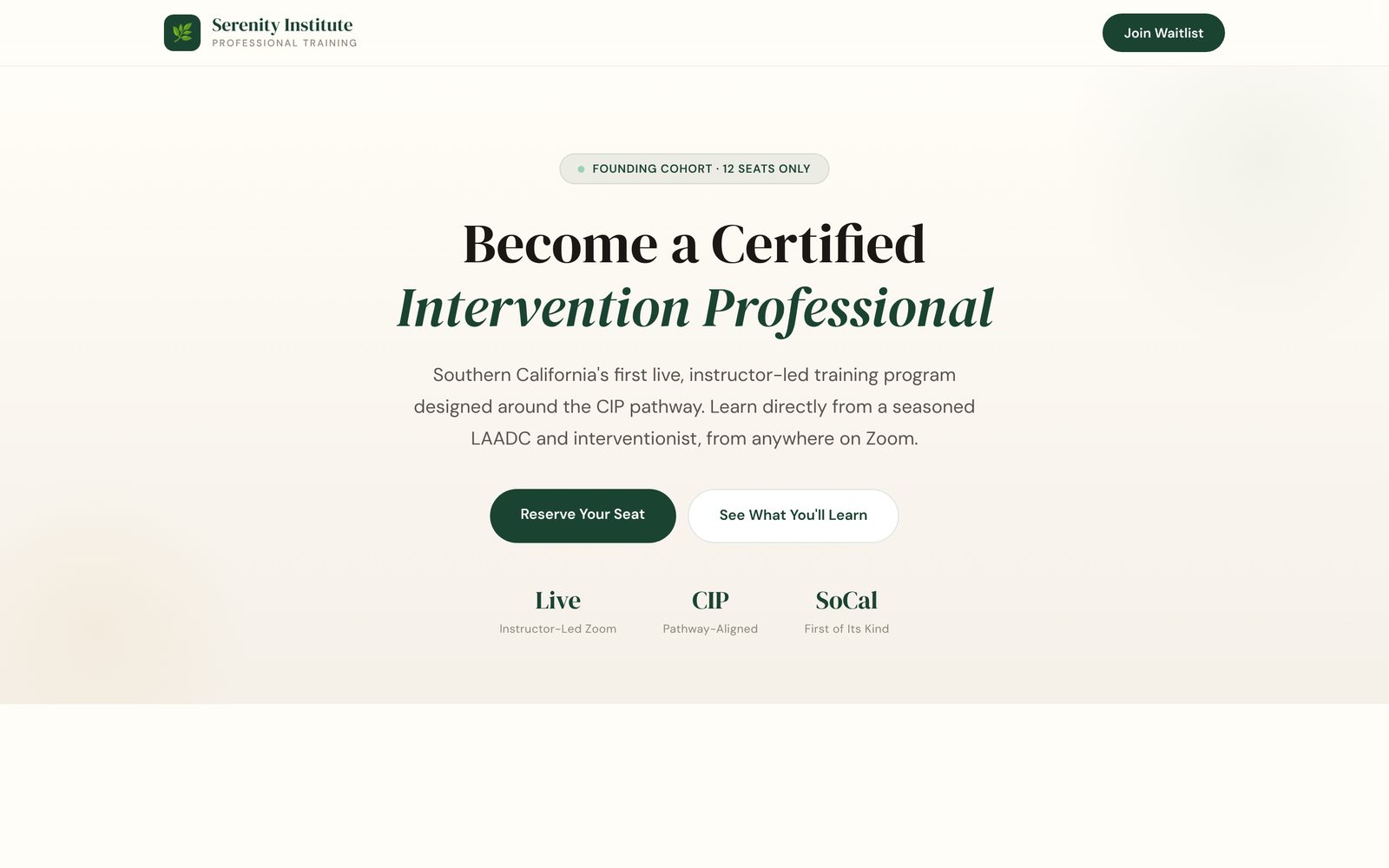
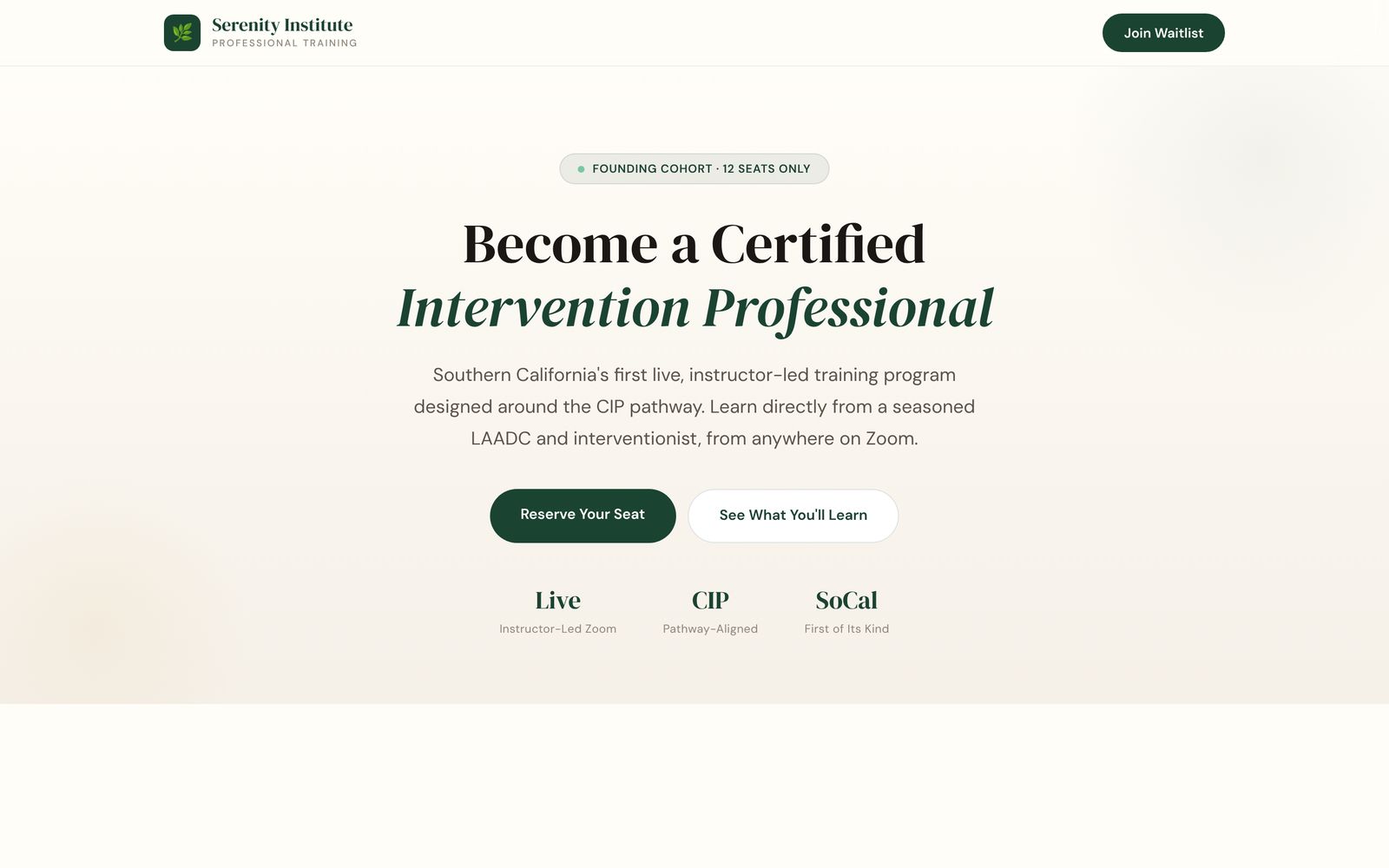
A hero with a clear promise and a clear limit
The hero reads "Become a Certified Intervention Professional", with a short line about live, instructor-led training on Zoom and a small tag above it: founding cohort, 12 seats only. Two buttons lead to the waitlist or the curriculum. Under them, three short markers summarize the program: live instructor-led Zoom, CIP pathway aligned, and based in Southern California.
The scarcity is real (the cohort is small by design), so it belongs in the hero. It tells a visitor this is a cohort with a start, not an on-demand video library.
Four program pillars
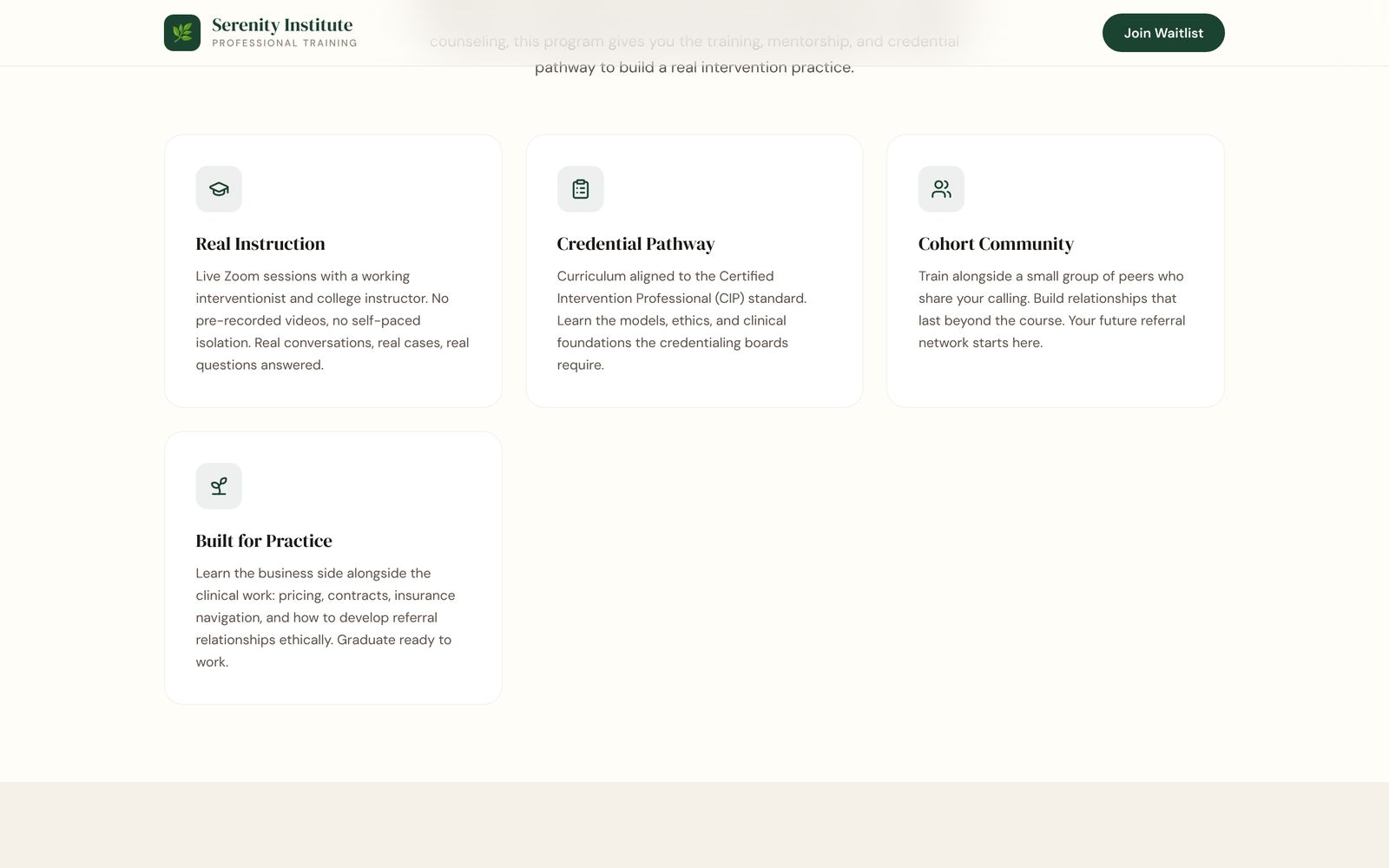
"A serious program for serious practitioners" introduces four cards: real instruction in live sessions with a working interventionist, a credential pathway aligned to the CIP standard, a small cohort community that can become a referral network, and training on the business side of the work, such as pricing, contracts and insurance navigation.
Each pillar answers a doubt a careful buyer has about online training: is it just recorded videos, does it lead anywhere, will I be alone, and can I actually make a living from it.
A curriculum you can actually read
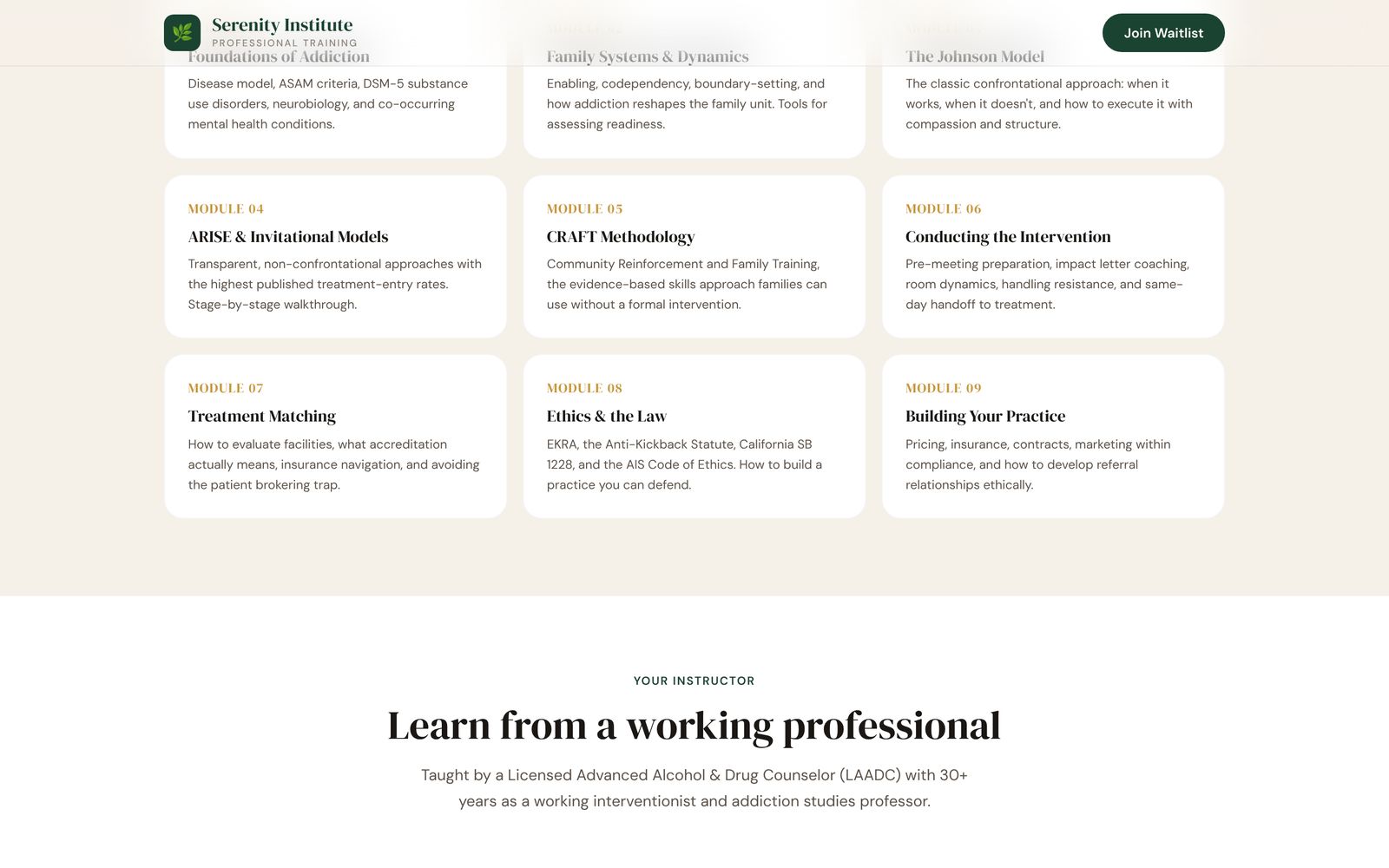
The curriculum lists nine modules, each with a number, a title and a short description: foundations of addiction, family systems, the Johnson model, ARISE and invitational models, CRAFT, conducting the intervention, treatment matching, ethics and the law, and building a practice.
I gave the curriculum its own full section instead of a bullet list in a sidebar. For a professional program, the syllabus is the product. A prospective student reading "EKRA, the Anti-Kickback Statute, California SB 1228, and the AIS Code of Ethics" in the ethics module learns more about the course's seriousness than any headline could tell them.
Instructor and format
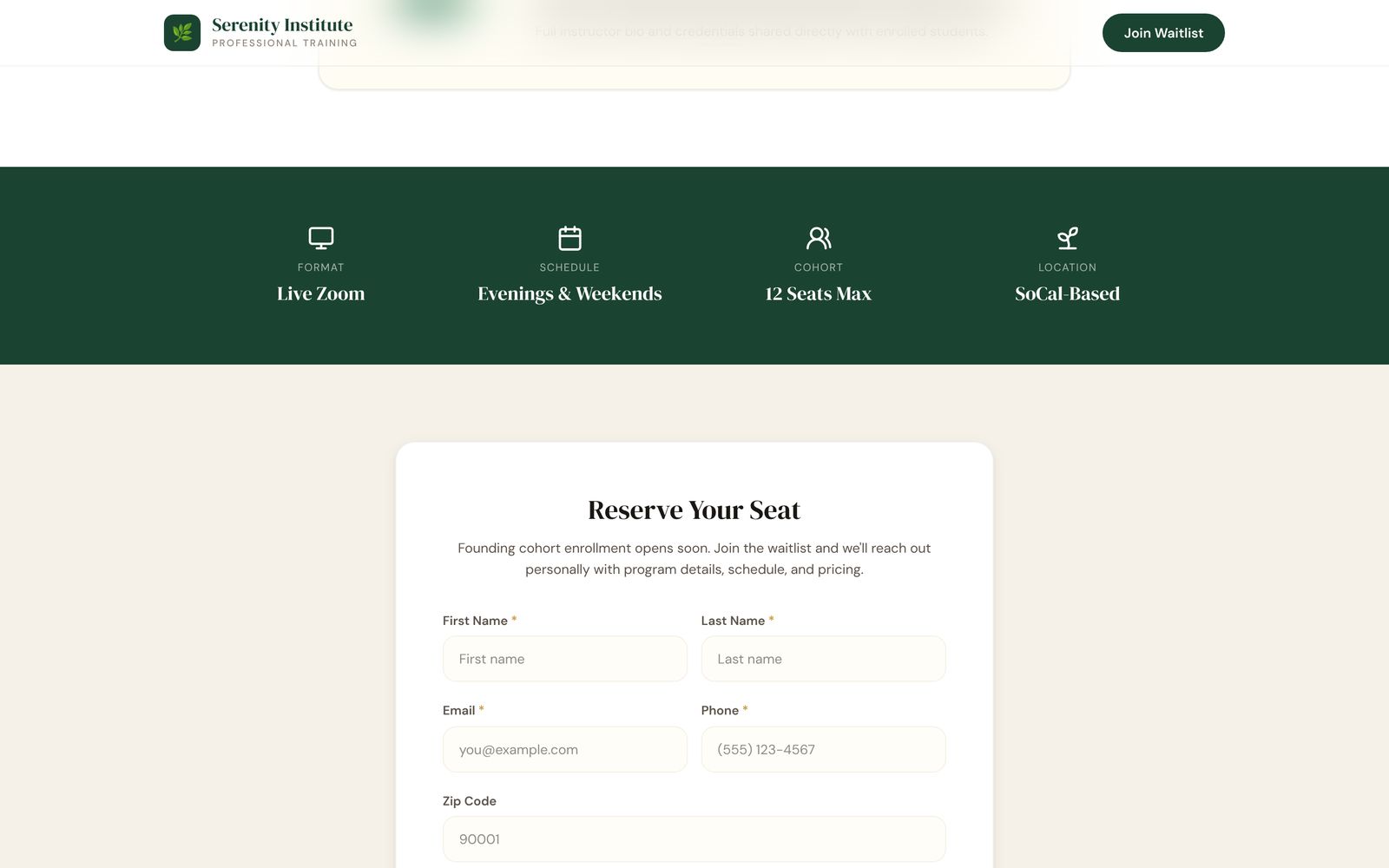
The instructor section describes a Licensed Advanced Alcohol and Drug Counselor (LAADC) with more than 30 years as a working interventionist and addiction studies instructor, and notes that the full bio is shared directly with enrolled students. Below it, four short facts set expectations: live Zoom, evenings and weekends, 12 seats maximum, and a Southern California base.
A waitlist form built for a personal follow-up
The waitlist form is the core of the site. Beyond name, email, phone and zip code, it asks whether the person is in personal recovery (with ranges and a prefer not to say option), their current background, which class times work for them, how they heard about the program and, optionally, why they want to become an interventionist.
Each of those questions exists for a reason. Recovery time matters because many credentialing boards expect a minimum period of sobriety, which the FAQ explains. Background and preferred times help the instructor plan the cohort and its schedule. The referral question shows which channels are working, with options like a flyer at a meeting or a friend's referral. The open question is optional so it never blocks someone from joining.
Under the button, a note says the information is confidential, that joining the waitlist is not a commitment to enroll, and that the CIP credential is issued by the Pennsylvania Certification Board, not by the program. When the form is sent, it is replaced by a "You're on the list" message explaining that program details, schedule and pricing will come before public enrollment opens.
An FAQ that is honest about credentials
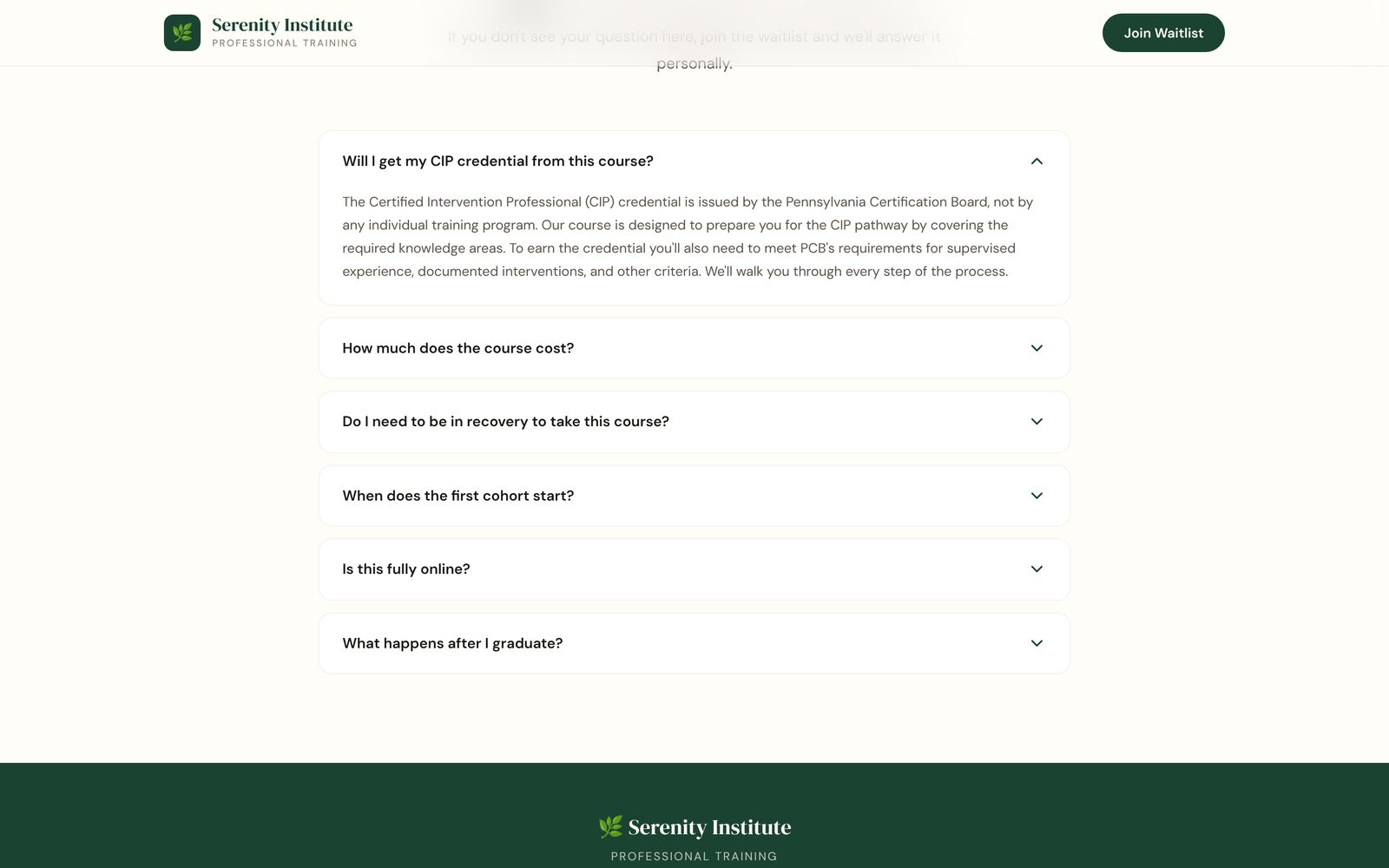
The FAQ answers the questions a careful applicant asks: will I get the CIP from this course, what it costs, whether I need to be in recovery, when the first cohort starts, whether it is fully online and what happens after graduation. The credential answer is direct. The course prepares students for the CIP pathway, and the credential itself requires meeting the Pennsylvania Certification Board's own requirements.
Technical decisions and why
- Next.js. The page is prerendered and served as static HTML, which the live site's response headers confirm. Text appears immediately, and search engines see the full curriculum and FAQ as plain content.
- A server route for the waitlist. The form posts its data as JSON to the site's own API route instead of a third-party form widget. The browser checks that the required fields are filled before sending, and the server response decides whether the visitor sees the confirmation or an error message they can act on. Keeping submission on the site's own route means applicant details go where the program decides, and the form looks like the rest of the page.
- Clear error and success states. If the request fails, the form shows the message and keeps everything the person typed. For a form this long, losing answers to a network hiccup would cost a sign-up.
- Tailwind CSS. The site's warm palette (forest greens, sand and earth tones) is defined once as theme tokens and used through utility classes, which kept spacing and colors consistent across the cards, form fields and FAQ.
- Web fonts chosen for tone. DM Serif Display for headings and DM Sans for body text, loaded from Google Fonts. A serif headline reads calm and established, which suits a program asking people for trust.
- Vercel. The site is deployed on Vercel, so copy changes can be checked on a preview link before they go live. That matters on a site where wording around credentials has to be exact.
What I would tell someone planning something similar
If you are not ready to take payments, build a waitlist page, not a sales page. A waitlist lets you launch before pricing and dates are final, and it gives you a list of people to talk to personally.
Ask the questions that help you plan, and make the personal ones optional or give a prefer not to say option. Every field should earn its place.
Publish the full curriculum. For professional training, the syllabus does more selling than any tagline.
Be precise about credentials. If a third party issues the certification, say so in the form note, the FAQ and the footer. Overstating what a course grants is the fastest way to lose a serious applicant's trust, and wording around credentials is worth having the instructor check line by line. This is general guidance, not legal advice.
Handle form failures gracefully. Show a clear message and never clear what the person typed.
A one-page site with a working waitlist form fits the Business Site package on my services page, and the website cost calculator gives a quick estimate for a different scope.
Need something like this?
Custom Next.js websites for small businesses, clinics, restaurants and startups. Fast, SEO-ready, built from scratch with booking, ordering or quote tools. Based in Los Angeles.
Custom Next.js websites for businesses