November 22, 2026 · 9 min read · Thomas Osayi
How to validate a SaaS idea before you build it
Practical ways to validate a SaaS idea before paying for a full build: customer interviews, landing page tests, concierge MVPs, pre-sales and a cheap first version.
Most of the SaaS ideas people bring me are reasonable. The problem is rarely that the idea is bad. It is that nobody has checked whether a specific group of people has the problem badly enough to pay for a fix, and the first real test is a finished product that took three months and most of the budget.
You can run that test much earlier and much more cheaply. Here is how I would validate a SaaS idea before building it, in the order I would do it, with the signals that count and the ones that only feel like they count.
How do you validate a SaaS idea before building it?
You validate it by collecting evidence, in rising order of cost to the customer, that a specific group has the problem and will pay for your way of solving it.
Think of it as a ladder. Each rung asks the customer for a bit more:
- Talking to you about the problem: costs them 20 minutes.
- Leaving an email on a landing page: costs them almost nothing.
- Booking a call or demo: costs them a calendar slot.
- Using a manual or rough version: costs them effort and trust.
- Paying, even a deposit: costs them money.
The higher the rung, the more the evidence is worth. Compliments are free, so they prove nothing. A payment from someone who does not know you proves a lot.
The ladder also tells you what to build. You do not need software for the first three rungs. You may not need much for the fourth. Software becomes necessary when the manual version cannot keep up, which is a good problem to have.
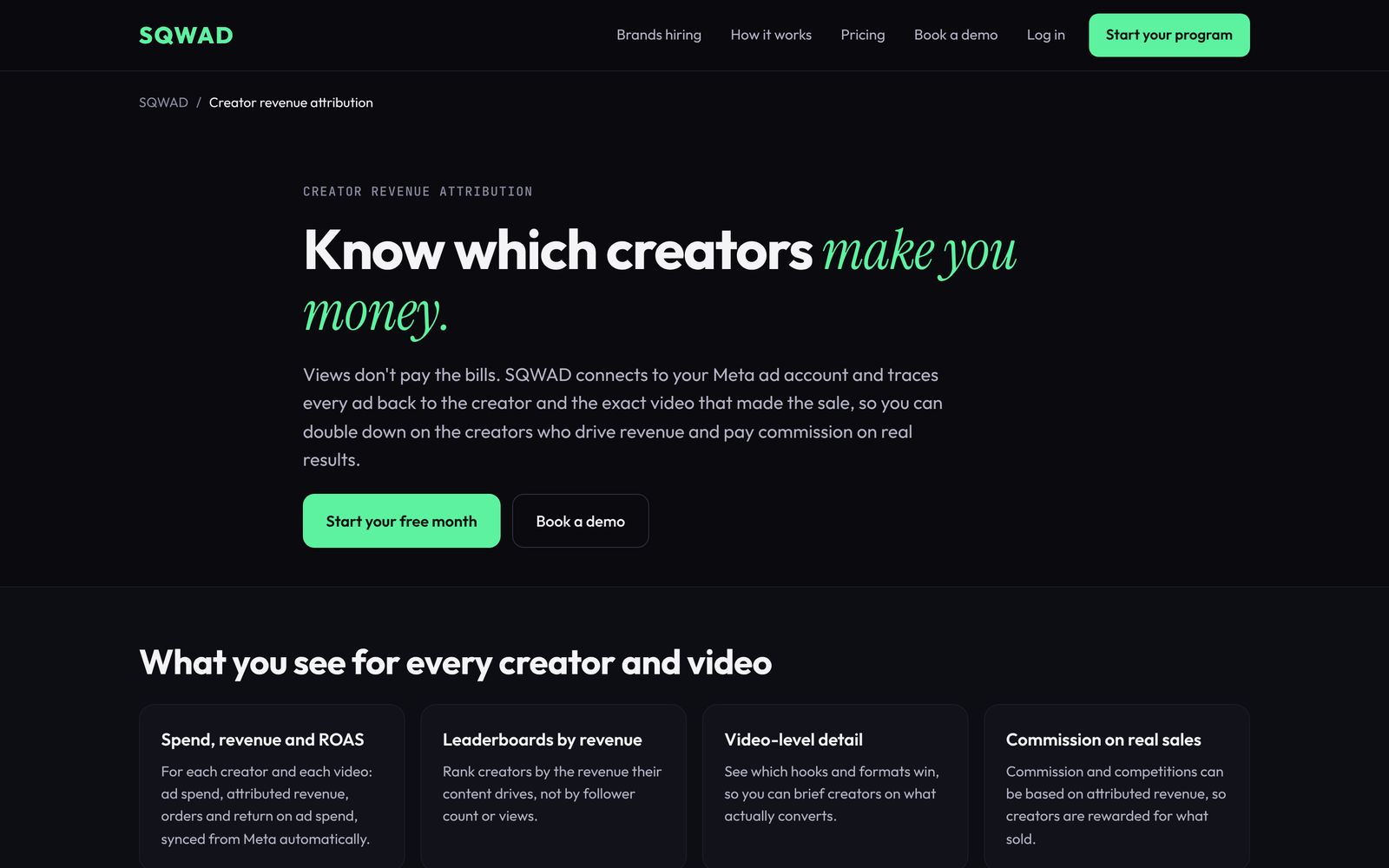
I learned this from my own product. SQWAD started because I had built a custom creator portal for TheHoopGang, a basketball streetwear brand, and saw the same needs come up that any brand running creators would have. The first version of SQWAD did one thing: let a brand see which creator drove a sale. Everything else came later.
How do I run customer interviews that tell the truth?
Ask about what people did recently and what they use today, never about whether they would use your idea.
People are kind in interviews. Ask "would you use an app that does this?" and most will say yes, because saying no to your face is awkward. Ask about the past instead, and you get facts:
- "Tell me about the last time this problem came up. What happened?"
- "How do you handle it today? Spreadsheet, another tool, someone on staff?"
- "What does that cost you, in time or money, each week?"
- "Have you looked for a better way? What did you try, and why did you stop?"
- "Who else is involved when this goes wrong?"
Strong signs: they already pay for a clumsy workaround, they have built a spreadsheet or hired someone to cope, they describe the problem before you do, and they ask when they can try your version. Weak signs: polite enthusiasm, "that would be cool", and feature ideas that are not tied to a real event.
Find interviewees where the problem lives: industry forums, LinkedIn, local businesses, past colleagues. Avoid friends and family, who are the kindest audience of all. Keep notes in one document and look for repeated phrases. The words people use to describe the problem become your landing page copy later.
Stop interviewing when you stop learning, when the same problems, workarounds and objections keep coming back.
Does a landing page test prove anything?
A landing page proves that a message attracts interest, but on its own it does not prove anyone will pay.
A simple test: a one-page site that states the problem in your interviewees' words, explains the outcome, shows a rough screenshot or mockup, and asks for one action. Send targeted traffic to it, from communities you joined, direct outreach or a small ad budget, and measure what people do.
The action you ask for decides what you learn:
- Email signup: weak. It measures curiosity.
- Book a 15 minute call: better. People rarely give time to things they do not care about.
- Join a paid pilot or place a refundable deposit: strongest, because it costs money.
Stripe Payment Links make the strongest version easy to run. You create a payment page in the Stripe dashboard without writing code and put the link behind your button. You can also limit how many purchases a link accepts, which suits a founding customer offer with a fixed number of spots.
Be honest on the page. Say the product is in development, say when you expect it to be ready, and say deposits are refundable. A test that tricks people is not validation; it is just a misleading page, and the trust you lose costs more than the data is worth.
If you only need the page, my Starter Site package from $150 covers a one-page site in about 7 days. I also wrote "Landing page vs website: which do you need?" if you are deciding what to put up first.
What is a concierge MVP and when should I use one?
A concierge MVP delivers the result your software promises, but done by hand, so you can test whether customers want the outcome before automating it.
Say your idea is software that turns a contractor's job notes into a client-ready quote. Instead of building it, you offer the service: contractors email you their notes, you write the quotes yourself in a template, and send them back within a few hours. The customer gets the outcome. You learn exactly what the inputs look like, which steps take time, and what the customer actually values.
Paul Graham's essay "Do Things that Don't Scale" makes the broader case: early startups often get going by doing labour-intensive things by hand, like recruiting users one by one and giving them unusual attention. A concierge MVP is that idea applied to the product itself.
Use one when:
- The outcome is clear but the right workflow is not.
- You can deliver it manually for 5 to 20 customers without drowning.
- Customers care about the result more than the interface.
The concierge phase ends when you are spending your days repeating the same manual steps. Those steps are your product specification, written by real customers.
Should I ask for money before the product exists?
Yes, if you are honest about what exists, when it will ship, and that you will refund if you do not deliver.
Pre-selling is the clearest test there is. A founding customer offer, such as a discounted first year or a paid pilot with a refund guarantee, separates people who like the idea from people who need it. A handful of committed buyers who match the same profile is a stronger reason to build than hundreds of email signups.
How to do it well:
- Describe the first version precisely, including what it will not do yet.
- Give a delivery window you can meet, and update buyers if it moves.
- Promise refunds in writing and make them easy. Stripe lets you refund all or part of a payment from the dashboard, though its processing fee on the original charge is not returned, so treat that as a small cost of the test.
- Keep the number of founding customers small enough that you can serve each one personally.
If nobody will pay even a deposit after a good conversation, that is useful news. It is far cheaper to learn it now than after a launch.
What counts as a real signal, and what does not?
Real signals cost the customer something; false signals cost them nothing.
Signals I trust:
- Payments, deposits or signed pilot agreements.
- People introducing you to colleagues who have the same problem.
- Users who keep using a rough version without being reminded.
- Specific complaints about the rough version, because people only complain about things they intend to use.
Signals that mislead:
- Compliments, likes and "I would totally use this".
- Email lists built from giveaways.
- Interest from people who are not the buyer, such as staff who would use the tool but cannot approve the spend.
- Investor or friend enthusiasm without customer evidence.
Also check who pays. In B2B products, the user and the buyer are often different people, and you need both to care.
A worked example: validating a scheduling tool for tutoring centers
This is an illustration, not a client story. A founder believes small tutoring centers waste hours each week juggling tutor availability, student sessions and parent reminders in spreadsheets and group texts.
Week one, they interview a dozen center owners about the last scheduling mess they had. Most use a shared spreadsheet plus texts. Several mention parents missing sessions as the real cost, more than scheduling itself. That changes the pitch from "scheduling" to "fewer no-shows".
Week two, they put up a one-page site with the no-show message, a mockup and a "founding center" offer: a refundable deposit for a discounted first year, limited to ten centers. They send it to interviewees and local owner groups. Four centers pay the deposit.
Weeks three and four, they run a concierge version for those four: the founder manages each center's schedule in a shared calendar and sends reminder texts by hand. They learn that reminders and rescheduling matter most, and that tutors care about seeing their week on a phone.
Only then do they build: one workflow, booking plus automatic reminders, for four customers who are already paying.
When is it time to build, and how small should the first build be?
Build when the manual version cannot keep up or when paying customers are waiting, and build only the workflow the evidence supports.
The first build should do one job end to end for the people who already committed. In the tutoring example, that is sessions, availability and reminders, not invoicing, reports or a parent app.
That size is what my MVP Starter package is for: from $250 over about 7 days for a working first version of one workflow. It is a cheap way to put real software in front of real users. If the evidence supports a broader product with sign-in, a dashboard, a database and payments, the SaaS MVP from $1,200 over about 21 days covers it. I wrote about where those budgets go in "How much does an MVP cost? SaaS MVP prices and what drives them".
Mistakes that waste months
The expensive mistakes all come from building before asking.
- Asking "would you use this?" instead of "what did you do last time?"
- Interviewing friends, then treating their kindness as demand.
- Building every feature from every interview instead of the one that kept repeating.
- Picking a market so broad, "small businesses", that no message fits anyone.
- Treating email signups as customers.
- Hiding the price until launch, then finding out nobody will pay it.
- Waiting for the product to be perfect before letting anyone use it.
The bottom line
Validate a SaaS idea by climbing the ladder: interviews about real past events, a landing page that asks for something real, a concierge version done by hand, and an honest pre-sale with refunds. Each rung costs you little and tells you more. When people are paying and the manual version is creaking, build the smallest working version of the one workflow they paid for, and let their use of it decide what comes next.
Questions, answered in one line
How many customer interviews do I need to validate a SaaS idea?
There is no magic number; keep interviewing until the same problems, workarounds and objections repeat and you stop hearing new things.
Is a landing page with an email signup enough validation?
No. Email signups show curiosity, so add a step that costs something, such as booking a call, joining a paid pilot or placing a refundable deposit.
What is a concierge MVP?
A concierge MVP delivers the result your software would deliver, but by hand, so you can test whether customers want the outcome before automating it.
Should I pre-sell my SaaS before building it?
Pre-selling is the strongest test if you are honest about what exists and when it will ship, and you offer refunds if you do not deliver.
What is the cheapest way to build a first version for testing?
Thomas Osayi builds an MVP Starter from $250 in about 7 days, a working first version of one workflow that real users can try.
Sources
- Do Things that Don't Scale Paul Graham
- Accept payments online without writing code (Payment Links) Stripe Documentation
- Refund and cancel payments Stripe Documentation
Related articles
- How to scope an MVP: one workflow, three lists and the cuts that matter
- Multi-tenant SaaS with Firestore: data layout, security rules and custom claims
- Web app vs mobile app for your MVP: which to build first
- PWA vs native app in 2026: what a web app can do on iPhone now
SaaS MVP and full-stack web app development
I build SaaS MVPs and full-stack web apps in Next.js, TypeScript and Firebase or Postgres: auth, dashboards, payments, roles and admin tools. Founder of SQWAD.
See the service