November 23, 2026 · 9 min read · Thomas Osayi
Stripe vs Paddle vs Lemon Squeezy for SaaS billing: fees, tax and who should use what
Stripe vs Paddle vs Lemon Squeezy for SaaS billing: merchant of record vs processor, sales tax and VAT, fees, payouts, and what the Lemon Squeezy shutdown means.
Billing is the part of a SaaS MVP where a small decision becomes expensive to undo. Once customers have saved cards and active subscriptions with one provider, moving them is a project of its own. So it is worth spending an hour on this choice before the first payment, not after.
The three names that come up most for SaaS billing are Stripe, Paddle and Lemon Squeezy. They are not three versions of the same thing. Stripe is mainly a payment processor, where you stay the seller. Paddle is a merchant of record, which means it becomes the seller and takes the tax work off your plate. Lemon Squeezy was a merchant of record popular with indie founders, and its situation changed this month. If you have already picked Stripe and want the setup steps, "Setting up Stripe subscriptions for a SaaS MVP: what you actually need" covers that. This post is about choosing.
What is the difference between Stripe, Paddle and Lemon Squeezy?
The difference is who legally sells your product: with Stripe's standard products you are the seller, while Paddle and Lemon Squeezy act as the merchant of record and sell on your behalf.
That one distinction drives everything else. When you are the seller, your company is responsible for charging the right sales tax or VAT in each place you have an obligation, registering where required, filing returns and dealing with chargebacks. Stripe gives you tools for much of that, but the responsibility stays with you.
When a merchant of record sells for you, the customer's receipt shows the merchant of record, it charges and remits the tax, and it pays you the net amount. You trade a higher fee and less control for a lot less compliance work.
Stripe now also offers both models. Alongside its normal processing, Stripe Managed Payments makes Stripe the merchant of record for eligible digital products.
And then there is the news. On November 16, 2026, Lemon Squeezy announced that it has closed new store sign-ups and will stop processing payments on March 31, 2027, and that it will not extend that date. Its suggested path for eligible sellers is Stripe Managed Payments. For a new SaaS, that takes Lemon Squeezy off the list.
What is a merchant of record, and do you need one?
A merchant of record is the legal seller in each transaction, and you need one most when you sell to consumers or businesses in many countries and do not want to manage tax registrations yourself.
Here is what a merchant of record typically handles that you would otherwise own:
- Calculating and charging sales tax, VAT or GST at checkout.
- Registering, filing and remitting those taxes in each jurisdiction.
- Fraud screening, disputes and chargebacks.
- Buyer support for payment questions and refunds.
The cost is a bigger cut of each sale and less flexibility. Merchant of record platforms limit what you can sell. Stripe Managed Payments, for example, supports digital products such as software, SaaS and online courses, and excludes physical goods and professional services such as consulting or development work. It also does not support Stripe Connect, so it is not a fit for marketplaces.
You probably do not need one if you sell mostly to US businesses from a US company, have a handful of customers abroad, and are comfortable using Stripe Tax and an accountant. You probably do want one if you sell a low-priced subscription to consumers in Europe, the UK and beyond from day one.
This is general information, not tax or legal advice. Tax obligations depend on your company, your customers and where they are, so check with an accountant before you rely on any setup.
Stripe and Stripe Managed Payments, option by option
Stripe is the most flexible option and the one most SaaS tools are built around, and Managed Payments now adds a merchant of record mode for digital products.
Stripe (processor, with Billing and Tax)
- Best for: US-based SaaS selling mainly to businesses, marketplaces that need Connect, and products with custom billing such as usage-based pricing or invoices.
- Cost range: at the time of writing, 2.9% plus 30 cents per successful US card payment, plus 1.5% for international cards and 1% when currency conversion is needed. Stripe Billing adds 0.7% of billing volume on pay as you go. Stripe Tax Basic is 0.5% per transaction on the no-code setup.
- Pros: the deepest API and documentation; Checkout, the customer portal and webhooks cover most MVP needs; Connect for marketplaces; works with nearly every SaaS tool.
- Cons: you are the seller, so tax registration and filing are your job; fees stack once you add Billing and Tax; more decisions to make up front.
Stripe Managed Payments
- Best for: digital products and SaaS sold to customers worldwide by a business based in a supported country, including the US, Canada, much of Europe, the UK, Australia, Hong Kong, Japan and Singapore.
- Cost range: 3.5% per successful transaction on top of the normal payment fees, at the time of writing.
- Pros: Stripe becomes the merchant of record and handles sales tax, VAT and GST in more than 80 countries, plus fraud, disputes and transaction-level customer support; you keep Stripe's tooling.
- Cons: eligibility review; digital products only; subscriptions must be created through Checkout or Payment Links; no Connect; some advanced integrations are not supported.
Paddle and Lemon Squeezy, option by option
Paddle is the established independent merchant of record for software, and Lemon Squeezy is now a platform to migrate away from rather than one to join.
Paddle
- Best for: SaaS selling to consumers or small businesses internationally, where tax compliance would otherwise eat founder time.
- Cost range: 5% plus 50 cents per checkout transaction at the time of writing, with no monthly fee; products under $10 need custom pricing.
- Pros: merchant of record with tax collection, filing and remittance included; fraud, chargebacks and buyer support handled; subscription and payment method migration offered at no added cost.
- Cons: a bigger cut than Stripe's card fee on low-volume plans; you cannot withdraw on demand, because payouts run monthly; less control over checkout and receipts.
Lemon Squeezy
- Best for: existing sellers planning a migration. It is not accepting new stores.
- Cost range: 5% plus 50 cents per transaction until it stops processing on March 31, 2027.
- Pros: still works for current stores until the deadline; migration tooling was announced for December 2, 2026, plus a data export guide and a migration intake form.
- Cons: shutting down; Stripe Managed Payments is not available in every country Lemon Squeezy supported, so some sellers will need another provider.
What do the fees look like on a $49 plan?
On a $49 monthly plan paid by a US card, Stripe with Billing comes to roughly $2.06 a month per customer before tax tools, while Paddle comes to $2.95 with tax handling included.
This worked example uses the list prices at the time of writing and ignores refunds, disputes and negotiated rates.
- Stripe card fee: 2.9% of $49 is $1.42, plus 30 cents, so $1.72.
- Stripe Billing at 0.7%: about 34 cents. Running total about $2.06.
- Stripe Tax Basic at 0.5%: about 25 cents. Running total about $2.31, and you still file the returns.
- Stripe Managed Payments at 3.5%: about $1.72 on top of the payment fees, so roughly $3.43 before Billing.
- Paddle at 5% plus 50 cents: $2.45 plus 50 cents, so $2.95, with filing handled.
For an international customer, Stripe adds 1.5%, about 74 cents, which narrows the gap further. On a $9 consumer plan the fixed 50 cents makes the merchant of record options much more expensive in percentage terms, so model your real price points.
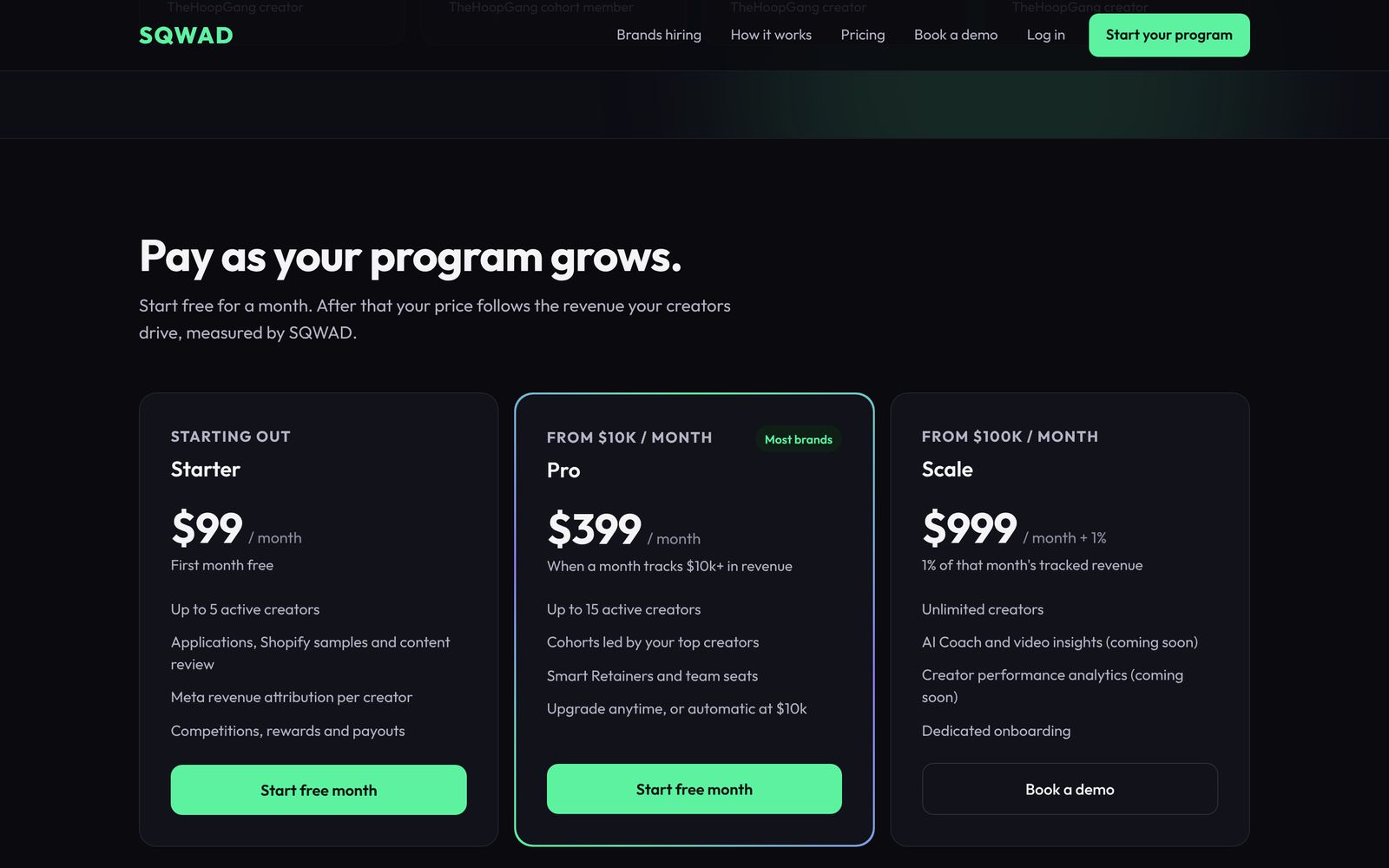
SQWAD, my creator program software, has a tier with a percentage on top of a flat monthly price. If your pricing looks like that, check that your billing provider can charge the variable part cleanly before you pick it, because usage and revenue-based charges are where providers differ most. "SaaS pricing models compared: flat, per-seat, tiered, usage-based and revenue-based" goes deeper on the models themselves.
How and when do you get paid?
Stripe pays out on a schedule you choose, typically from two business days after a US card payment, while Paddle pays monthly once your balance passes a threshold.
Stripe's docs say US card funds typically settle in two business days, and the first payout on a new account usually completes within 7 to 14 days of the first live payment. After that you can choose daily, weekly, monthly or manual payouts.
Paddle works differently. On the first of each month, if your balance is over the threshold (by default $100, or the equivalent in pounds or euros), it becomes a payout. Paddle sends it by the 15th by wire transfer or Payoneer, and it can take up to three working days to arrive. Some countries incur a $15 SWIFT fee.
Lemon Squeezy paid out twice a month while it operated normally. Check its migration guidance for how final payouts are handled.
For a young SaaS, the monthly rhythm matters for cash flow. If you need revenue in the bank within days, a processor model is easier.
Which billing provider should you pick?
For most new SaaS products in 2026 the choice is between Stripe as a processor, Stripe Managed Payments and Paddle, and the deciding question is who you sell to.
- US company selling mainly to US businesses: Stripe with Billing, plus Stripe Tax when you have obligations. This is what I set up most often.
- Marketplace or platform paying out to sellers: Stripe with Connect. Merchant of record products do not support it. "Stripe Connect payouts for a marketplace" explains the setup.
- Solo founder selling a subscription to consumers worldwide: Paddle or Stripe Managed Payments, so tax registration is not your problem.
- Existing Lemon Squeezy seller: start the migration now. Use Stripe Managed Payments if your business location is supported, and look at Paddle or another merchant of record if it is not.
- Selling services, coaching or physical goods: not a merchant of record product. Use Stripe as a processor.
Mistakes to avoid when choosing billing
The most expensive mistakes are choosing on headline fee alone and treating payment success as the only event your app needs to handle.
- Ignoring tax until a customer asks for a VAT invoice.
- Choosing a merchant of record for a product it does not support, such as consulting bundled with software.
- Building checkout before deciding on monthly versus annual plans and trials.
- Not handling failed renewals and cancellations through webhooks, so access never changes. "Stripe payment went through but your app did not update? Fix the webhook" covers the usual cause.
- Skipping a full test of live mode. "Stripe test mode to live mode: the checklist I use before taking payments" is the list I run.
The bottom line
Stripe keeps you in control and is the cheapest per transaction on US business sales, but you own tax compliance. Paddle and Stripe Managed Payments cost more per sale and take tax, fraud and disputes off your plate as merchant of record. Lemon Squeezy is closing on March 31, 2027, so do not start there. Pick based on who your customers are and where they live, then set up webhooks and live-mode testing properly. If you want billing built into your MVP, my SaaS MVP package from $1,200 includes payments.
Questions, answered in one line
What is a merchant of record?
A merchant of record is the company legally selling to your customer, so it charges the right sales tax or VAT, files the returns, handles disputes and then pays you what is left.
Is Paddle more expensive than Stripe?
Paddle's 5% plus 50 cents is higher than Stripe's card fee alone, but it includes tax collection and filing that you would otherwise pay for separately in software, registrations and accountant time.
Is Lemon Squeezy shutting down?
Yes, Lemon Squeezy announced in November 2026 that it has closed new store sign-ups and will stop processing payments on March 31, 2027, and it points eligible sellers to Stripe Managed Payments.
What is Stripe Managed Payments?
Stripe Managed Payments is Stripe's merchant of record option for digital products such as SaaS, charging 3.5% per transaction on top of standard payment fees at the time of writing.
Can I switch billing providers later?
Yes, but moving active subscriptions means migrating saved cards, which needs cooperation from both providers, so it is much easier to choose carefully before you have paying customers.
Can Thomas Osayi set up billing for my SaaS MVP?
Thomas Osayi's SaaS MVP package, from $1,200 in about 21 days, includes payments along with auth, a dashboard and a database.
Sources
- Stripe pricing Stripe
- Managed Payments eligibility Stripe
- Paddle pricing Paddle
- When and how do I get paid? Paddle
- Saying goodbye to Lemon Squeezy Lemon Squeezy
Related articles
- How to scope an MVP: one workflow, three lists and the cuts that matter
- Multi-tenant SaaS with Firestore: data layout, security rules and custom claims
- Web app vs mobile app for your MVP: which to build first
- PWA vs native app in 2026: what a web app can do on iPhone now
SaaS MVP and full-stack web app development
I build SaaS MVPs and full-stack web apps in Next.js, TypeScript and Firebase or Postgres: auth, dashboards, payments, roles and admin tools. Founder of SQWAD.
See the service