November 22, 2026 · 9 min read · Thomas Osayi
How long does it take to build an MVP? Timelines by scope
Realistic MVP timelines for one workflow, a full SaaS MVP and a multi-role platform, what each fits in 7, 21 or 45 days, and the delays that push launches back.
Founders ask how long an MVP takes before they ask almost anything else, and the honest answer is that it depends on one decision more than any other: how much you put in the first version. The code is rarely the slow part. Deciding what to leave out is.
I build MVPs on a fixed scope and a fixed number of days, so I have had to get specific about what fits in a week, three weeks and six or seven weeks. This post walks through those three sizes, what happens before the clock starts, the things that quietly add weeks, and a worked example. If you are planning a marketing website rather than an app, "How long does it take to build a website?" covers that separately.
How long does it take to build an MVP?
Most MVPs take between one and seven weeks of build time, depending on whether you are shipping one workflow, a product people can pay for, or a platform with several kinds of users.
Those are build times. Around them sit a few days of preparation before the build and a few days of launch work after it. A realistic way to think about it:
- One workflow, a handful of screens, no payments: about 7 days.
- Sign-in, a dashboard, a database and payments: about 21 days.
- Several roles, admin tools and integrations with other systems: about 45 days.
Anything bigger than the third size is usually not an MVP anymore. It is a version one that has been allowed to grow before anyone has used it. That is the most expensive way to find out what customers want, because every feature you add before launch is one more thing you might have to change after it.
The point of an MVP is to put the core workflow in front of real users as early as possible. A shorter timeline is not just cheaper. It also gets you the feedback that tells you what the second version should be.
What can be built in about 7 days?
In about a week you can build a working first version of one workflow: the single thing your product does that someone would care about.
That might be a form that collects a request and shows it in a simple admin list, a calculator that turns inputs into a quote, or a tool that takes an upload and produces a result. It has real data storage and it works end to end, but it does one job.
What a 7 day build usually leaves out:
- Payments, unless they are a simple payment link.
- More than one or two kinds of user.
- Integrations with other software beyond one simple connection.
- A full settings area, team invites or notification preferences.
This is the size my MVP Starter package covers, from $250. It suits founders who want to test whether anyone will use the core idea before paying for the rest, and it suits internal tools where one team needs one workflow working this month.
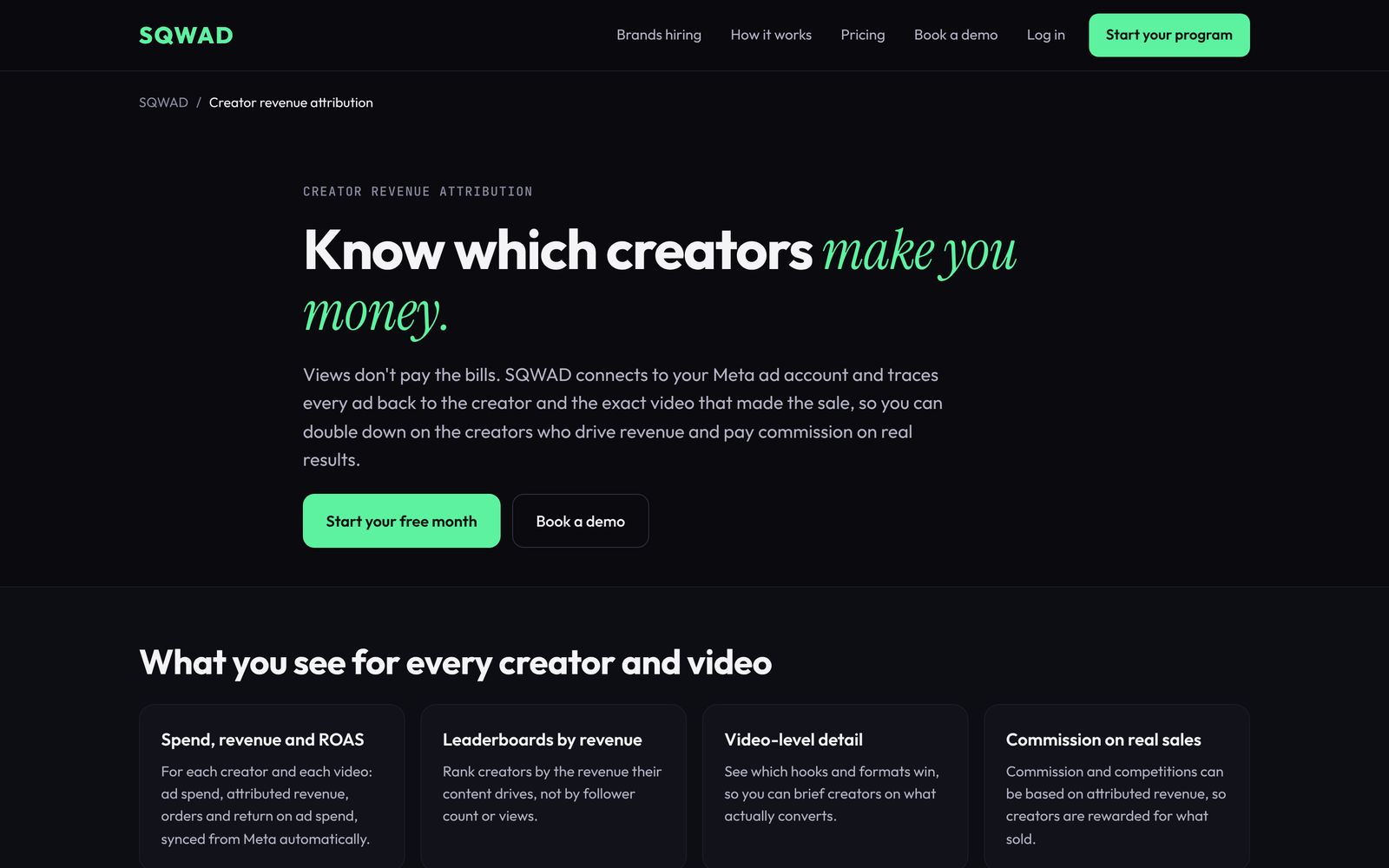
When I built SQWAD, the first version did one thing: it let a brand see which creator drove a sale. Applications, shipping and payouts came later. That order meant the hardest and most valuable part was proven before anything else was added around it.
What fits in about 21 days?
In about three weeks you can build a SaaS MVP that a customer can sign up for, use and pay for: authentication, a dashboard, a database and payments.
This is the size most founders mean when they say MVP. The product has accounts, so users can come back to their own data. It has a dashboard that shows the core workflow. It has a database with rules about who can read and change what. And it takes money, usually through Stripe Checkout and a subscription or one-time payment.
A rough shape for those three weeks:
Week one: foundations
Data model, sign-in, the main screens in rough form and the database rules. By the end of the week the core workflow runs with test data.
Week two: the product
The dashboard, the workflow's edge cases, emails that the app sends, and payments in test mode.
Week three: launch
Real content, error states, testing as each kind of user, moving payments from test mode to live mode, the custom domain and deployment.
This is my SaaS MVP package, from $1,200. If you want to know what pushes the price of a build like this up or down, "How much does an MVP cost? SaaS MVP prices and what drives them" goes through it line by line.
What takes about 45 days?
About six to seven weeks covers a full platform: several user roles with different permissions, admin tools, and integrations with other systems.
The time goes up faster than the feature list suggests, because roles multiply testing. With two roles you check a few combinations. With five roles, each screen has to be tested as each role, and each record has to be checked for who can read it and who can change it.
Guardian MindCare is an example of this size of product. It has five roles (therapists, supervisors, trainees, clients and admins), each with its own portal, plus a public site with a therapist search by insurance. A product shaped like that needs the permissions decided before the first screen is designed, which is why I wrote "Roles and permissions in a SaaS app: a practical guide for founders" about that step on its own.
Integrations add time for a different reason: you are working against someone else's API, rate limits and test environment, and you only find their quirks by building against them. This is my Full SaaS Platform package, from $3,000.
What happens before the build starts?
The build clock should start only when the core workflow is written down and every account the app needs is ready, and getting there usually takes two to five days.
Preparation is the part founders underestimate. Before day one of the build I want:
- The core workflow in a few sentences: who does what, in what order, and what they see at the end.
- A list of what is explicitly out of scope for this version.
- Access to the accounts the app will run on: GitHub, hosting, the database project, Stripe, the domain registrar and the email sending service.
- Any real content: product names, prices, copy, logos.
- Example data, even a spreadsheet of ten rows, so the screens are built around real shapes of data.
If any of these arrive in week two instead of before day one, the build waits for them. "What to send a web developer before your project starts" has a fuller checklist that also applies to apps.
What slows an MVP down?
The biggest delays are scope added mid-build, slow feedback, third-party approvals and messy data, and almost none of them are about writing code.
New features during the build
Every MVP collects new ideas while it is being built, because seeing the product makes people think of more. Adding them on the spot is how a three-week build becomes six. I keep a version two list and put every new idea on it. Most of them look less urgent once real users show up.
Slow feedback
If a question waits three days for an answer, the build waits three days. A founder who answers within a working day keeps the schedule intact.
Payments going live
Stripe's go-live checklist includes registering live webhook endpoints, rotating keys and making sure nothing depends on test objects, since sandbox products and prices do not carry over to live mode. Account activation details also have to be complete. None of that is hard, but it has to be done, and it is easy to leave until the last day. I cover the steps in "Stripe test mode to live mode: the checklist I use before taking payments."
Domains and DNS
Pointing a custom domain at the app needs access to the registrar, and Vercel's own documentation notes that DNS changes can take time to propagate. If nobody knows who holds the registrar login, launch day stalls.
App store review
A native mobile app adds store review and device testing that a web app does not need. When speed matters, I usually suggest launching the MVP as a web app first.
Messy existing data
Importing customers from an old spreadsheet or system always takes longer than expected, because real data has duplicates, missing fields and formats nobody documented.
A worked example: a booking tool for tutors
Here is an illustration with a made-up business, to show how scope changes the timeline.
A founder wants a tool for independent tutors: parents book sessions, pay online, and tutors see their schedule. The first idea includes parent and tutor accounts, payments, reminders, reviews, a messaging inbox, an admin area for the founder and a calendar sync.
That full list is a 45 day platform. Instead, we split it:
- Version one, about 7 days: a booking page per tutor and a tutor dashboard showing upcoming sessions. Payment happens outside the app for now. This tests whether tutors share the link and parents book.
- Version two, about 21 days in total from the start: parent accounts, Stripe payments, reminder emails and the founder's admin view.
- Later: reviews, messaging and calendar sync, built once real tutors ask for them.
The founder gets something in front of tutors in the first week. If tutors do not share the link, the founder has learned that for the price of a week instead of two months. If they do, every later feature is shaped by how people actually used the first one.
Can AI tools make an MVP faster?
AI builders such as Lovable or Bolt speed up the first draft of an MVP, but the slow parts of a real launch take about as long as they always did.
Generating screens is fast now. Deciding the data model, writing database rules, wiring payments correctly, handling errors and testing as each type of user are still careful work. I see many AI-built apps that look finished and then need a week or two of fixes before they can safely take real users and money.
If you already have an AI-built version whose core features work, finishing it can be quicker and cheaper than starting over. My Finish and Launch package, from $600 over about 10 days, is for that case. "Fix or rebuild your AI-built app? How to decide before you spend more" helps decide which path you are on.
When should you hire help instead of building it yourself?
Build it yourself if the MVP is a single workflow and you have the time to learn, and hire help when you need payments, roles or a fixed launch date.
Doing it yourself costs time instead of money, and that trade can be right early on. The risk shows up when the MVP handles other people's data or money, because mistakes in database rules and payment webhooks are quiet until they are expensive. A developer who has shipped these pieces before mainly saves you from the problems you do not know to look for yet.
If you do hire someone, ask for a fixed scope, a written out-of-scope list and a date, and agree on how fast feedback needs to come back. Those four things protect the timeline more than any choice of framework.
The bottom line
An MVP takes about 7 days for one workflow, about 21 days for a SaaS product people can pay for, and about 45 days for a multi-role platform with integrations. The fastest way to launch is to shrink the first version until it does one job well, prepare every account before the build starts, answer questions quickly, and put every new idea on the list for version two.
Questions, answered in one line
What is the fastest realistic time to build an MVP?
About one week, if the MVP is a single workflow with a small number of screens and no payments or complex roles.
Why do MVPs take longer than estimated?
Usually because features get added during the build, feedback takes days instead of hours, or a third party such as a payment provider or app store adds waiting time.
Does using AI tools make an MVP faster to build?
AI tools speed up the first draft of screens, but the time spent on data rules, payments, permissions and testing does not shrink by the same amount.
Is a mobile app MVP slower than a web app MVP?
Usually yes, because app store review, device testing and native features add time that a web app launched on its own domain does not need.
How long would Thomas Osayi take to build my MVP?
Thomas Osayi builds a working first version of one workflow from $250 in about 7 days, a SaaS MVP with auth, dashboard, database and payments from $1,200 in about 21 days, and a full multi-role platform from $3,000 in about 45 days.
Sources
- Go-live checklist Stripe
- Adding and configuring a custom domain Vercel
Related articles
- How to scope an MVP: one workflow, three lists and the cuts that matter
- Multi-tenant SaaS with Firestore: data layout, security rules and custom claims
- Web app vs mobile app for your MVP: which to build first
- PWA vs native app in 2026: what a web app can do on iPhone now
SaaS MVP and full-stack web app development
I build SaaS MVPs and full-stack web apps in Next.js, TypeScript and Firebase or Postgres: auth, dashboards, payments, roles and admin tools. Founder of SQWAD.
See the service