November 17, 2026 · Updated November 22, 2026 · 9 min read · Thomas Osayi
Vibe coding vs hiring a developer: what makes sense for your app?
When building with AI tools like Lovable, Bolt or Cursor is enough, when to bring in a developer, and how to combine both without wasting money.
AI app builders changed who can make software. They did not remove the need for someone to own the hard parts.
I work on both sides of this. I use AI tools in my own development, and a large part of my freelance work is taking over apps that founders started in Lovable, Bolt, v0, Replit, Cursor, Windsurf or Claude and got stuck on. So this is not an argument for one side. It is a practical account of what each approach is good for, where the line sits, and how to spend the least money getting a real product live.
What is vibe coding actually good at?
It is very good at getting from an idea to something you can click, in hours instead of weeks, as long as nothing serious depends on the result yet.
Vibe coding means describing what you want in plain language and letting an AI tool write the code, usually without reading most of it. That works well for:
- Testing whether an idea is worth building at all
- Clickable prototypes to show investors, partners or early users
- Internal tools used by a few trusted people
- Landing pages and simple sites
- Trying three versions of a screen before choosing one
What these have in common is that speed matters most and mistakes are cheap. If a prototype leaks its test data, nothing is lost. If an internal tool has a bug, the three people using it tell you at lunch.
There is a second benefit people underrate. Building the prototype yourself forces the product decisions: what the first screen is, what a user can do, what you charge for. Those decisions are the slow part of any software project, and you have made them before paying anyone.
Where do AI-built apps usually break?
They break in the parts you cannot see by clicking around: security, payments, behavior under real data, and long-term maintainability.
Security
The app has a login screen, so it feels secure. Underneath, the database rules may allow any signed-in user to read every record, or the admin page may be hidden in the menu but open to anyone who types the URL. AI tools optimize for the app working in the preview, and an open database always works. Nothing on screen tells you the difference.
Payments
A checkout button that opens Stripe is the easy tenth of the job. The rest is webhooks that mark the account as paid, subscriptions that renew, cards that fail, cancellations, refunds, and making sure a user cannot unlock the paid plan by editing a field. Generated code often handles the happy path once and nothing else.
Scale
Code that loads an entire collection and filters it in the browser is fine with 20 test records. With several thousand real ones it is slow and costs money on every page view. The same goes for missing pagination, images stored at full size, and queries that run again on every keystroke.
The prompt loop
Past a certain size, each prompt that fixes one thing breaks another. The tool no longer holds the whole codebase in view, so it duplicates components, leaves old versions in place and patches symptoms. You notice it when you have asked for the same fix three times, and when you are afraid to request changes because the last one took a day to recover from.
How do I know it is time to bring in a developer?
Bring one in before real users, real data or real money touch the app, or sooner if you are stuck in the loop.
Concrete signals:
- You are about to collect personal information, health details or payment from people you do not know
- You are about to charge money, especially on a subscription
- The build fails on deploy and the AI tool's fixes keep failing differently
- The same bug has come back after being "fixed" more than twice
- You cannot explain where user data is stored or who can read it
- A customer, partner or investor has asked about security
- You have spent more hours prompting around one problem than the feature took to create
The cost of waiting is not symmetrical. Bringing a developer in a week early costs a small review fee. Bringing one in after a data leak or a round of wrong charges costs refunds, apologies and sometimes the business.
What does a production app need that a prototype does not?
It needs the unglamorous systems around the features: access control, payment handling, error handling, backups, monitoring and a deploy process you can repeat.
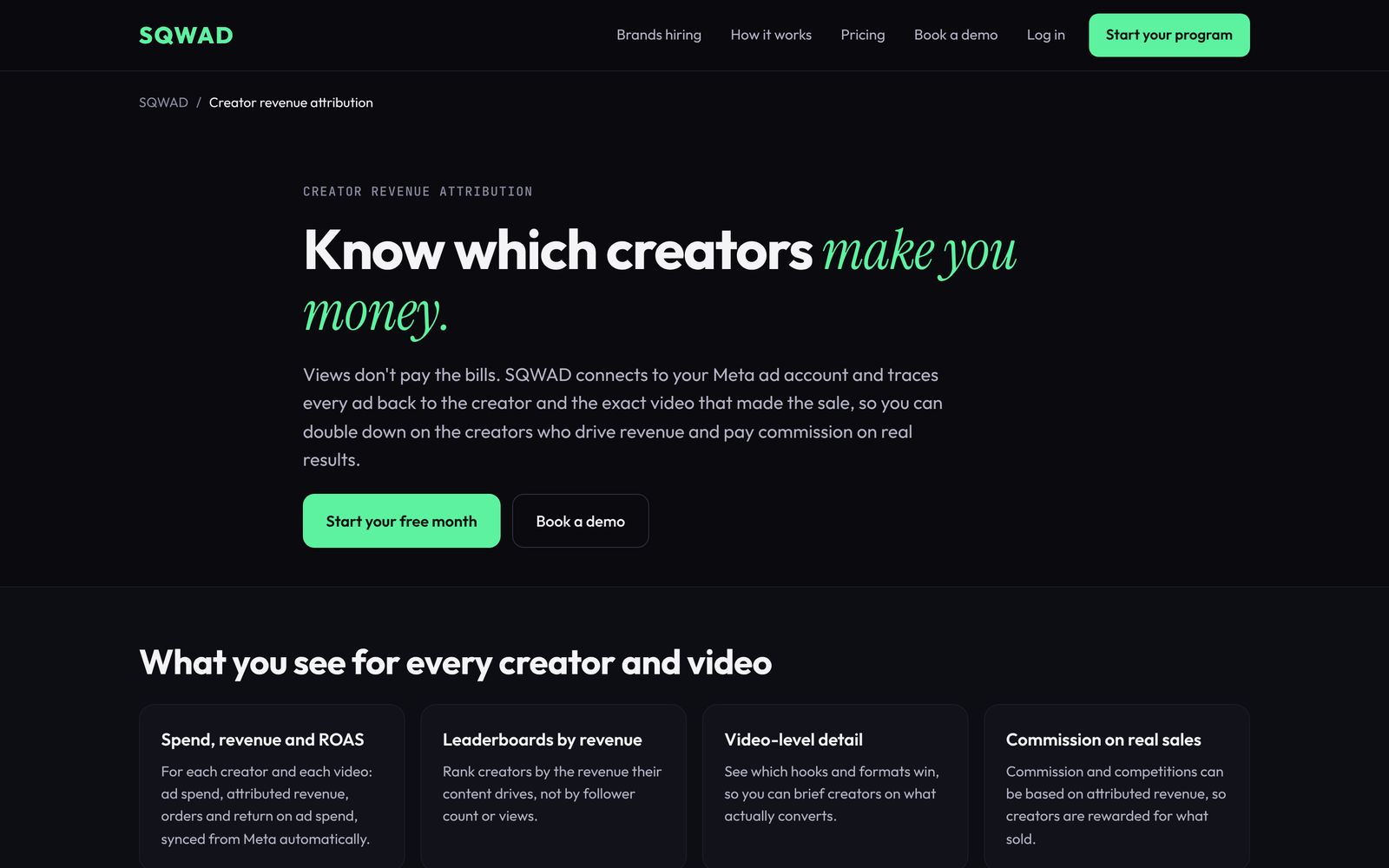
I know this list from the inside, because I founded and built SQWAD, a SaaS platform that Shopify brands use to run creator programs. The visible product is a branded portal where creators apply, receive product, submit content and get paid. Under it sit the parts nobody demos: who is allowed to see which brand's data, how payouts are recorded, and how every Meta ad is traced back to the creator whose content made the sale. SQWAD's published TheHoopGang case study reports more than $500K in revenue attributed to creator videos, and none of that would be trustworthy if those parts were approximate.
For a typical first product, the production checklist looks like this:
- Database rules or server checks so each user reads and writes only their own data
- Roles enforced on the server, not just hidden in the interface
- Secrets in server-only environment variables, never in browser code
- Payment webhooks verified and handled for success, failure and cancellation
- Input validation on every form and API route
- Sensible error states instead of blank screens
- A production deploy on your own domain, from a repository you own
- A way to see errors when they happen to real users
A prototype can skip all eight. A product cannot skip any.
Can I combine vibe coding with a developer?
Yes, and for most founders it is the cheapest route: you build the prototype, a developer hardens it, and you keep prompting afterward on a codebase that can take it.
The sequence I recommend:
- Build the prototype yourself and put it in front of a few real people
- Use what you learn to decide what the first version must do, and cut the rest
- Bring in a developer to review security, wire payments properly, clean up the structure and deploy
- Keep adding features with AI tools afterward, with changes going through git so each one can be reviewed and undone
The handoff goes faster if you prepare three things: the code in a GitHub repository, access to the hosting and database projects, and a short written list of what is broken and what the app must do on launch day. That is enough for me to start. I do not need a specification document.
Is hiring a developer after vibe coding a waste of the earlier work? No. A working prototype makes the developer faster, because the screens, the flows and the data are already visible. I keep what works and fix what does not.
What does it cost to fix an AI-built app?
My fixed-price packages start at $60 for a single fix, $200 for several fixes plus a feature, and $600 to take a stuck app all the way to launch.
- Quick Fix, from $60, about 2 days: one bug or error fixed and explained
- Fix Plus Features, from $200, about 5 days: several fixes plus a feature or integration added
- Finish and Launch, from $600, about 10 days: the app taken from stuck to live in production
Each one ends with a short write-up of what was wrong and what changed, so you understand your own app better afterward.
For comparison, building with me from nothing starts at $250 for an MVP Starter covering one core workflow in about 7 days, $1,200 for a SaaS MVP with auth, dashboard, database and payments in about 21 days, and $3,000 for a full multi-role platform in about 45 days. If you already have a working prototype of the right product, fixing and finishing it is usually far less than starting over.
The costs outside any developer's fee are small at the start. Hosting on Vercel and a database on Firebase or Supabase both have free tiers that cover most early products, and Stripe charges per transaction.
Should I fix the app I have or rebuild it?
Fix it in almost every case, and rebuild only when the structure cannot support the product.
A rebuild is justified when the data model is wrong at the root, for example a multi-company product where every record was stored without any link to a company, or when the app was built on a platform that cannot do something the product requires. It is not justified because the code is untidy or because it was written by an AI. Untidy code that works can be cleaned up one area at a time.
If a developer recommends a rebuild, ask for the comparison: what fixing would cost, what rebuilding would cost, and what specifically cannot be fixed. A clear answer to the third question is the test.
A worked example. A founder builds a booking tool for fitness studios in Lovable. It works in the preview, the build fails on deploy, the Firestore rules are in test mode, and Stripe checkout opens but nothing records the payment. None of that needs a rebuild. It is a build fix, a rules rewrite with ownership checks, a webhook and a deploy, which is Finish and Launch work. The screens and the booking logic the founder built stay as they are.
Which problems can I fix myself, and which should I hand over?
Keep prompting for anything you can see and check on screen, and hand over anything where a mistake is invisible until a stranger or a payment finds it.
Safe to keep doing yourself with the AI tool:
- Wording, layout, colors and images
- New screens that only display data the app already has
- Small form changes, such as a new optional field
- Adding a missing environment variable in your hosting dashboard when the error message names it
Worth a developer's eyes, even if the AI tool says it fixed them:
- Database rules or row level security. Firebase's own documentation warns that open rules let anyone who finds your project read, change or delete your data, and Supabase warns never to put a secret key in the browser.
- Sign-in, password reset and anything that decides who sees what
- Payment webhooks, since Stripe's subscription documentation treats them as required for keeping accounts in step with payments
- Changes to how data is stored, because they affect every record already saved
A useful test: if you cannot tell from clicking around whether the change worked, it belongs in the second list. Those are exactly the areas the Quick Fix and Finish and Launch packages are built around.
The bottom line
Use AI tools for what they do best: getting an idea on screen quickly and cheaply. Then apply a simple rule. If losing the data or charging someone wrong would hurt your business, have a developer look before launch. Build the prototype yourself, have the security, payments and deployment done properly, and keep prompting on top of a foundation that holds.
Questions, answered in one line
Can I launch an app built only with AI tools?
You can, but have the auth, database rules and payments reviewed first; those are where most AI-built apps break.
Is hiring a developer after vibe coding a waste?
No. A working prototype makes the developer faster because the product decisions are already visible.
When does it make sense to rebuild instead of fix?
Rarely; only when the structure cannot support the product, and a developer should show you the cost comparison.
How much does it cost to have a developer fix a vibe-coded app?
Thomas Osayi fixes a single issue from $60, several fixes plus a feature from $200, and takes a stuck app to a production launch from $600.
Can I keep using AI tools after a developer has worked on my app?
Yes. A cleaned-up codebase with clear structure is easier for AI tools to extend, as long as changes go through git so they can be reviewed and undone.
What should I give a developer who is taking over my AI-built app?
Access to the code in GitHub and to the hosting and database projects, plus a short list of what is broken and what the app must do at launch.
Sources
- Avoid insecure rules Firebase
- Row Level Security Supabase
- Using webhooks with subscriptions Stripe
Related articles
- Supabase auth redirect URL not working? Fix localhost, preview and production redirects
- Environment variables undefined on Vercel? Every cause and fix
- How to fix a CORS error on a Next.js API route
- Firestore "Missing or insufficient permissions": what triggers it and how to fix it
Fix, finish and launch your AI-built app
Built your app with Lovable, Bolt, v0, Replit or Cursor and got stuck? I fix the bugs, connect auth and payments, clean up the code and deploy it to production.
See the service